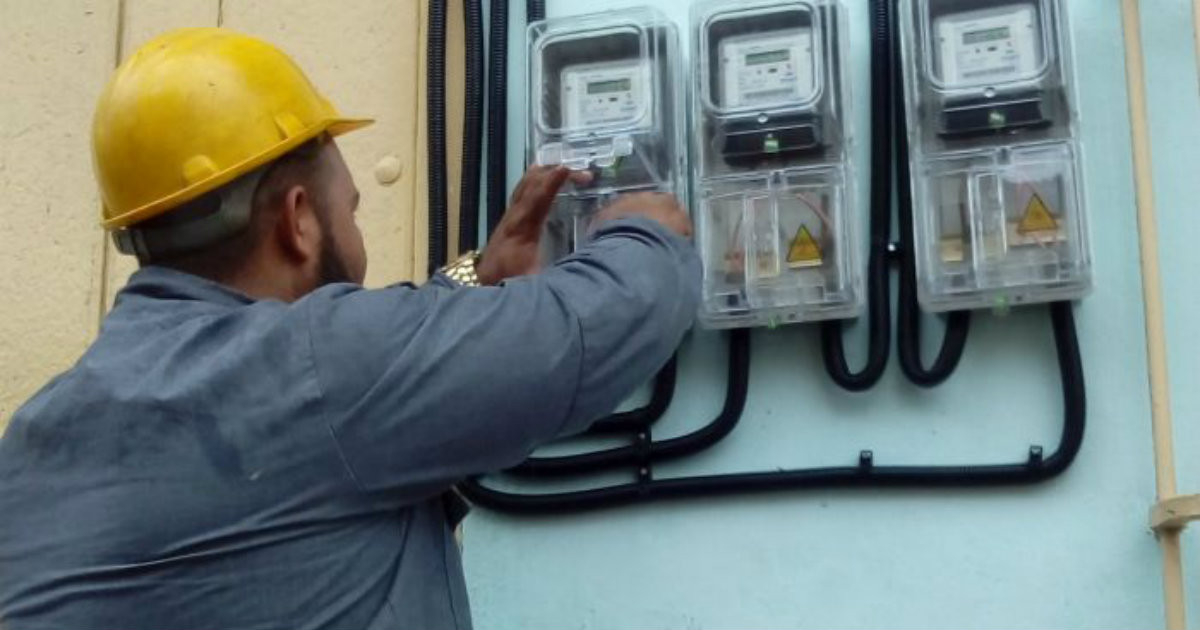
The persistent power outages plaguing Isla de la Juventud have led to a new burden for electricity customers. Residents are now required to personally read their digital meters and report the readings, as the Electric Company claims it can no longer perform this task in person.
This directive was announced on Saturday through a "Notice" from the UEB Commercial Services, shared via the local Electric Company's Facebook page.
Customers have been instructed to send their meter readings to the appropriate commercial office using a reader supervisor, by telephone, WhatsApp, or in person.
The notice attributed this decision to the municipality's "current electro-energy situation" and concluded by expressing gratitude for the clients' "understanding and cooperation."
The company did not clarify procedures for those who might struggle to interpret their digital meter readings.
Ramón Leyva Morales, a host and journalist for Radio Caribe, shared the notice with a touch of irony on his Facebook profile Carapachibey Pinero, labeling the new requirement as a "Cederista task in the neighborhood."
He also warned that individuals unable to read their meters would need to seek assistance from an employee of the Electric Union (UNE).
Leyva further mentioned his attempts to pay for services using the EnZona and Transfermóvil apps, but noted that his bill has been missing since the previous month.
Other users commented, questioning why an energy crisis-related issue is now becoming the responsibility of the consumers instead of the Electric Company.
"You offer me poor and almost non-existent service, and on top of that, I have to do your job," remarked one resident. Another questioned if the decision was due to a shortage of Electric Company workers.
A local pointed out the usual meter reading dates, which typically occur on the 22nd or 24th of each month, while the notice was issued on October 3rd, without explaining how to calculate readings for the previous period. "Poor us, burdened with so many worries, and now another one," she wrote.
Critiques also highlighted the challenges faced by older individuals unfamiliar with operating digital meters and the difficulty of obtaining the WhatsApp number of the reader supervisor.
One resident also mentioned waiting since September 9th for the repair of a meter damaged when a tree fell on the power lines.
"What do power and schedule have to do with a person whose only job is to read a meter?" questioned another neighbor, reflecting the discontent triggered by a measure the Electric Company attributes directly to the municipality's energy situation.
This incident arises during the most severe energy crisis the region has experienced. Once hailed as Cuba's "energy showcase," Isla de la Juventud has seen its status deteriorate since mid-2025. By July this year, residents reported only two hours of electricity per day.
On August 18th, the company declared a near-total blackout across the municipality, maintaining power only for the hospital and water pumping stations.
This is not the first instance where a Cuban electric company has shifted this responsibility to its users. Earlier this year, the Electric Company of Holguín released a guide instructing clients on how to read their meters, an initiative also met with widespread sarcasm on social media.
Understanding the Electric Meter Reading Initiative
Why are Isla de la Juventud residents required to read their own meters?
Residents must read their meters due to the Electric Company's inability to perform this task in person, citing the municipality's current energy crisis.
How can residents report their meter readings?
Residents are advised to report their meter readings via a reader supervisor, by phone, WhatsApp, or in person at the appropriate commercial office.
What challenges do residents face with this new policy?
Challenges include difficulties in interpreting digital meters, the lack of guidance for those unfamiliar with the process, and issues in obtaining necessary contact information for reporting.