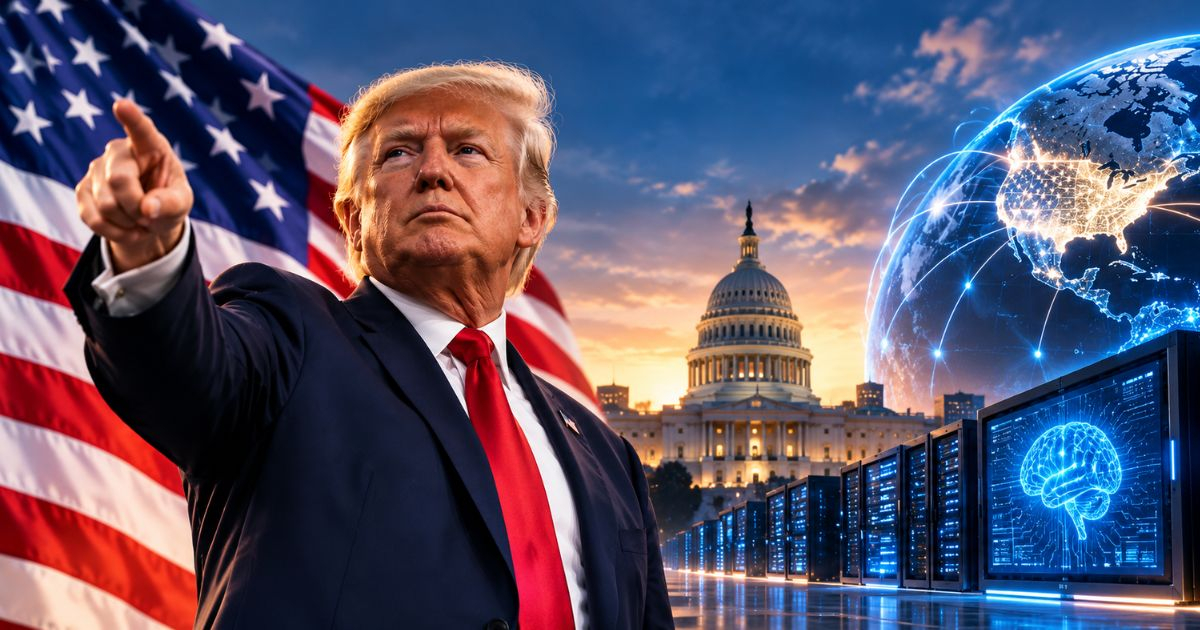
In a bold move, former U.S. President Donald Trump has introduced a groundbreaking "Superintelligence Task Force" aimed at orchestrating federal efforts to secure America's dominance in the realm of advanced artificial intelligence.
Trump unveiled this initiative on Sunday via his Truth Social account, presenting it as an extension of a recent agreement signed at the White House with some of the world's leading tech giants.
"I'm announcing the formation of the Superintelligence Task Force," Trump declared, emphasizing that this group is tasked with aligning federal government actions to ensure the United States remains at the forefront of this technological evolution.
Trump further highlighted that the advent of superintelligence has the potential to become a monumental transformation. According to his statement, "many assert" it could eclipse both the Industrial Revolution and the Internet in significance.
Coordinating AI Efforts Across Sectors
The newly established task force will be responsible for managing the government's interactions with consumers, public interest organizations, religious groups, critical infrastructure providers, and companies involved in developing advanced AI technologies.
The leadership of the task force will include key figures such as Director of National Intelligence Jay Clayton, Federal Trade Commission Chairman Andrew Ferguson, Under Secretary of Defense for Research and Engineering Emil Michael, and Office of Personnel Management Director Scott Kupor.
This task force will provide reports directly to the President and White House Chief of Staff Susie Wiles, as per the announcement.
Building on the White House AI Agreement
This announcement follows the signing of the White House AI Agreement on September 29, which Trump and representatives from tech giants such as Google, Anthropic, Meta, OpenAI, xAI, and Nvidia endorsed.
The agreement outlines a voluntary commitment to enhance the security and oversight of the most advanced AI models. It proposes four layers of control: internal mechanisms to monitor AI capabilities and risks, an independent internal team to verify these controls, audits by external reviewers, and oversight by an independent committee within each company's board of directors.
The commitments focus on specific threats related to cybersecurity, biosecurity, and chemical threats, alongside measures to prevent unauthorized access or interference with technological systems.
Currently, the pact is voluntary, relying heavily on corporate self-regulation. The document itself acknowledges that over time, some of these measures might evolve into federal laws or regulations.
Reframing AI Terminology
The Trump administration has also officially begun using the term "superintelligence" to describe technologies previously categorized as artificial intelligence, despite the technological community typically reserving the term for hypothetical systems that far exceed human intellectual capabilities.
According to The Wall Street Journal, the Superintelligence Task Force has approximately 120 days to assess the risks and opportunities associated with these technologies and propose recommendations concerning the federal government's role.
The group will explore issues related to national security, the protection of critical infrastructure, potential impacts on employment and consumers, and the relationship between the government and major tech companies.
The creation of this task force is part of a series of recent White House decisions aimed at overhauling its policy regarding artificial intelligence.
On September 29, Trump signed an executive order mandating the federal government to officially use the terms "superintelligence" and "SI" instead of "artificial intelligence" and "AI" in relevant communications. The order, titled "Ushering in the Era of Superintelligence," states that the capabilities of the most advanced systems have surpassed the original concept of artificial intelligence and sets a 60-day deadline to present a legislative proposal establishing a federal definition of "superintelligence."
On the same day, Trump assembled executives from leading tech companies at the White House and announced a voluntary self-regulation agreement, which he described as "morally binding."
Participants included representatives from Anthropic, Google, Meta, OpenAI, Nvidia, and xAI.
The pact outlines four layers of oversight for the most advanced models: internal controls, independent teams within the companies, external audits, and oversight from the boards of directors.
Although Trump likened it to a "constitution," the agreement does not have legal binding authority.
FAQs on the Superintelligence Task Force
What is the purpose of the Superintelligence Task Force?
The Superintelligence Task Force aims to coordinate federal efforts to maintain U.S. leadership in advanced AI development, overseeing interactions with various stakeholders including tech companies and public organizations.
Who will lead the Superintelligence Task Force?
The task force will be led by Director of National Intelligence Jay Clayton, FTC Chairman Andrew Ferguson, Under Secretary Emil Michael, and OPM Director Scott Kupor.
What did the White House AI Agreement entail?
The agreement involves a voluntary commitment to enhance AI model security and oversight, with four layers of control including internal checks, independent teams, external audits, and board oversight.