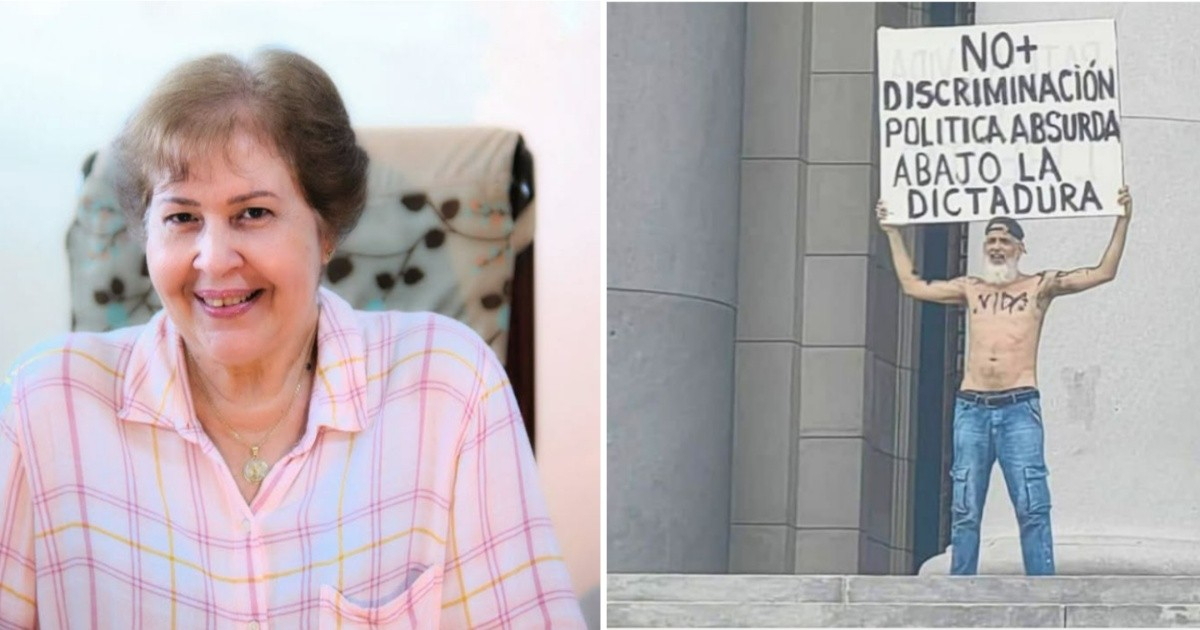
Historian and activist Alina Bárbara López Hernández cautioned on Saturday that Christian churches in Cuba possess the potential to evolve into a political force potent enough to challenge the regime. This could occur if their millions of followers embrace the defense of the persecuted and the fight against injustice as a religious duty.
In a post shared on her Facebook profile, López stated, "If the millions of believers in Cuba begin to see protecting the persecuted and battling injustice as a cherished task for Christ, the Cuban state will find itself with a formidable enemy."
The Power of Collective Faith
The discussion stems from events on Friday, October 2, when Ariel Limias Leyva marched through several streets of Central Havana with an anti-government banner and managed to ascend the steps of the historically guarded Capitolio of Havana. This occurred while law enforcement was preoccupied with monitoring the trial of Ana Sofía Benítez Silvente (Anna Bensi) and her mother, as well as the homes of journalists and Christian pastors.
Limias Leyva was taken to Villa Marista, the main detention and interrogation center of State Security in Havana, in the early hours of Saturday, according to his wife, Yulia Morales. She also highlighted her husband's fragile health condition: "He suffered a heart attack recently on January 18 and is on heart treatment."
Historical Context and Strategic Weakness
López, who does not follow any religion but examines the phenomenon from her background as a historian, argues that this incident highlights a structural gap within the regime: dissent is growing "in geometric progression," while law enforcement grows "in arithmetic progression," and a collapsed economy further weakens the state's ability to maintain multiple fronts of repression simultaneously.
"Though it may seem so, having power is not the same as having control," the activist noted.
Unity Among Christian Denominations
The most significant factor, according to López, is the coordination among several historic denominations—Baptists, Pentecostals, and Methodists—in making explicitly critical statements about the repression of their members. On September 30, the Methodist Church in Cuba, the Western Baptist Convention of Cuba, and the Pentecostal Evangelical Church of Cuba, Assemblies of God, issued statements supporting Anna Bensi and her mother, who were sentenced to two years of restricted freedom for recording a MININT agent.
On the day of the trial, an evangelical pastor attempting to attend the hearing was arrested, as was a Christian activist with the same intention.
López draws a historical line to support her argument: early Christianity overcame the Roman Empire, and Protestant denominations emerged precisely from the organized resistance of believers against the prosecution of Martin Luther. She also quotes Sun Tzu to describe the regime's repressive strategy: "If you open several fronts of combat, your position will be weak, and your enemy's position will be strong."
Rising Tensions Amid Increased Repression
The analysis comes at a time of accumulated repression. The Cuban Conflict Observatory recorded 1,415 protests in July 2026, a historic record, and Cubalex counted nearly 2,000 repressive actions in the first half of the year. Journalist Henry Constantin has been held in pretrial detention since mid-September, with prosecutors requesting sentences of eight to ten years for the young members of the El 4tico project.
López herself, under house arrest since June 2024 as a precautionary measure, has been detained at least five times in 2026 while attempting to carry out her monthly civic protest in Matanzas.
"They have just opened a powerful new front, which will be difficult to close. It adds to older ones and those that will come," she concluded. "No exclusionary system has been eternal."
Understanding the Potential Shift in Cuban Christian Politics
How might Christian churches become a political force in Cuba?
Christian churches could become a political force if their millions of followers begin to see defending the persecuted and fighting injustice as a religious duty, challenging the regime's authority.
What recent events highlight the growing dissent in Cuba?
Recent events include Ariel Limias Leyva's protest and subsequent detention, as well as the arrest of a pastor and a Christian activist trying to attend a trial. These incidents underscore the increasing dissent and the regime's struggle to manage multiple fronts of repression.
What historical parallels does López draw in her analysis?
López draws parallels between early Christianity's triumph over the Roman Empire and the emergence of Protestant denominations from organized resistance, suggesting that a united Christian front in Cuba could similarly challenge the regime.