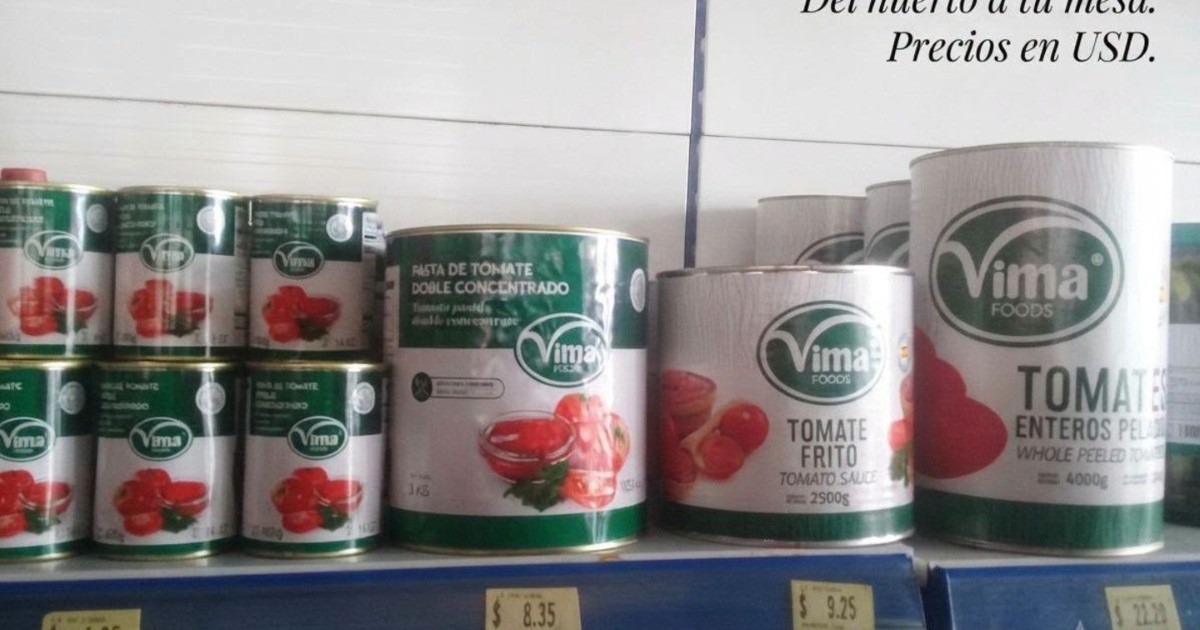
The Spanish food company, Vima, has removed its branding and all corporate signage from its sole Havana store, located at Infanta and Santa Marta in Central Havana, on September 30th. This move is widely viewed as a direct response to the increased pressure from US sanctions against GAESA, the business conglomerate run by the Cuban military.
According to reports from international media, the decision came just a day after the Office of Foreign Assets Control (OFAC) announced its most comprehensive sanctions package against Cuba to date, on September 29th. The sanctions, which took immediate effect, prohibit indirect transactions with entities on the Cuba Restricted List and eliminate so-called U-Turn transactions, while also blocking Cuban private entrepreneurs' bank accounts in the US.
Two employees at the Infanta and Santa Marta store confirmed to 14ymedio the nature of the pullback. "The company is in the process of withdrawing," one worker stated. Marks from the removed signs were still visible on the storefront, according to the media outlet.
Impact on Store Operations and Warehouses
The store operated in partnership with Cimex, a corporation part of GAESA, and Vima's products occupied a substantial portion of its shelves. While some canned and packaged items from Vima remained, fresh products had disappeared.
The contraction signs extended beyond the store. At the Berroa warehouses, east of the capital, only one of the three facilities linked to Vima still had goods, with the other two sitting empty, although employees in company uniforms were still present.
Vima's Economic Ties with Cuba
Vima's reliance on Cuba was significant. The company's food division, based in A Coruña, generated approximately 106 million euros in 2025, with roughly 49 million euros (about 46%) stemming from operations on the island, according to US State Department data. Cuba was its largest market, surpassing the Dominican Republic (33 million euros) and Mexico (15.4 million euros).
This market exposure was built through its subsidiary, Vima Caribe S.A., which partners locally with Tiendas Caribe, an entity linked to the Cuban military. In May 2024, Vima signed an agreement to manage 20 stores on the island and exports products from the US via Vima USA Ltd., with offices in New York and Miami, exposing it to US sanctions through two different channels.
The Failed Lobbying Effort and Broader Implications
Vima's attempt to mitigate political pressure unraveled quickly. In July, the company hired lobbying firm Continental Strategy LLC—whose partners include former US Ambassador to the OAS Carlos Trujillo and former Chief of Staff to Secretary of State Marco Rubio, Alberto Martínez—to handle its interests in Washington. However, the $37,742 contract was terminated just five weeks later, on September 1st, according to an investigation into the failed lobbying effort. A few weeks later, Vima's branding disappeared from the Havana store.
The situation with Vima adds to a growing list of foreign companies that have exited or scaled back operations in Cuba since the US formally designated GAESA under Executive Order 14404 on May 7th. Prior to Vima, hotel chains like Meliá, Iberostar, Barceló, and Blue Diamond Resorts either left or reduced their hotel operations. Vima's case marks the expansion of this phenomenon into food supply through foreign currency stores, a key channel for imported goods among Cubans with access to foreign currency.
Vima has not released an official statement on whether the withdrawal is permanent, a rebranding, or a temporary pause. The Spanish government pledged on September 23rd to defend its businesses and opposed the extraterritoriality of the sanctions, but no practical outcomes have materialized.
In August, US Deputy Secretary of State for Western Hemisphere Affairs, Juan Pablo Segura, warned, "Foreign companies wishing to invest in Cuba must partner with a Cuban state enterprise, making them complicit in the dictatorship's corruption scheme."
Understanding Vima's Withdrawal from Cuba
Why did Vima remove its branding from its Havana store?
Vima removed its branding in response to heightened US sanctions against GAESA, which impacted its operations in Cuba.
What are the implications of the US sanctions on foreign companies in Cuba?
The US sanctions prohibit indirect transactions with entities on the Cuba Restricted List, affecting foreign companies like Vima that do business with Cuban military-linked enterprises.
How significant was Cuba to Vima's business?
Cuba was Vima's largest market, generating nearly 46% of its food division's revenue, highlighting its significant economic ties to the island.