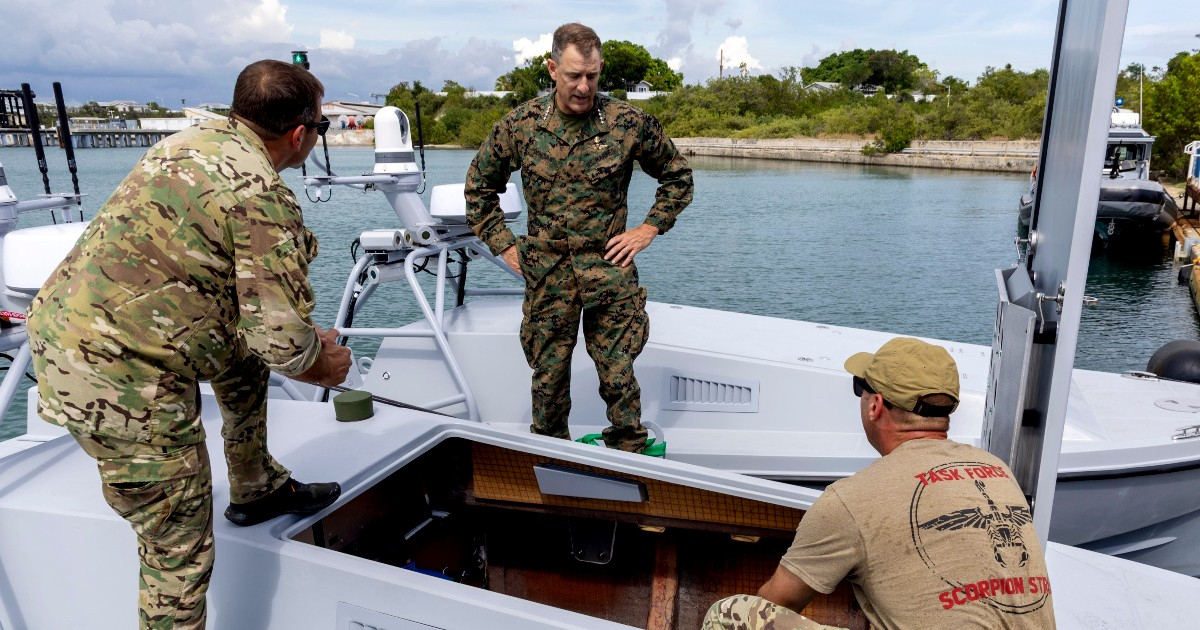
The United States Southern Command (SOUTHCOM) announced on Friday the transformation of Guantánamo Bay Naval Base into the first regional hub for the Autonomous Warfare Command (SAWC). This development follows the deployment of unmanned systems, which were personally overseen by General Francis L. Donovan during an operational visit to the site located on Cuban soil.
SOUTHCOM revealed on its official platform that this deployment marks "the initial step" toward establishing a permanent SAWC base in Guantánamo. Here, teams will be able to train, integrate autonomous capabilities, support operational demands, and apply lessons learned to innovate new capabilities. The U.S. Navy echoed this sentiment, stating, "The future won't wait, and neither will we."
Established on April 21, 2026, by a directive from General Donovan, the SAWC aims to broaden the application of autonomous, semi-autonomous, and unmanned platforms across Latin America and the Caribbean. According to SOUTHCOM, this new framework "merges people, autonomous and unmanned systems, data, communications, and other capabilities to gain a decisive and operational edge."
This announcement comes just weeks after official U.S. Space Force photographs depicted Cuba and the Caribbean as visible backdrops for the military experiment DASH, a command and control test using artificial intelligence to speed up decision-making in joint operations.
In these images, the island was central to several screens filled with symbols, identifiers, lines, and operational areas. However, the Air Force and Space Force did not publicly disclose what these elements represented or whether they corresponded to real or fictitious positions.
What has been documented so far is that Cuba served as a prominent geographical environment in battle management applications designed to transfer validated capabilities to classified military networks. This fact gains additional significance with the conversion of Guantánamo into a regional autonomous warfare platform.
The recent SOUTHCOM announcement follows closely behind Defense Secretary Pete Hegseth's introduction of the Autonomous Warfare Command (AUTOWARCOM) at Quantico. This new four-star combatant command at the Pentagon level is set to be operational by October 1, 2027. Meanwhile, the SAWC acts as the regional laboratory, laying the groundwork for this doctrine on a hemispheric scale.
The deployment at Guantánamo represents the latest step in a steady U.S. military pressure campaign on Cuba throughout 2026. In April, SOUTHCOM conducted the FLEX2026 exercise in Key West, just 90 miles from the island, integrating artificial intelligence, the Vanilla UAS drone—capable of flying continuously for ten days and covering 15,000 nautical miles—and the unmanned naval vehicle Tsunami USV.
In May, Donovan himself visited Guantánamo and held an unusual meeting with Cuban General Roberto Legrá Sotolongo at the base perimeter amid rising bilateral tensions. Weeks later, Hegseth personally visited the facility and cautioned Cuba against acquiring weaponry capable of reaching the base or the U.S. mainland, calling such an attempt "reckless."
The atmosphere of confrontation intensified following an intelligence report published by Axios—though not officially confirmed—suggesting that Cuba had acquired over 300 military drones since 2023 and had considered their use against Guantánamo, U.S. warships, and targets in Florida. Cuban Foreign Minister Bruno Rodríguez dismissed the allegations as a "fraudulent dossier," while Deputy Foreign Minister Carlos Fernández de Cossío described them as "increasingly implausible."
SOUTHCOM has characterized the Guantánamo Bay Naval Base as a "vital operational and logistical center" for countering threats in the hemisphere. With the establishment of the SAWC site, the base—leased from Cuba since 1903 and viewed by the regime as an illegal occupation—now takes on an unprecedented strategic role as a platform for autonomous warfare in the Caribbean.
Key Developments in Guantánamo's Autonomous Warfare Expansion
What is the purpose of the SAWC at Guantánamo?
The SAWC at Guantánamo aims to train and integrate autonomous capabilities, support operational requirements, and apply lessons learned to innovate new military capabilities.
How does the SAWC fit into the broader U.S. military strategy?
The SAWC serves as a regional laboratory for the Autonomous Warfare Command, facilitating the expansion of autonomous and unmanned platforms across Latin America and the Caribbean.
What are the implications of the U.S. military presence in Guantánamo for Cuba?
The U.S. military presence in Guantánamo, now enhanced by the SAWC, increases strategic pressure on Cuba and underscores the base's significance as a counter to regional threats.