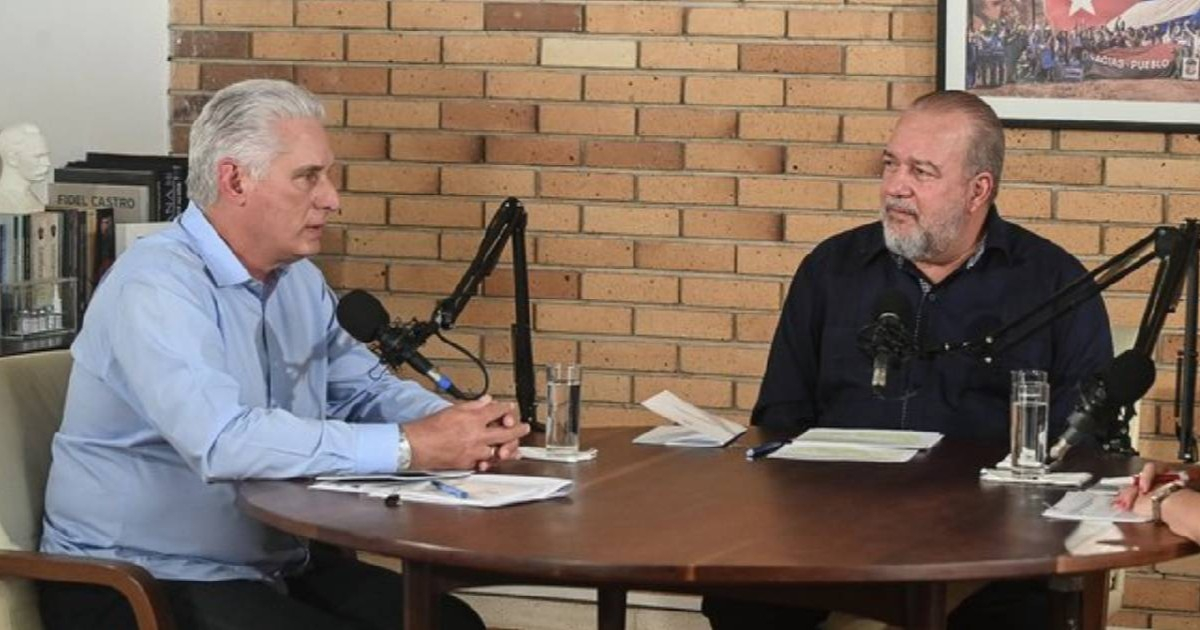
Cuban Prime Minister Manuel Marrero Cruz expressed confidence on Friday, stating that the regime now has a "pathway to progress" in its economic reforms. However, he acknowledged that these efforts have yet to improve the everyday lives of Cubans.
During an episode of the official podcast "Desde la Presidencia," hosted by Miguel Díaz-Canel, the state of the 176 Economic and Social Transformations approved by the National Assembly in June 2026 was discussed. This episode followed the latest Council of Ministers meeting.
Marrero Cruz provided a detailed overview of the program, noting that in the three months since the measures were approved, the government has focused on designing the "How," which involves the implementation mechanisms.
According to the prime minister, within this timeframe, 160 implementation proposals were developed, along with the approval of 197 supporting legal norms, which include four laws, 29 decree-laws, and 26 decrees from the Council of Ministers.
"A meticulous design process has resulted in 160 implementation proposals; to legally support these, 197 legal norms have been designed and approved," the prime minister stated.
Growth of Small Enterprises and Cooperatives
During the same quarter, the regime approved over 3,600 new micro, small, and medium enterprises (MiPymes), bringing the total to 16,100 across the country. Additionally, 448 non-state cooperatives and more than 385,000 self-employed workers were registered.
Despite the optimistic tone, Marrero admitted that these advancements have not yet manifested in tangible improvements for the population: "We have the pathway to progress open; indeed, progress is being made and results are already visible, although they are not yet reflected in an improved quality of life for the population. However, we are advancing gradually in this process."
Future Expectations and Sovereignty
The prime minister projected that the effects of the reform package will become noticeable by 2027, dismissing any notion that these changes signal a shift towards capitalism. He emphasized that these are "completely sovereign decisions" not influenced by external pressure.
Díaz-Canel, on his part, framed the transformations as a response to what he described as a "Fourth Generation war": "A multidimensional war is unfolding—economic, ideological, cultural, and also communicational," he stated, adding, "We are in a moment of urgency, under conditions of war against Cuba."
Economic Challenges and Official Rhetoric
The official narrative stands in stark contrast to the country's dire economic situation. The Economic Commission for Latin America and the Caribbean (CEPAL) forecasts a 10.3% drop in Cuba's GDP in 2026, the worst in Latin America. Meanwhile, economists from the University of Havana predict another recession following a near 5% decline in 2025.
Interannual inflation was recorded at 25.19% in August 2026, with food prices rising by 36.01% year-over-year, according to official figures.
By the end of September, the regime claimed to have implemented 89% of the reform package—158 out of the 176 measures—though independent analysts have questioned whether these paper advancements translate into real changes for Cubans.
Díaz-Canel concluded the podcast episode with a statement that encapsulates the regime's stance amid both internal and external skepticism: "The challenge is formidable, but we will not come to a halt."
Understanding Cuba's Economic Reforms
What are the main objectives of Cuba's economic reforms?
The primary goal of Cuba's economic reforms is to enhance the country's economic structure and improve the quality of life for its citizens through the implementation of 176 Economic and Social Transformations.
When will the effects of the reforms be noticeable?
According to Prime Minister Manuel Marrero, the effects of the reforms are expected to become noticeable by 2027.
How has the economic situation in Cuba changed recently?
Despite the new reforms, Cuba continues to face severe economic challenges, with a projected GDP drop of 10.3% in 2026 and high inflation rates, especially in food prices.