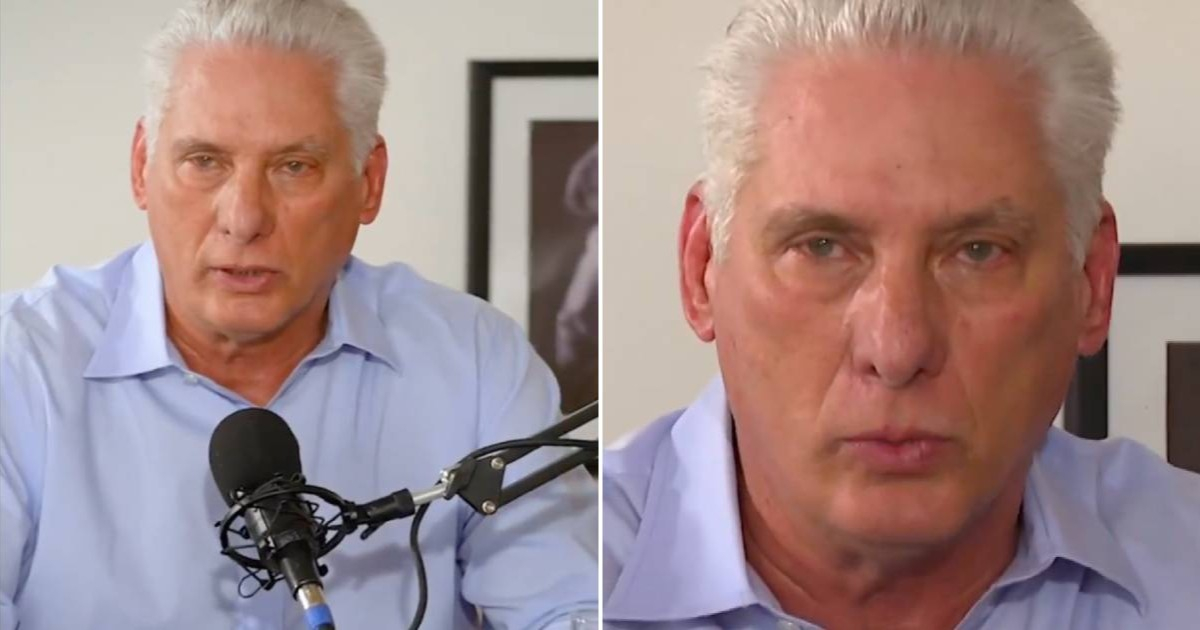
On Friday, Miguel Díaz-Canel resumed his official podcast "From the Presidency," passionately defending the progress of the 176 Economic and Social Transformations approved in June. In a statement encapsulating the regime's stance, he declared, "The challenge is significant, but we will not stop."
Joining him in the 35th episode of the podcast were Prime Minister Manuel Marrero Cruz and Justice Minister Rosabel Gamón Verde. They provided the most comprehensive update to date on the reforms' implementation, three months after their approval during a special session of the National Assembly.
The Progress and Numbers Behind the Reforms
Marrero Cruz detailed the work accomplished from July to September, noting that 160 implementation proposals were crafted, and 197 legal regulations were enacted. These included four laws, 29 decree-laws, and 26 decrees from the Council of Ministers.
Additionally, during this period, over 3,600 new micro, small, and medium-sized enterprises (MSMEs) were approved, bringing the national total to 16,100. Moreover, 448 non-state cooperatives and more than 385,000 self-employed workers were registered.
Challenges and Contradictions in Reform Implementation
Despite these achievements, Marrero acknowledged a primary contradiction within the process: "The path is open for progress, and indeed, progress is being made with visible results, yet the improvement in people's quality of life remains elusive."
The ideological core of the episode reiterated that these reforms are not a shift toward capitalism, a stance the regime has maintained since day one. Despite the presence of mechanisms such as private banking, currency exchanges, trading of state company shares, partial dollarization, and removal of employment caps for MSMEs, independent economists describe these as characteristic of market economies.
Reaffirming Commitment to Socialist Ideals
Marrero asserted that the transformations "enhance and strengthen our socialism" and are "a completely sovereign decision," unaffected by external pressures.
Díaz-Canel framed the urgency of the reforms within what the regime describes as a "multidimensional war" against Cuba, encompassing economic, ideological, cultural, and communicational fronts. He attributed the primary obstacles to development to the U.S. embargo and Washington's "coercive measures."
Justice Minister Gamón Verde was more emphatic, stating, "This process is irreversible. The transformations have the highest political approval, and there’s no turning back. No one is authorized to act against them."
Economic Reality vs. Official Optimism
The optimistic official narrative clashes with an economic reality the regime cannot completely conceal. The Economic Commission for Latin America and the Caribbean (ECLAC) forecasts a 10.3% decline in Cuba's GDP by 2026, the worst in Latin America. Interannual inflation hit 25.19% in August, with food prices soaring by 36.01%.
The minimum wage is worth less than five dollars at the informal exchange rate, and the country has experienced eight nationwide blackouts this year. Just a day before the podcast's release, economist Elías Amor criticized the reform package as "a grand deception."
Internal opinion studies acknowledged by the regime reveal that some of the population perceives the benefits of these changes as reaching only those with money, exacerbating inequalities and generating discontent.
Marrero assured that by 2027, the results will be tangible: "Next year, we will start with a level of progress and outcomes that our people will truly be able to appreciate."
Key Questions About Cuba's Economic Reforms
What are the main features of the economic reforms in Cuba?
The reforms include the establishment of private banking, currency exchanges, trading of state company shares, partial dollarization, and the removal of employment caps for MSMEs, among other measures.
How has the Cuban government justified the reforms?
The government claims that these reforms are a sovereign decision aimed at enhancing and strengthening socialism, not a shift towards capitalism.
What are some of the challenges facing the implementation of these reforms?
Challenges include ensuring that improvements in quality of life are felt by the population, dealing with economic constraints attributed to the U.S. embargo, and addressing public perception of increased inequality.