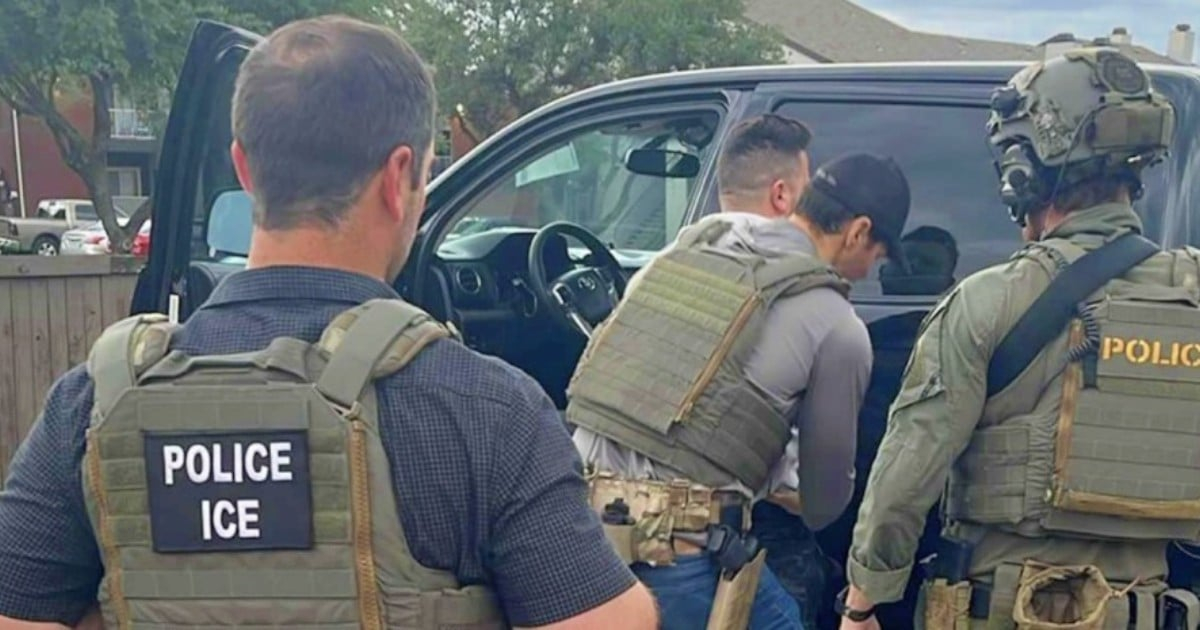
The U.S. Immigration and Customs Enforcement (ICE) has introduced new operational boundaries for vehicle stops. Only specifically trained agents will be authorized to conduct these procedures, and pursuits of drivers who refuse to pull over are strictly forbidden.
As outlined in a memo dated September 30, this update amends ICE's fugitive operations manual, supplanting previous directives, according to ABC News, which obtained the document.
Despite these new guidelines, ICE asserts that this does not constitute a major shift in policy, and that vehicle stops will persist as before.
Effective immediately, as per the memo, only agents from Enforcement and Removal Operations (ERO) who have completed specific ICE training courses may carry out both standard vehicle stops and those deemed high-risk or related to serious crimes.
Agents lacking this training may only assist and not lead such operations.
Vehicles used to signal a driver to stop must be equipped with lights and sirens, identifying them as law enforcement when activated.
Additional versions of the memo reviewed by CNN and the Associated Press highlight that agents must also have an officially activated body camera during these operations.
A significant update addresses situations where drivers do not comply with stop orders. The memo clearly states that agents are prohibited from initiating vehicle chases or employing the PIT (Precision Immobilization Technique) maneuver against moving vehicles.
Instead, they are instructed to gather vehicle information for further investigation.
While some tactics remain permissible, select trained agents may use vehicle immobilization techniques or tire deflation devices under specific agency-approved conditions.
ICE downplays the impact of these guidelines. A spokesperson mentioned that the agency routinely issues operational reminders, and this memo "does not alter" ICE's vehicle stop procedures.
Furthermore, the agency emphasized that both vehicle stops and immigration arrests will continue unabated.
The formalization of these rules follows incidents where ICE vehicle stops escalated into shootings. This past July, after two fatal events in Texas and Maine occurring within days of each other, the Department of Homeland Security temporarily halted most of these operations pending additional agent training. This pause primarily affected vehicle stops tied to immigration enforcement.
However, the suspension was short-lived. The following day, President Donald Trump lifted the halt, allowing ICE to resume these tactics. Consequently, vehicle stops rejoined the suite of immigration enforcement operations.
This discussion resurfaced in September after an ICE agent shot Wilber Rafael Garcés Pérez, a Venezuelan migrant working as a delivery driver in Austin, Texas. Federal authorities claimed that during the stop, the man disregarded orders to halt and later attempted to ram an agent with his car. His attorneys assert that he still has a bullet lodged in his body.
Vehicle-related detentions have also caused concern among Cuban immigrants, notably after a Cuban with humanitarian parole was detained while working as an Uber driver. Immigration attorney Wilfredo "Willy" Allen recounted that the man was stopped based on license plate information and subsequently taken into immigration custody.
These new guidelines do not imply a cessation of ICE vehicle checks or a general decrease in immigration arrests. In fact, the agency has reiterated that operations are ongoing. Just prior to the memo's release, Allen had warned the Cuban community that ICE detentions remained active despite circulating rumors of a pause for immigrants without criminal records.
This update in ICE protocols is part of a continuously evolving immigration landscape. Stay informed on the latest developments in operations, policies, and rights in our U.S. Immigration section.
Understanding ICE's New Vehicle Stop Guidelines
What are the new vehicle stop guidelines for ICE agents?
ICE has restricted vehicle stops to trained agents, banned pursuits of non-compliant drivers, and updated equipment requirements for these operations.
How has ICE addressed the use of force in vehicle stops?
The memo prohibits vehicle chases and PIT maneuvers, focusing on collecting information for later investigation, with certain agents allowed to use immobilization techniques under specific conditions.