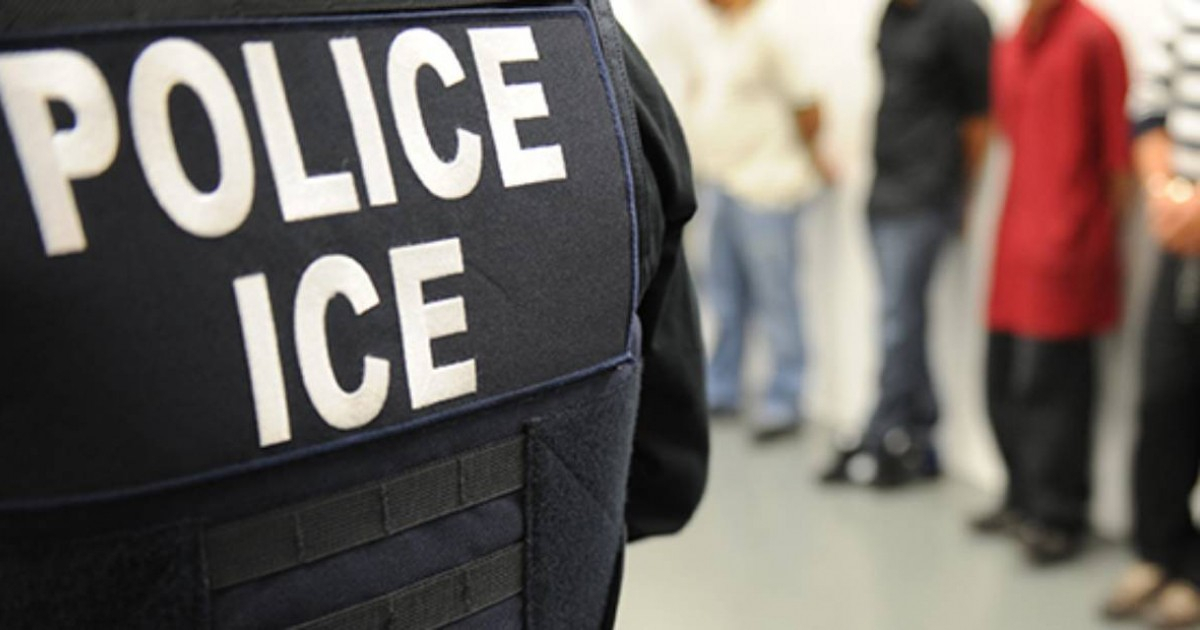
The U.S. Supreme Court has agreed to examine the controversial policy from the Trump administration that enables the detention of certain immigrants without a bail hearing while they face deportation proceedings. This legal battle could have significant implications for many Cubans currently detained by ICE.
This Thursday, the highest court accepted the case, officially recorded as Rhoney v. Barbosa da Cunha. The case will explore the extent of federal authority in enforcing mandatory detention on immigrants already residing in the United States and determine if these individuals should have the opportunity to request release on bail.
Although the Supreme Court has not yet ruled on the legality of this policy, their decision to review the case highlights the ongoing conflict between federal courts, as reported by the Associated Press. Arguments will be heard in the coming months, and a verdict could set a nationwide standard.
Legal Foundations and Disagreements
The dispute revolves around two provisions of the Immigration and Nationality Act: 8 U.S.C. § 1225 and 8 U.S.C. § 1226. The Trump administration argues that individuals who entered the U.S. without formal admission can be treated as "applicants for admission" and subjected to mandatory detention under section 1225, despite living in the U.S. for years.
Conversely, the plaintiffs argue that those already in the country and subsequently apprehended by immigration authorities should fall under section 1226(a), which allows for a hearing before an immigration judge to assess the possibility of bail release during proceedings.
Historically, the federal government allowed bail hearings for many immigrants who had entered without inspection but were later detained within the U.S. However, this interpretation changed in 2025, prompting broader enforcement of mandatory detention and sparking numerous legal challenges.
Implications for Cuban Immigrants
The Supreme Court's involvement follows conflicting conclusions from various federal courts. Most circuits have opposed the government's interpretation, recognizing that some detained immigrants can request a bail hearing. However, the Fifth and Eighth Circuits have supported the administration's stance.
The American Civil Liberties Union (ACLU), representing the immigrant defendant, argues that the government's interpretation could impact millions living in the U.S. without formal admission. The administration counters that the 1996 immigration law passed by Congress mandates this detention regime.
This issue is particularly significant for Cubans due to the rise in immigration detentions and the circumstances of individuals entering through the border, receiving documents like the I-220A, and being processed via parole or other immigration avenues before falling under ICE custody.
Current Legal Landscape and Future Developments
Notably, the Supreme Court's decision did not eliminate the right to seek bail currently available to certain detainees within the 11th Circuit. This circuit, covering Florida, Georgia, and Alabama, ruled on May 6 in Hernandez Alvarez v. Warden, Federal Detention Center Miami that mandatory detention under section 1225 applies mainly to new arrivals, while those already inside the U.S. fall under section 1226.
An analysis by the Cato Institute in April revealed that the detention of Cuban migrants by ICE surged by 463% between October 2024 and January 2026. Florida led in Cuban arrests, with 708 cases reported by December 2025, primarily in Miami-Dade, Broward, and Collier counties.
The ability to obtain a bail hearing gained importance in May when the 11th Circuit acknowledged that certain immigrants detained by ICE in Florida, Georgia, and Alabama could request a judge's evaluation for release on bail. This precedent is crucial as the Supreme Court reviews the case.
However, distinctions between immigration categories remain vital. Recently, a Cuban who entered via humanitarian parole and was detained by ICE while working as an Uber driver was classified as an arriving alien, which limited the immigration judge's jurisdiction to grant bail, despite him living in the U.S. for nearly three years and having a pending application for residency under the Cuban Adjustment Act.
This Supreme Court case could reshape detention rules for thousands of immigrants nationwide. Stay updated on all developments in our U.S. Immigration section.
Key Questions Surrounding Immigration Detention
What is the significance of the Rhoney v. Barbosa da Cunha case?
This case will determine the extent to which the federal government can enforce mandatory detention on immigrants within the U.S. and whether these individuals should have the right to request bail during their deportation proceedings.
How does the outcome affect Cuban immigrants?
The decision will particularly impact Cuban immigrants, many of whom face increased detention rates and specific legal challenges related to their entry and status in the U.S.
What are the legal provisions involved in this case?
The case involves sections 8 U.S.C. § 1225 and 8 U.S.C. § 1226 of the Immigration and Nationality Act, which outline the conditions under which immigrants can be detained or request a bail hearing.