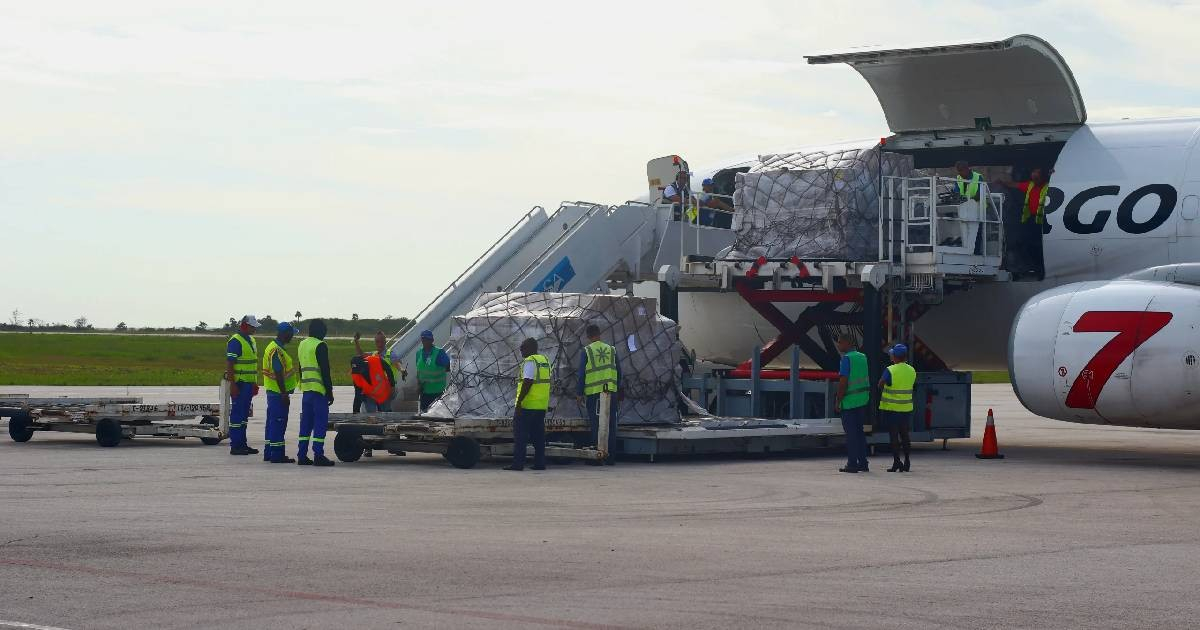
On Thursday, the International Ignacio Agramonte Airport in Camagüey witnessed the arrival of a humanitarian aid shipment from the United States government, part of a $100 million assistance program aimed at supporting the Cuban population.
Key figures such as Archbishop Wilfredo Pino Estévez of the Archdiocese of Camagüey and María Rosa Rodríguez Aguilar, director of Caritas Camagüey, were present to oversee the reception of the cargo.
First Shipment Reaches Vulnerable Communities
This initial delivery included 700 kits: 300 designated for families in the Lugareño community and 400 for those in Nuevitas. Volunteers from these areas, who have undergone prior training, will handle the distribution to ensure an organized and transparent process, having already identified the most vulnerable households.
Efficient and Secure Unloading Process
Caritas Cuba reported that the reception and unloading of the aid were conducted smoothly and securely, assisted by airport authorities.
Distribution of Funds and Program Structure
Of the $100 million allocated by the U.S., $60 million is managed by Caritas Cuba and Catholic Relief Services (CRS), with the remaining $40 million distributed via other independent organizations. The program is designed to bypass the Cuban regime, operating through the Catholic Church's diocesan and parish structures.
Contents of the Aid Kits
The kits contain essential food items such as rice, beans, oil, sugar, spaghetti, sardines, and tuna, as well as hygiene products like soap, toothpaste, and toothbrushes.
Anticipation for the aid's arrival in Camagüey had been building since mid-September, following an announcement from the U.S. Embassy in Havana that the assistance would soon reach five provinces: Camagüey, Ciego de Ávila, Cienfuegos, Matanzas, and Pinar del Río.
Expanding the Program Across Cuba
Mike Hammer, the U.S. chargé d'affaires, previously met with Carmen María Nodal Martínez, director of Caritas Cuba, to coordinate the expansion of the program to these provinces. The distribution efforts began in July 2026 in the Archdiocese of Havana and have progressively expanded. By mid-September, a shipment of 700 food kits and 700 hygiene kits had been delivered to Santa Clara for the Diocese of Cienfuegos.
The program prioritizes aid for the most vulnerable groups, including elderly individuals living alone, pregnant women, nursing mothers, people with disabilities, and families with children under five at risk.
The overarching goal is to reach between 100,000 and 120,000 families throughout Cuba.
Caritas Camagüey concluded their statement with a call for solidarity: "We ask for your prayers for our volunteers and team, that God may grant them wisdom and strength to serve those most in need."
Key Insights into US Aid to Cuba
What is the main objective of the U.S. aid program in Cuba?
The program aims to support between 100,000 and 120,000 Cuban families, focusing on the most vulnerable groups such as the elderly, pregnant women, and families with young children.
How is the humanitarian aid distributed in Cuba?
The aid is distributed through Caritas Cuba and Catholic Relief Services, using the diocesan and parish structures of the Catholic Church to bypass the Cuban regime's control.
What items are included in the aid kits?
The kits include basic food items like rice, beans, oil, and tuna, as well as hygiene products such as soap and toothpaste.