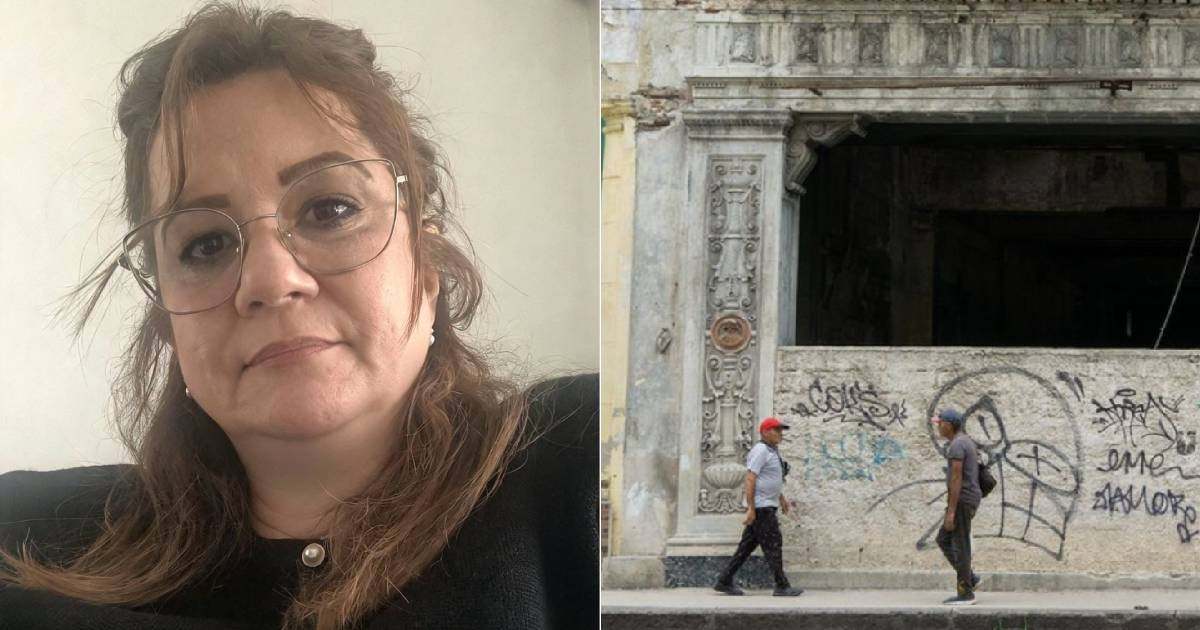
Cuban economist Elaine Castro Castañeda shared a comprehensive analysis on Facebook this Thursday, systematically dismantling what she describes as the "complete trap" set by the Cuban regime in response to the new financial sanctions imposed by the United States on the island.
The catalyst for this situation is the decision by the U.S. Department of the Treasury's Office of Foreign Assets Control (OFAC) to revoke, effective September 30, the authorization that allowed U.S.-jurisdiction banks to hold accounts for Cuban private entrepreneurs since 2024. These funds are now frozen, and their release requires an individual license. Díaz-Canel accused Washington of harming Cuba's private sector, while Foreign Minister Bruno Rodríguez defended the "proven efficiency" of GAESA, the military's business conglomerate.
Castro Castañeda, an economist who left Cuba in 2018 and currently resides in Uruguay, flatly rejects this narrative.
"Who made Cubans dependent on an MIPYME that belongs to them for food? THE DICTATORSHIP," she writes. She adds, "They destroyed agriculture, banned private enterprise for 60 years, and now that everything is broken, they tell you the only way to eat is thanks to them. And if the U.S. touches their MIPYMES, you'll starve."
The economist acknowledges the real impact on ordinary Cubans: MIPYMES are now nearly the sole channel for accessing basic goods like chicken, oil, and detergent, as well as receiving remittances from abroad. However, she warns that this is no accident but the deliberate outcome of decades of economic destruction.
"They make you dependent and then use your hunger as a shield," she summarizes.
GAESA: The Economic Stronghold
The core of her argument targets GAESA, the economic arm of the Armed Forces. The New York Times reported in May that GAESA controls between 40% and 70% of Cuba's formal economy, with assets estimated at over $18 billion. Castro Castañeda argues that many MIPYMES handling half a million dollars are not genuine private enterprises but rather military apparatuses disguised as entrepreneurship.
"As long as GAESA controls 70% of the foreign exchange, any dollar that enters, whether through MIPYME, remittances, or tourism, ends up in the hands of the military, who then use it to repress you," she writes.
Proposals for Change
In response to calls for lifting sanctions, the economist proposes three solutions that rely on Havana, not Washington: the military should exit the economy, distinguish genuine entrepreneurs from figureheads, and allow free agricultural production with private land ownership for farmers.
On the first point, she notes that OFAC has left a window open: section §515.584(h)(1) remains in effect, allowing accounts to receive authorized payments. "If you're a real designer in Cuba, you can keep getting paid. The one crying is the one who used the account to move half a million dollars of chicken," she asserts.
On the third, she is categorical: "No sanction will make food appear if you don't produce it. As long as they maintain the idea that a farmer can't own land and sell crops freely, they'll continue to suffer with or without measures."
Secretary of State Marco Rubio labeled GAESA the "financial heart of the regime" and stated on Tuesday that Cuban military "won't be able to steal or earn money at the expense" of the people. A former GAESA employee recently revealed the presence of military counterintelligence within the conglomerate.
"The ordinary Cuban suffers today because the regime has taken them hostage between the sanction and its monopoly. And the dictatorship cries not because they're hurt by your hunger, but because their trick has been exposed," Castro Castañeda concludes, before delivering her most powerful statement: "The solution is not to ask the U.S. to fund GAESA disguised as MIPYME. The solution is for Cuba to stop being a military estate."
Understanding Cuba's Economic Challenges
What is GAESA and why is it significant?
GAESA is the business conglomerate of the Cuban military, controlling a significant portion of the country's formal economy, with assets valued over $18 billion. Its influence makes it a key player in Cuba's economic structure.
How do the U.S. sanctions affect Cuban entrepreneurs?
The recent U.S. sanctions have frozen accounts of Cuban private entrepreneurs in U.S.-jurisdiction banks, requiring individual licenses for funds release, thus complicating financial transactions and affecting their business operations.
What changes does Elaine Castro Castañeda propose for Cuba?
Elaine Castro Castañeda suggests that Cuba should remove military control from the economy, clearly differentiate genuine entrepreneurs from military proxies, and allow free agricultural production with private land ownership.