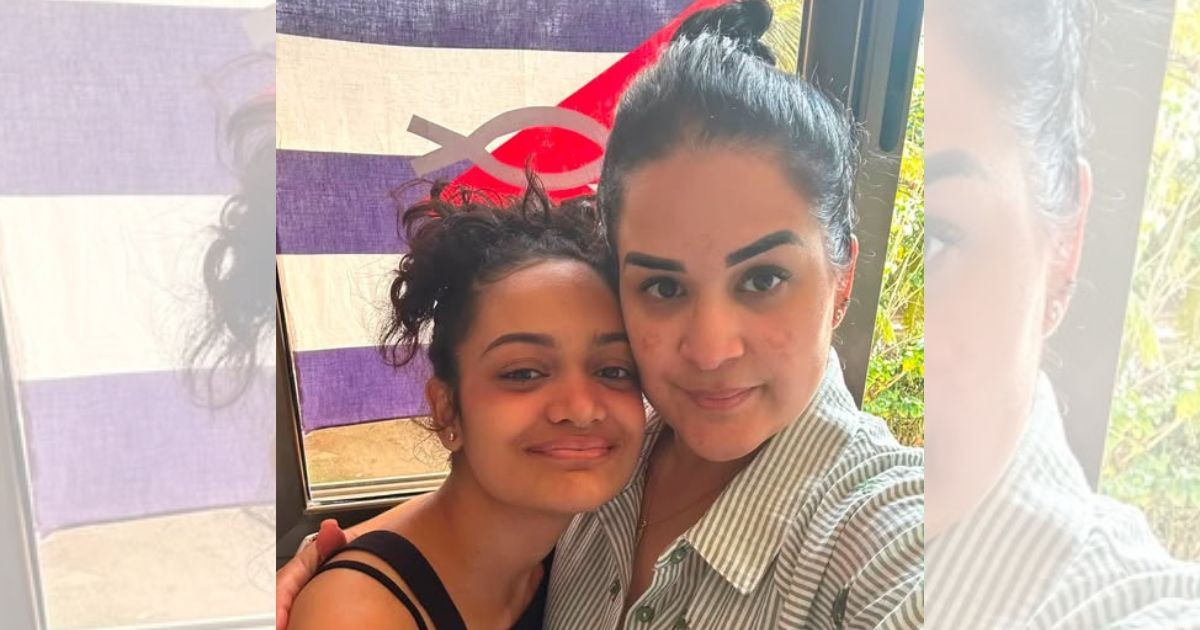
The sister of Anna Sofía Benítez Silvente, popularly known as Anna Bensi, publicly criticized the fact that only one defense witness was allowed to attend the trial of the young activist and her mother, Caridad Silvente, held in Cojímar, Havana.
Elmis Rivero Silvente, an American citizen and Anna Bensi's sister, explained to Martí Noticias that three witnesses were initially set to support the accused. However, two of them—Rolando, referred to as the "Christ's Crier," and Christian activist David Espinosa—were detained before entering the East Havana Municipal People's Court.
"Just one witness, the pastor, managed to accompany them, even though supposedly three witnesses were allowed," Elmis Rivero stated.
Imbalanced Evidence Admission
Another concern highlighted was the disparity in the acceptance of evidence. While Anna Bensi's defense was only allowed one psychologist as a witness, the prosecution presented seven witnesses, all approved.
"The prosecution, I believe, had all its witnesses accepted, all seven. For her, none. Only the psychologist was admitted," Elmis Rivero remarked.
The trial was overseen by Judge Zamira Marrero Morgado, criticized by activists for participating in tribunals related to the July 11th protests. Charges were brought under Article 393 of the Cuban Penal Code, concerning "acts against personal and family privacy," with potential sentences ranging from two to five years.
Trial Outcomes and Broader Implications
The trial concluded with a two-year restriction of freedom for both women. The complete written sentence was pending by the end of the day.
Prior to the trial, Anna Bensi expressed her skepticism about receiving a fair trial and called for a free Cuba, as reported by Infobae.
Elmis Rivero perceives the regime's intent as evident: to silence her sister. She also pointed out that the timing of the trial was strategic.
"It’s about silencing her, above all. Silence her. Everything. Especially choosing today, October 1st, considering what's happening in Washington, they took advantage of that to silence her, just as they’ve said," she asserted.
On the same day, Cuban exiles gathered in Washington D.C.'s Pershing Park with the slogan "Do it Trump, do it," organized by Alexander Otaola, demanding action against the Cuban government, with attendees from Miami, Michigan, and Canadian cities.
Background of the Case
The case dates back to March 2026, when Anna Bensi and her mother recorded and shared on social media the visit of a MININT agent to their home, delivering a State Security summons. Since March 25th, both had been under house arrest and prohibited from leaving the country.
Cubalex, a legal organization, argues that recording the police is not a crime but a citizen's right, directly criticizing the legal proceedings that ended with the two women's sentencing this Thursday.
Understanding Anna Bensi's Trial and Its Implications
Who is Anna Bensi and why is she significant?
Anna Bensi is an activist known for her criticisms of the Cuban government. Her significance stems from her vocal opposition and the legal challenges she faces as a result of her activism.
What were the charges against Anna Bensi and her mother?
The charges were based on Article 393 of the Cuban Penal Code, related to "acts against personal and family privacy," carrying a penalty of two to five years in prison.
What was the outcome of the trial?
The trial ended with both Anna Bensi and her mother receiving a two-year limitation of freedom.
How did the defense and prosecution witness admissions differ?
While the defense was allowed only one psychologist as a witness, the prosecution was permitted seven witnesses, all of whom were accepted by the court.