In an astonishing turnaround, U.S. exports of petroleum products to Cuba have surged from virtually non-existent to record-breaking levels in just seven months.
Data released by the Energy Information Administration (EIA) on September 30 reveals that from January to July 2026, these exports accumulated nearly 4.9 million barrels, with July alone averaging 103,900 barrels per day.
The magnitude of this shift becomes clear when contrasting the extremes: in January, the U.S. exported a mere 30 barrels daily to Cuba, which soared to almost 104,000 barrels per day by July. This July figure far surpasses the quantities Venezuela shipped to the island in 2025.
July Breaks All Records
The month of July marked an unprecedented surge in scale. U.S. fuel exports to Cuba skyrocketed to 103,900 barrels per day, quadrupling the June level. That month's exports were valued at $61.1 million, bringing the January-July total to $156.8 million, according to the U.S.-Cuba Trade and Economic Council (UCTEC).
The Impact of Venezuela's Oil Cutoff
This dramatic shift was set in motion by the abrupt cessation of Venezuelan oil supplies. After Nicolás Maduro's capture by U.S. forces on January 3, 2026, Reuters confirmed that there were no Venezuelan exports to Cuba that month, ending decades of subsidized oil.
In 2025, Venezuela sent between 27,000 and 30,000 barrels daily, according to Reuters estimates with data from PDVSA and expert Jorge Piñón from the University of Texas, who noted that this supply covered 50% of Cuba's energy shortfall.
Early 2026: A Symbolic Trickle
In January 2026, U.S. exports to Cuba were barely a trickle at 30 barrels daily—a symbolic volume given the void left by Venezuela's cutoff. In 2024 and 2025, these shipments were nearly nonexistent.
February saw a slight uptick to around 700 barrels per day, but this was still marginal. Cuba requires between 100,000 and 110,000 barrels daily to meet total demand, producing internally about 40% of that amount.
March: Regulatory Change Sparks Increased Flow
A significant change occurred in March, with shipments reaching about 6,100 barrels daily. The catalyst was the February 25 release of the "Support for the Cuban People" (SCP) license exception by the Department of Commerce, allowing refined product exports to private Cuban entities without specific OFAC authorization. This framework explicitly excludes the Cuban government, military, and sanctioned state entities.
Meanwhile, the regime authorized small and medium enterprises to import fuel, though intermediates like QUIMIMPORT or MAPRINTER were mandatory, with a CUPET fee raising costs to over $2.50 per liter. April maintained similar levels, with about 7,000 barrels daily.
May and June: Steep Climb in Exports
May saw another increase, with 15,400 barrels per day. June nearly doubled that figure to 25,900 barrels daily, approaching the levels Venezuela supplied in 2025. That same month, Washington sanctioned CUPET, Cuba's state oil company, and by late July, extended sanctions to CEINPET, ENERSA, and EINARBO, tightening the grip on the regime's energy chain.
The growth trajectory is striking: from about 30 barrels daily in January to 103,900 by July, surpassing Venezuela's past supply to Cuba of 27,000-30,000 barrels daily in 2025.
Understanding the Data
It's crucial to clarify what these figures represent. The EIA tracks refined products—gasoline, diesel, kerosene, lubricating oils, propane—not crude oil. These are exports declared at U.S. ports, not confirmed arrivals in Cuba.
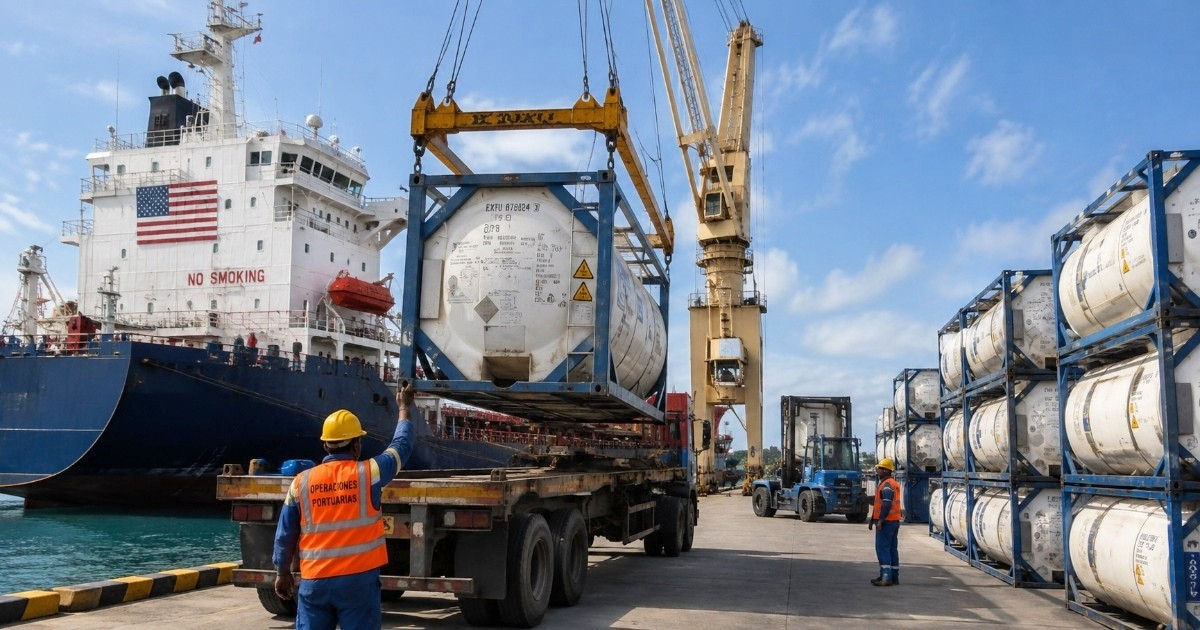
The shipments depart from Houston-Galveston, Miami, New Orleans, and Tampa, heading to the port of Mariel in ISO tank containers on container ships.
This growth occurs amid a severe energy crisis on the island. In May, Energy and Mines Minister Vicente de la O Levy acknowledged Cuba had "absolutely no fuel, no diesel, only accompanying gas."
The August 2026 data will be released on October 30, which will reveal whether July's record was an anomaly or the start of a new trend.
Frequently Asked Questions about US Fuel Exports to Cuba
Why did US fuel exports to Cuba increase so dramatically in 2026?
The increase was primarily due to the abrupt halt of Venezuelan oil supplies following the capture of Nicolás Maduro, coupled with regulatory changes in the U.S. that facilitated the export of refined petroleum products to private Cuban entities.
What products are included in US exports to Cuba?
The exports consist of refined petroleum products such as gasoline, diesel, kerosene, lubricating oils, and propane, not crude oil.
How does the current US export level compare to past Venezuelan supplies?
In July 2026, the US exported 103,900 barrels per day to Cuba, which far exceeds the 27,000 to 30,000 barrels per day that Venezuela supplied in 2025.