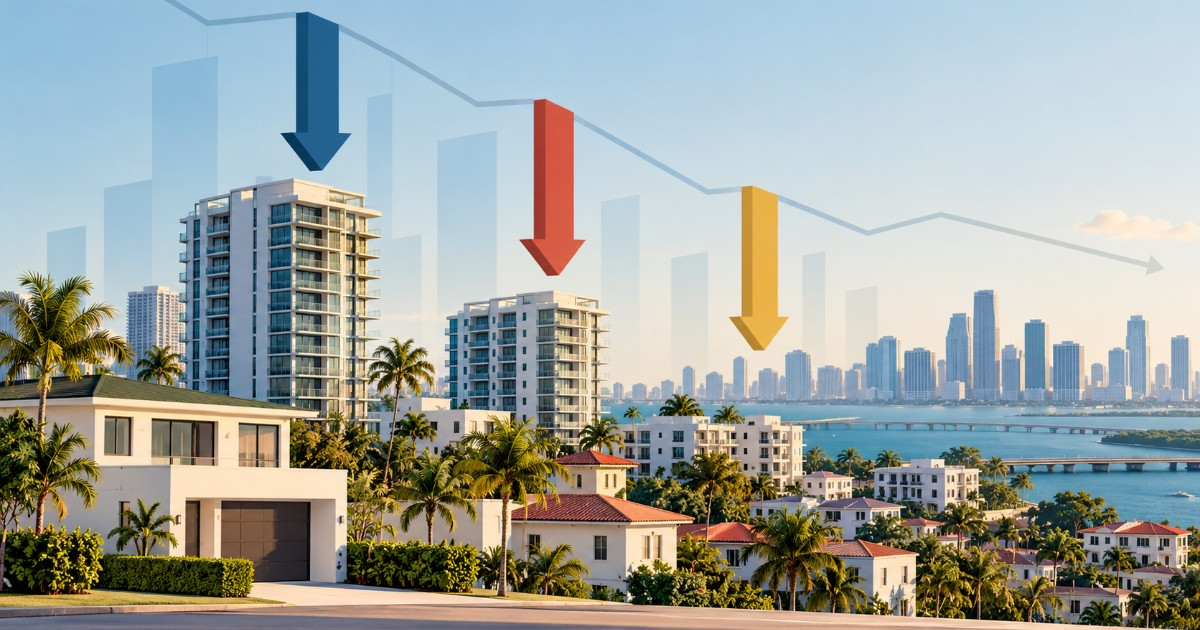
In Miami-Dade, the median rent is now at $2,900 per month, marking a decline of 2.29% compared to last year and a 1.09% decrease from August, based on Realtor.com's September 2026 data.
For those contemplating renting or purchasing a home, these figures provide valuable insights into the current market landscape, although there are significant variations among Miami, Hialeah, Doral, Kendall, and Homestead.
A reduction in overall rental prices throughout the county does not necessarily mean all properties are more affordable, nor does it imply that sale prices are decreasing at the same rate.
Current Rental and Purchase Prices Across Key Areas
September's statistics highlight notable disparities between the five key areas examined. All listed amounts are medians, representing the central value in each data set rather than the price of any specific property.
In Miami, the median rent stands at $2,939 monthly, down 1.38% from a year ago. The median listed home price is $620,000, with the median sale price reaching $564,000.
In Hialeah, the median rent is $2,412 per month, showing a year-over-year decline of 3.52%. Homes are listed with a median price of $450,000, while the median sales price is $464,000.
Doral records a median rent of $2,920 monthly, experiencing the most significant annual drop among the five areas at 5.81%. The median listed price is $560,000, and the median sales price is $675,000.
In Kendall, the median rent decreases to $2,400 per month, down 4% from a year prior. The median listed price is $415,000, with closed sales showing a median of $585,000.
Finally, in Homestead, the median rent remains steady at $2,500 monthly, unchanged from September 2025. The median listed price is $449,900, and the median sales price is $482,500.
Among these locations, Kendall and Hialeah offer the most affordable median rents, while Miami features the highest. Doral shows the sharpest annual decrease in rental prices.
Understanding Price Dynamics: List vs. Sale
In Miami-Dade, the median listed price is $589,000, a 2.37% decrease from a year ago. However, the median price of homes actually sold is $549,900, showing little change from 2025, with only a 0.02% drop.
This distinction is crucial: the listed price reflects the asking price for market-available properties, while the sale price represents completed transactions.
Because these are separate pools of properties, subtracting the medians won't accurately portray negotiated savings or costs for buyers.
This helps explain scenarios like Doral or Kendall, where the median sales price exceeds the list price. This doesn't necessarily mean buyers are paying more than the asking price for those specific properties.
Additionally, Realtor.com's residential base includes single-family homes, condos, and townhouses. The types of properties listed and sold can differ each period.
Miami-Dade: A Buyer's Market
Realtor.com identifies Miami-Dade as a buyer's market in September, indicating that the supply of homes surpasses demand.
Overall, properties in the county sell for 3.21% less than the listed price on average, with the sale-to-list price ratio hovering around 97%.
The median time listings spend on the market is 88 days, a 6.32% decrease from September 2025.
These indicators portray the general market behavior but don't imply all homes sell at a discount. Negotiation margins vary based on the property's location, condition, initial price, and buyer interest.
Conditions also fluctuate by area. Realtor.com classifies Miami, Doral, and Homestead as buyer's markets, while Hialeah and Kendall are balanced markets, where supply and demand are more equally matched.
Considerations Before Renting or Buying
For renters, median prices serve as a benchmark for price comparison but don't predict the exact cost of a specific apartment. Comparing similar properties in size, location, condition, and amenities is most useful.
When renting, it's wise to calculate the full cost: monthly rent, deposit, initial expenses, and included or excluded services. A seemingly lower rent may come with different conditions than another property.
For prospective buyers, the home's price isn't the full picture of monthly ownership costs.
The Consumer Financial Protection Bureau (CFPB) advises that, besides mortgage principal and interest, property taxes, homeowner's insurance, and possibly mortgage insurance should be factored in.
In condos and communities with homeowner associations, extra fees may apply. According to the CFPB's guide on association fees, these payments are typically separate from the mortgage payment.
In summary, September data reveals a drop in rents and listed prices in much of Miami-Dade, with significant differences between areas. To determine if a property is truly affordable, one must consider the total cost, rental or financing terms, and each household's available budget.
Understanding the Real Estate Market in Miami-Dade
Why are rental prices falling in Miami-Dade?
Rental prices are dropping due to a shift in the market dynamics where the supply of housing is exceeding demand, leading to more affordable rents in certain areas.
What distinguishes a buyer's market from a balanced market?
In a buyer's market, the number of available homes surpasses the demand, giving buyers more negotiating power. A balanced market has an equilibrium between supply and demand, leading to stable prices.
How do listed prices differ from sale prices in real estate?
Listed prices are the asking prices set by sellers for properties on the market, whereas sale prices are the final amounts paid in completed transactions.