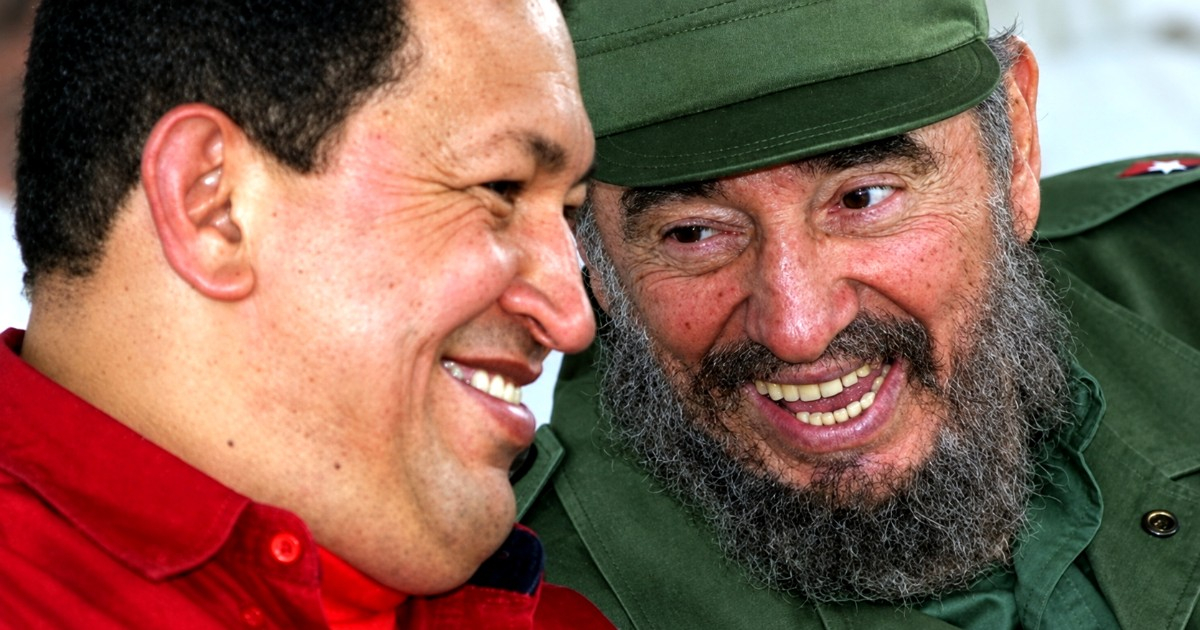
Hugo "El Pollo" Carvajal, the former head of Venezuela's Military Intelligence, has made shocking claims in an unpublished memoir draft. He alleges that Fidel Castro orchestrated the infiltration of more than 20,000 Cuban agents into Venezuela's government and society, with the approval of Hugo Chávez, in what he describes as an "unprecedented" operation.
The draft, accessed by the Spanish outlet Artículo14, was penned during Carvajal's incarceration at Spain's Estremera prison, where he was held from September 2021 until his extradition to the United States in July 2023.
Entitled What Really Happened in Venezuela: Memoirs of Hugo Carvajal, the document includes chapters like "How Fidel Castro Took Control of Venezuela" and "The Evolution of Chavismo into a Criminal Organization."
The Inside Look at Venezuelan Intelligence
Carvajal served as the head of Venezuela's Military Intelligence from 2004 to 2011 under Chávez and again from 2013 to 2014 under Nicolás Maduro, granting him an insider's view of the regime's inner workings. "What I know is from leading Venezuela's military intelligence for nearly a decade under Chávez," he asserts in his memoir.
His account of Cuban infiltration is unequivocal: "A contingent of over 20,000 Cuban agents infiltrated the Venezuelan government and society." Carvajal claims, "With Chávez's approval, Castro infiltrated Venezuela in an unprecedented manner," placing advisors in every ministry and expanding bureaucratic control to exert increasing influence over the Venezuelan population.
Chávez and Cuba: A Complex Relationship
While Carvajal notes that Chávez "sought advice from Havana but was not dictated to," he leaves no doubt about the depth of Cuban influence: "Chávez compromised our sovereignty from the moment he fell in love with the Cubans."
This testimony aligns with findings from the United Nations' 2022 Independent International Fact-Finding Mission on Venezuela, which concluded that Cuban agents "instructed, advised, and participated" in intelligence and counterintelligence activities within Venezuela's DGCIM and SEBIN, describing a "parallel intelligence structure" based on a confidential 2008 memorandum.
The Cuban impact on Venezuelan repression has been documented in numerous international reports.
New Revelations and Historical Context
The memoirs also reveal insights about Delcy Rodríguez, the current acting president of Venezuela following Maduro's capture by U.S. forces on January 3, 2026.
Carvajal recounts that in 2012, during his last personal conversation with a gravely ill Chávez, the former president expressed a desire to distance himself from a group including Tareck El Aissami, Jorge Rodríguez, and his sister Delcy. "Relax, if I survive this, I hope never to have them by my side again," Chávez reportedly said.
Specifically about Delcy, Carvajal is candid: "She had no position since she took valuables from the president's safe when she was the minister of the office, including a three-million-euro award won by Muammar Gaddafi that he gifted to Chávez. It was his only fortune, if it can be called that."
Delcy Rodríguez served as the Minister of the Presidential Office in 2006 and remained out of power until 2013 when Maduro reinstated her as Minister of Communication.
Accusations Against Cuba's Covert Operations
The revelations in Carvajal's memoirs are not his first claims of Cuba's direct role in clandestine operations through the Chavista apparatus.
In 2021, while detained in Spain, the former Intelligence chief submitted a report to the Spanish National Court alleging Cuban regime involvement in financing the Spanish party Podemos. He detailed supposed money transfers from Havana through the Cuban Embassy in Caracas and the Venezuelan diplomatic pouch. Carvajal claimed he could provide witnesses to corroborate some of these operations.
His accusations took on greater significance in December 2025, when from a U.S. federal prison, he sent a letter to President Donald Trump, directly accusing Cuba of being central to the structure created during Chávez's government.
Carvajal asserted that Havana had proposed using drug trafficking as a weapon against the United States and implicated Cuban agents in intelligence operations, support for armed groups, and infiltration of U.S. institutions.
Havana's response was swift. Senior officials from the Ministry of the Interior (MININT) and the Ministry of Justice publicly denied any Cuban involvement in drug trafficking and emphasized cooperation with the United States in anti-drug efforts.
Days later, Deputy Foreign Minister Josefina Vidal dismissed the accusations as "absurd and false," defending Cuba's record in combating drug trafficking.
Foreign Minister Bruno Rodríguez Parrilla also entered the fray to defend Cuba's anti-drug efforts, amid escalating tensions between Washington, Caracas, and Havana coinciding with Carvajal's statements.
The newly revealed memoirs expand on the early years of Chavismo and offer Carvajal's perspective on how Cuban influence was established within the Venezuelan state.
It is important to distinguish Carvajal's claims, which are supported by other investigations—such as the presence of Cuban agents in Venezuelan intelligence agencies documented by the UN mission—from broader accusations that remain primarily based on his testimony.
Carvajal is currently in pre-trial detention in New York after pleading guilty to four federal charges related to narco-terrorism.
While awaiting sentencing, he is cooperating with U.S. prosecutors and, according to Artículo14 sources, has provided crucial information that even led to Maduro's capture in early January. His sentencing was postponed in April 2026 after offering additional details about Chavista leaders to authorities.
In his memoirs, Carvajal also warned about Maduro—prior to his arrest—stating that "severe human rights violations are not subject to statute limitations and will eventually lead to trials."
Understanding Fidel Castro's Influence in Venezuela
How many Cuban agents were allegedly involved in Venezuela?
According to Hugo Carvajal, over 20,000 Cuban agents infiltrated the Venezuelan government and society.
What was the role of Cuban agents in Venezuela?
Carvajal claims that Cuban agents, with Chávez's approval, were placed as advisors in Venezuelan ministries and expanded the bureaucracy to exert greater control over the population.
How did the Cuban government respond to Carvajal's accusations?
Cuban officials publicly denied involvement in drug trafficking and highlighted cooperation with the United States in anti-drug efforts, dismissing Carvajal's claims as false.