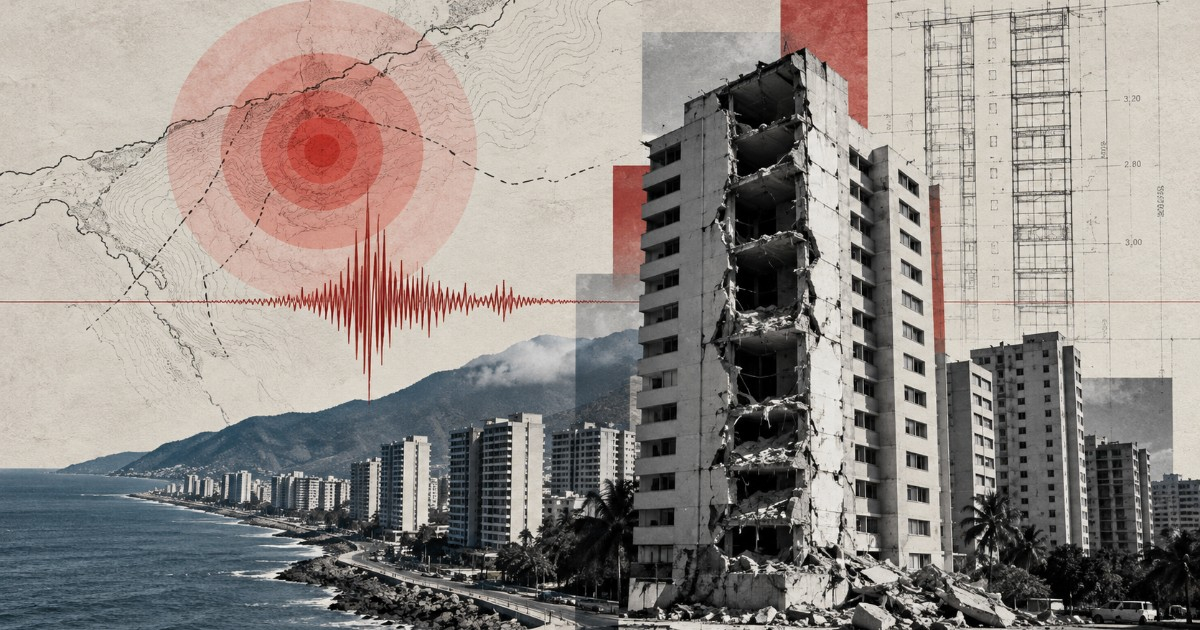
An Associated Press report released on Wednesday reveals that the Venezuelan government disregarded critical warnings from scientists and engineers before constructing large residential complexes along the coastal stretch of La Guaira. This area, known for its high seismic risk, saw at least 14 apartment towers collapse on June 24, 2026, during two consecutive earthquakes with magnitudes of 7.2 and 7.5.
The news agency spoke with numerous engineers, seismologists, and former officials to piece together the series of decisions that led to the construction of the most vulnerable building types on some of the country's most dangerous land.
The ground in La Guaira is composed of loose silt accumulated over centuries due to floods and landslides. This material amplifies seismic waves instead of dampening them. Additionally, the San Sebastián fault runs offshore and directly beneath the state. Experts interviewed by AP warned that towers between 10 and 20 stories could sway at the same frequency as seismic waves—a resonance phenomenon—greatly increasing stress on columns and leading to collapse.
Carlos Valdés, head of the seismology department at the National Autonomous University of Mexico's Institute of Geophysics, was straightforward: "They were challenging nature," he said regarding the officials who decided to build there.
Historical Decisions and Ignored Warnings
The roots of these decisions trace back to 2010 and 2011. Following torrential rains that displaced over 100,000 people in Venezuela, the Hugo Chávez administration initiated the Great Housing Mission to relocate the displaced. Political urgency and land scarcity drove rapid construction on the coastal strip, neglecting land-use restrictions specifically designed to protect the area.
These restrictions were drafted by Carlos Genatios, an engineer and former Science Minister who led reconstruction efforts after the 1999 disaster when floods and landslides killed tens of thousands in La Guaira. Genatios told AP that scientists had clearly warned: "There are areas, parcels of land, that should not have been used because they are prone to flooding during major surges; in those places, only very light structures, parks, sports fields, or similar facilities should be placed that do not cause great damage and, above all, do not result in deaths."
Impact on Major Housing Projects
Among the most affected projects was the Hugo Chávez Frías Urbanism in Playa Grande, inaugurated in 2012 with the cooperation of the Turkish company Summa. This complex, which housed around 3,400 families in roughly 190 buildings, saw nearly 80% of its structures collapse. Journalistic reports documented that the buildings were constructed with light materials—foam, aluminum, and thin sheets—without proper foundations or beams and columns capable of supporting the structural weight, and never met Venezuelan seismic standards.
The OPP towers in Caraballeda, including the OPP 26 and OPP 27 complexes, were also among the buildings that fell. Venezuelans risking their lives to rescue survivors from the rubble described scenes of floors crushed on top of each other, fires caused by exploding gas tanks, and hundreds trapped inside.
Lack of Government Response
The government, led by acting president Delcy Rodríguez, has not publicly addressed why so many buildings collapsed or why so many perished, according to AP. Three months after the earthquakes, survivors' questions and demands remain unanswered.
As of August 24, the official death toll stood at 6,509. In the immediate aftermath of the quakes, the UN estimated more than 50,000 missing. AP's investigation is the first comprehensive journalistic reconstruction of the decision-making chain that turned a well-known risk area into a deadly trap for thousands of Venezuelan families.
Frequently Asked Questions About the La Guaira Building Collapse
What caused the building collapse in La Guaira?
The building collapse in La Guaira was caused by two major earthquakes, with magnitudes of 7.2 and 7.5, amplified by the loose silt soil and inadequate construction practices.
Who is responsible for the construction decisions in La Guaira?
The Venezuelan government, particularly during Hugo Chávez's administration, is responsible for the decisions to construct large residential complexes in a known seismic risk area.
What measures were neglected in the construction process?
Proper seismic standards were neglected, including the use of adequate materials and construction techniques that could withstand seismic activity.