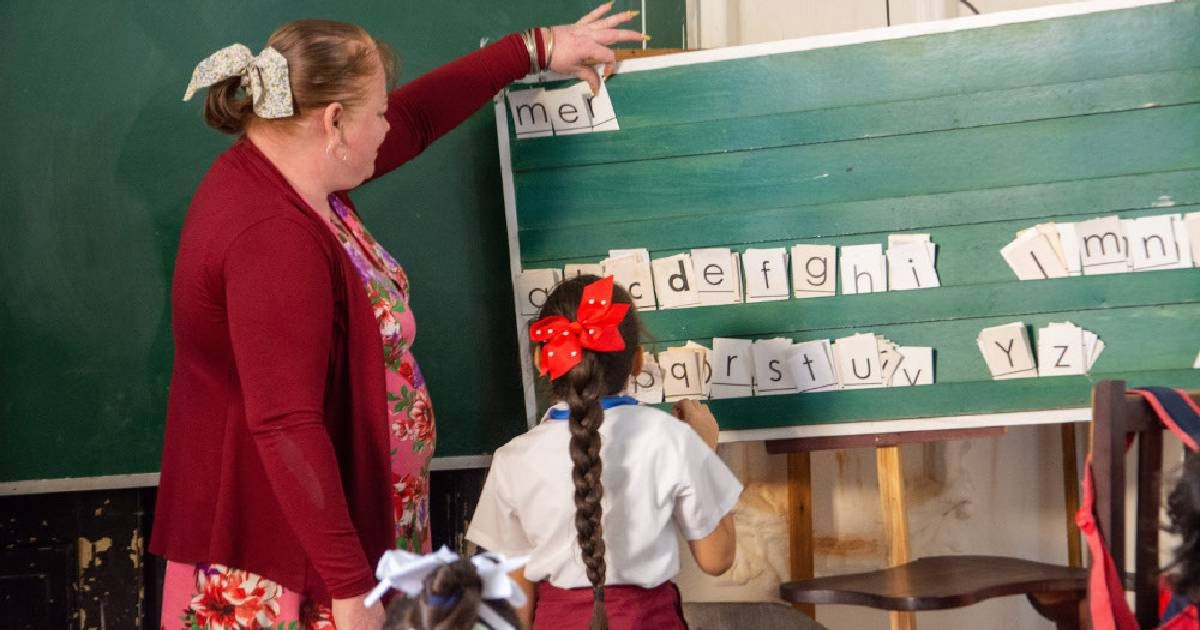
The Island of Youth began the 2026-2027 school year with only 72.2% of its teaching positions filled, as reported by the state agency ACN. This significant teacher shortage has become the primary educational challenge in the area, where over 11,000 students attend 84 schools.
Ena Nilvia Reyes, the municipal director of Education, acknowledged the difficulties but insisted that organizational measures have been implemented to prevent disruptions to the educational process and ensure that all students receive instruction.
Conditions are worsening progressively: by the end of the previous academic year, teacher coverage was at 79%. This figure already necessitated the reorganization of human resources and the school network.
Due to this reorganization, out of the 28 alternative classrooms that operated last year, only 17 remain in the current school year. These are staffed by 72 relocated teachers to maintain continuity in learning, mainly in primary, basic secondary, and Technical and Professional Education.
School transportation presents another unresolved issue. The director admitted that this aspect "is still in the process of improvement," a phrase that practically indicates an ongoing problem with no immediate solution. The situation mirrors that of 2022 when rural children couldn't attend classes due to lack of transportation.
The crisis extends into the future as well, with admissions to teaching careers in the area falling short of necessity. To date, only 86 students have enrolled in these careers, against a target of 125, suggesting the shortage will not be resolved soon.
The problem on the Island of Youth is not an isolated case but rather a reflection of the national educational crisis. Cuba started this school year with national teacher coverage at 73% and a deficit of approximately 24,000 teachers, leaving over 380,000 students without an assigned primary teacher, according to Infobae.
Camagüey began the school year with a teacher coverage of just 68.7% and a shortage of almost 3,000 educators for more than 95,000 students, while Holguín reported a lack of over 2,000 teachers at the start of the term.
Naima Ariatne Trujillo Barreto, the Minister of Education, recognized that the school year commenced under very challenging conditions. Despite this, the regime has attempted to portray emergency measures—such as the reintegration of retirees, university students as teachers, and teachers with responsibilities in multiple schools—as structural solutions.
The exodus of teachers is driven by insufficient salaries amidst inflation, massive migration, and the shift of professionals to the private sector, issues that emergency measures have failed to reverse.
Reyes concluded her assessment with a statement that encapsulates the scale of the challenge: "The success of the school year will depend on the efforts of teachers and administrators, as well as the support of families and the community, in a context where the shortage of educators remains the main challenge."
Understanding the Educational Crisis on the Island of Youth
What is the current teacher coverage on the Island of Youth?
As of the 2026-2027 school year, the Island of Youth has a teacher coverage of 72.2%.
How is the teacher shortage affecting students?
The teacher shortage has led to a reorganization of resources, resulting in fewer alternative classrooms and challenges in maintaining educational continuity.
What measures are being taken to address the shortage?
Organizational measures have been adopted, including the reallocation of teachers and attempts to improve school transportation, although these issues remain unresolved.
What factors contribute to the exodus of teachers from Cuba?
Key factors include low salaries amid inflation, mass migration, and the migration of professionals to the private sector.