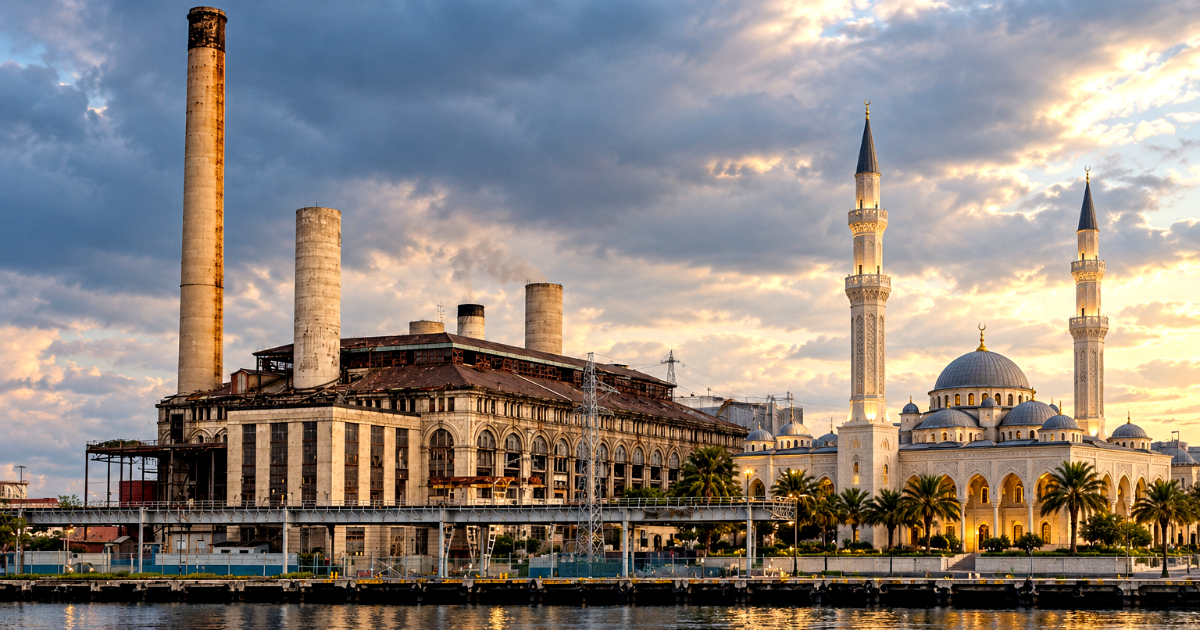
In a striking move, Saudi Arabia has allocated $9.3 million to construct a mosque in Havana during a time when Cuba is grappling with one of its most severe energy shortages in recent decades. Notably, this financial aid from the Gulf does not include a single barrel of oil for the island nation.
The details emerged from an investigation by journalist Darío Hernández, published in 14ymedio, confirming that the site designated for the project has recently been fenced off. The selected location is the former site of the Tallapiedra thermoelectric plant in Old Havana. While the plant's smokestacks lie dormant, they will one day be juxtaposed against the minarets of the planned King Salman Mosque.
The King Salman Mosque: A New Landmark in Havana
The mosque complex is designed to accommodate prayer halls for approximately 500 individuals, alongside a public library, dining facilities, green spaces, and community rooms. The design is managed by Restaura, a specialized entity within the Havana Historian's Office, while the construction is being overseen by Engimov Caribe, a Portuguese-owned company based in the Mariel Special Development Zone.
Funding for the project is provided by the Saudi Fund for Development, although the official investor is the Havana Historian's Office, which administers the funds. Despite having obtained a construction permit in 2020, the project has been beset by delays, with no foundations laid even after nearly ten years of announcements.
Cuba's Energy Woes: An Overlooked Crisis
The stark contrast is difficult to overlook: Cuba requires between 90,000 and 110,000 barrels of oil daily to sustain its electrical grid but produces a mere 40,000 barrels. Throughout 2026, the nation has endured at least eight complete collapses of its National Electric System, with deficits exceeding 2,000 megawatts and power outages lasting more than 24 hours in certain areas. While Saudi funds have arrived, they have not materialized in the form of much-needed fuel.
Cuba and Saudi Arabia's diplomatic ties date back to 1956. To date, the Saudi Fund for Development has financed seven projects on the island—including health, sanitation, and infrastructure initiatives—totaling approximately $193.3 million. However, according to a source within the Havana Historian's Office, part of a $26.6 million loan initially intended for housing was diverted to the Fidel Castro Ruz Center in El Vedado and the Capitolio. "The credit was supposed to be for housing, but some of it was used for the Center and the Capitolio," the source revealed to 14ymedio.
A Complex Journey to Construction
The project's journey has been complex. In 2014, Turkey proposed financing a mosque in Havana, spearheaded by President Recep Tayyip Erdogan, who even alluded to a supposed pre-Columbian Islamic presence on the island: "Columbus mentions a mosque on a hill along the Cuban coast. I will discuss with my Cuban brothers how suitable it would be to build a mosque on that hill." Initially rejected by the Cuban regime and later accepted, the Turkish plan never materialized. In 2016, the financing was taken over by Saudi Arabia, with ambitions for a complex capable of accommodating up to 10,000 worshippers, potentially the largest in Latin America.
The Muslim community in Cuba is small and relatively new in its organization. While historical references exist to Muslim African slaves and Arab immigrants—Lebanese, Syrians, Palestinians—from the late 19th century, organized Islamic practice began to grow primarily in the 1990s, spurred by the religious openness following the Special Period. The Islamic League of Cuba gained legal recognition in 2007, and it is estimated that the community numbers no more than 5,000 throughout the island. Their only formal place of worship in the capital is the Abdallah Mosque on Oficios Street. Believers face additional challenges in obtaining halal products and celebrating occasions like Ramadan or Eid amid widespread shortages.
In 2022, Cuban Ambassador to Riyadh Vladimir González described this community as "a small, well-organized Muslim community in the country," expressing his honor in facilitating their lives as Muslims in Cuba.
For these few thousand adherents, the King Salman Mosque—still without its foundations in September 2026—represents what could become the island's first major Islamic complex.
Understanding the Implications of Saudi Investment in Cuba
Why is Saudi Arabia funding a mosque in Cuba?
Saudi Arabia is investing in the construction of the King Salman Mosque in Havana as part of its broader efforts to support religious and cultural projects worldwide. This initiative aligns with their diplomatic and cultural outreach goals, despite Cuba's ongoing energy crisis.
What is the current state of Cuba's energy crisis?
Cuba is experiencing a severe energy crisis, producing only about 40,000 barrels of oil per day while needing between 90,000 and 110,000 to sustain its electrical system. This has led to significant power outages and system collapses throughout 2026.