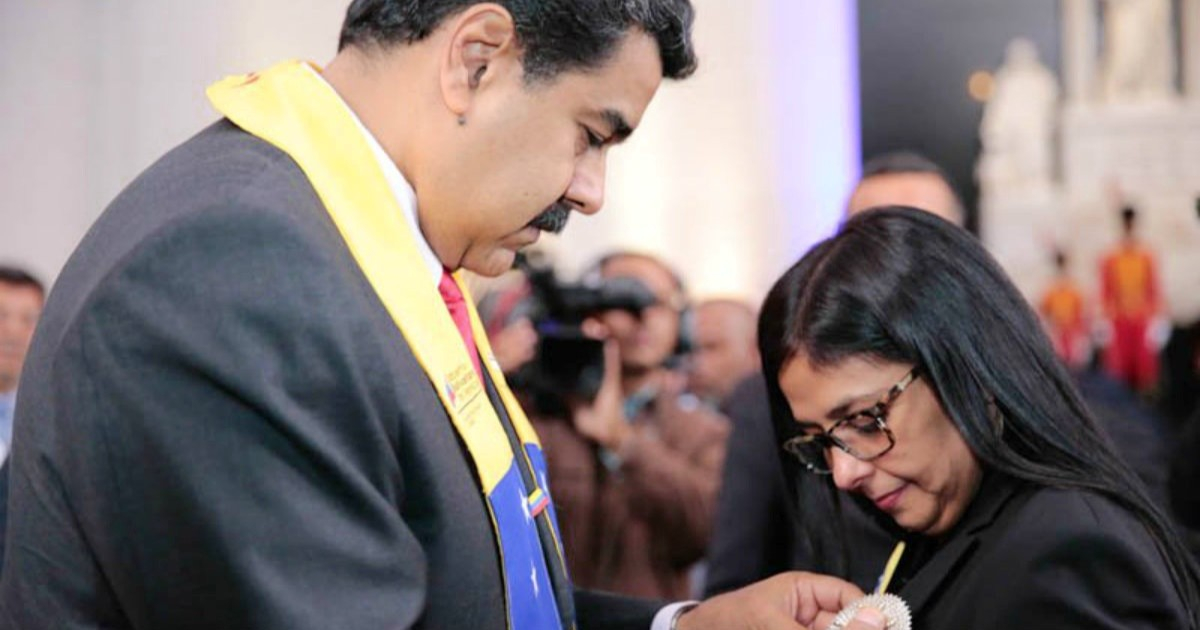
Delcy Rodríguez, the acting president of Venezuela, has formally requested the National Assembly to implement a partial reform of the Constitutional Law Against Hatred for Peaceful Coexistence and Tolerance. This is the very law she fervently supported in 2017 while leading the Chavista Constituent National Assembly.
The request was outlined in a presidential letter dated Monday, addressed to Deputy Jorge Rodríguez Gómez, the president of the National Assembly and Delcy's brother.
On Tuesday, the acting president shared the letter on her X account, stating, "We continue to make strides towards a new era of citizen coexistence in Venezuela."
Details of the Request
In the letter, Rodríguez states that "the proposed reform aims to make progress in decriminalizing behaviors outlined in the mentioned legal framework as part of the National Government’s efforts to transform our country's criminal justice system and promote democratic reconciliation and coexistence."
She also urged that the initiative be treated "as a matter of urgency," expressing confidence that it will have "a positive impact on rebuilding trust in institutions and revitalizing the nation's democratic life."
A Law Born to Suppress
The proposal does not call for the complete repeal of the law, but only a "partial reform," which has already drawn criticism from human rights and press organizations.
The Constitutional Law Against Hatred was passed on November 8, 2017, by the Chavista Constituent National Assembly—composed solely of PSUV militants and regime allies—during a peak of anti-government protests that resulted in around 125 deaths that year.
Nicolás Maduro himself introduced the bill, stating it was time "to punish hate crimes, intolerance in all its forms of expression."
The law, condemned from the outset as a tool of censorship, imposes penalties of up to 20 years in prison for inciting hatred or violence, requires the removal of social media messages within six hours under threat of fines, and empowers the state to shut down media outlets and revoke political parties' registrations.
Turning Point After Maduro’s Capture
Delcy Rodríguez, then the president of the Constituent Assembly, was one of its staunchest advocates.
"Promotion is prohibited, they must remove messages promoting hate, war, intolerance within six hours. If not, they will be subject to sanctions," she declared at the time.
Following Nicolás Maduro's capture by U.S. forces on January 3, 2026, Rodríguez took the helm of the Venezuelan government.
In February, during the approval of the Amnesty Law, Jorge Rodríguez acknowledged "situations of misuse" of the law, hinting that it was "very likely" to undergo reform.
It wasn't until this Monday that the executive branch formalized this request.
The proposal comes shortly after Delcy Rodríguez's "historic" meeting with Donald Trump in New York, where she pledged before the UN a "systematic legal reform" and a "democratic transformation" in Venezuela.
Organizations Demand More Than a Reform
Repression figures contradict the official narrative. Provea documented at least 40 judicial charges, 36 arbitrary detentions, and three sentences of more than 10 years for opinion-related crimes between January 2024 and October 2025 under this law.
Amnesty International warned that repressive mechanisms "have not changed" structurally, with between 379 and 500 people detained for political reasons and 64 new cases of torture documented since January 2026.
The National Union of Press Workers was more direct: it called for the complete repeal of the law, not just a partial reform, to stop the criminalization of journalism in Venezuela.
Understanding the Law Against Hatred in Venezuela
What does the Law Against Hatred entail?
The Law Against Hatred aims to penalize acts of hatred and intolerance, including incitement to violence. It imposes severe penalties, such as up to 20 years in prison, and mandates the removal of certain online content within six hours.
Why is Delcy Rodríguez proposing a reform to the law?
Delcy Rodríguez is proposing a reform to advance the decriminalization of certain behaviors outlined in the law, as part of efforts to transform Venezuela's criminal justice system and encourage democratic coexistence.
How have organizations reacted to the proposed reform?
Human rights and press organizations have criticized the reform, arguing that it is insufficient and calling for a complete repeal of the law to end the criminalization of dissent and journalism.