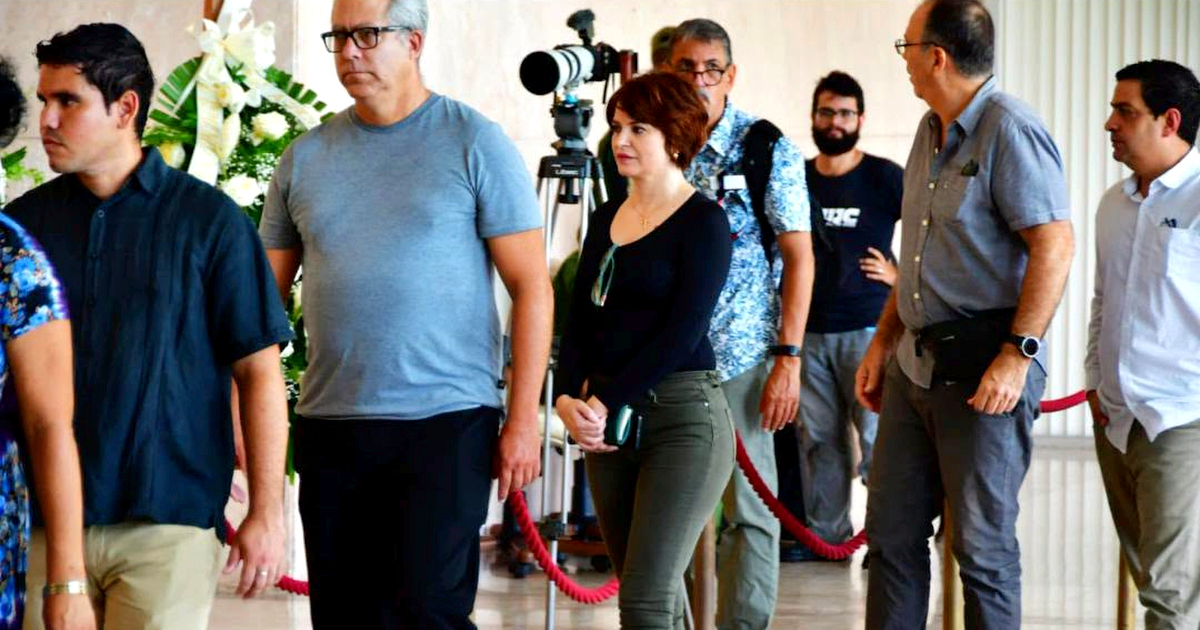
Ana Hurtado attempts to portray the recent leak by CBS News regarding U.S. military preparations related to Cuba as merely a "psychological warfare" tactic. However, a photo she shared on Facebook offers insight into her perspective as a Spanish propagandist.
On June 27, Hurtado posted an image from the funeral tribute to Ramiro Valdés, with the caption: "Always grateful to Roberto Garaycoa Martínez's lens. Paying respects to Ramiro."
This was no ordinary event. Ramiro Valdés was a key figure in the security framework of the Castro regime: a commander of the so-called "revolution," founder of the Ministry of the Interior, and a person deeply entwined with Cuba’s intelligence, counterintelligence, and internal control structures for decades.
Understanding the Context: A Web of Influence
The significance of the image lies in both its context and the individuals surrounding Hurtado. As identified in the scene, present are her husband, Senén Casas Más; Alejandro Castro Espín, the son of Raúl Castro; and Humberto López, a prominent media spokesperson for the Cuban government.
This trio—military family, intelligence, and propaganda—sheds new light on Hurtado's claims about Washington's alleged "psychological warfare."
Hurtado's Connections: More Than Ideological Advocacy
Hurtado is not merely a distant observer. Journalistic investigations have identified her as the wife of Senén Casas Más, who is reportedly connected to the inner circle of Alejandro Castro Espín.
According to CiberCuba, citing Martí Noticias and Mario J. Pentón, Casas Más allegedly accessed diplomatic passports from the Ministry of the Interior and participated in over 40 international missions with Castro Espín, visiting countries like Russia, China, Panama, and France.
This connection places Hurtado in a network far beyond ideological activism. Her husband is portrayed as a low-profile figure but linked to a power circle where state security, discreet diplomacy, and the Cuban military apparatus intersect.
Alejandro Castro Espín: A Shadowy Power Broker
Alejandro Castro Espín is pivotal to understanding this environment. As the son of Raúl Castro and Vilma Espín, he was one of the less visible yet highly influential figures in Cuban power circles for years.
El País described him as an "organic intellectual of the regime, but in uniform": he penned articles in official media, presented himself as a political scientist and master in International Relations, and authored books like "Imperio del terror" and "Estados Unidos: el precio del poder," which critically analyzed U.S. policy towards Cuba.
However, Castro Espín was more than just an anti-U.S. author. Following the announcement of a thaw between Barack Obama and Raúl Castro, he emerged as an architect of rapprochement with Washington, a key figure in secret negotiations, advisor to his father, and head of state intelligence and counterintelligence.
The Havana Syndrome and Castro Espín
Castro Espín's trajectory was also marked by the so-called Havana Syndrome. Diario de Cuba noted a report by The New Yorker that tied him to the context of alleged acoustic attacks affecting U.S. and Canadian diplomats in Havana.
The report suggested that the MININT department led by Castro Espín was dismantled around March 2018 amid speculations about his waning influence. While there is no public evidence of his direct involvement in these incidents, his name remains linked to one of the most sensitive episodes in recent U.S.-Cuba relations.
Humberto López and the Propaganda Machine
The presence of Humberto López in this milieu adds another layer. López is not just a television presenter. In recent years, he has become one of the most visible faces of the Cuban government's narrative against dissidents, exiles, sanctions, and international accusations.
CiberCuba documented how López defended on TV the idea that Cuba does not prosecute political dissidents but rather individuals accused of crimes against state security or common offenses, a narrative that contrasts with reports from activists and human rights organizations about surveillance, harassment, and political imprisonment.
The Role of Propaganda: A Strategic Response?
Hurtado's response to CBS should be viewed within this framework. The U.S. network reported that the Army Reserve is evaluating whether it can provide the Southern Command with military police units, medics, engineers, and logistical support within 90 to 120 days.
CBS clarified that there is no public deployment order and that the internal document does not directly mention Cuba, though U.S. officials linked these preparations to planning regarding the island.
Hurtado's dismissive reaction—"What the United States doesn't want to leak, doesn't leak"—seeks to cast Washington's actions as mere posturing.
However, this perspective overlooks context. Since January, the U.S. has issued public signals towards Cuba: sanctions, energy pressure, aerial surveillance in the Caribbean, military movements in Puerto Rico and Guantánamo, strategic documents on the Western Hemisphere, and statements by Donald Trump about "taking Cuba" or deploying an aircraft carrier.
In light of this, reducing everything to "psychological warfare" seems less like analysis and more like a rallying cry.
The key question is not whether Ana Hurtado genuinely believes it's all theatrics. It's whether the apparatus she appears closely linked to needs to convince its base that there's nothing to worry about.
Understanding the Dynamics of Cuban-U.S. Relations
What is the significance of Ana Hurtado's photo with Ramiro Valdés?
The photo highlights Hurtado's connection to influential figures in Cuba's security and intelligence circles, emphasizing her proximity to the regime's inner workings.
Who is Alejandro Castro Espín?
Alejandro Castro Espín is the son of Raúl Castro and a significant figure in Cuba's intelligence and diplomatic circles, playing a key role in the country's relations with the United States.
How does propaganda fit into the Cuban government's strategy?
Propaganda is used to lower public anxiety, mock adversaries, reinforce the idea of control, and prevent external signals from being perceived as internal vulnerabilities.