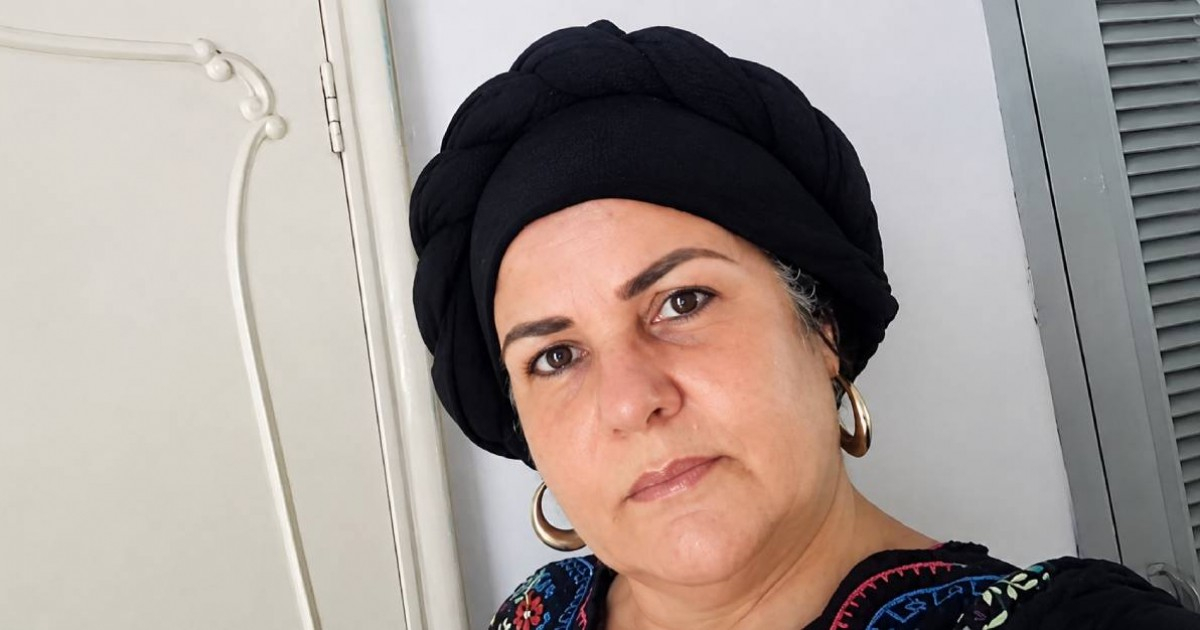
The Cuban host, actress, and presenter Laritza Camacho recently shared a powerful reflection on her Facebook profile addressing the censorship of images in Cuba. She challenged the official stance that capturing the reality of the country plays into the hands of the "enemy."
Camacho wrote, "If you publish a photo that might give the 'enemy' something to talk about, you could be judged." She then questioned what types of images were being referred to.
"A destroyed hospital? A cemetery in ruins? Youths lost to chemical consumption? People scavenging through trash? The astronomical price of an onion? ATMs out of order while there’s talk of digital banking and payments?" she enumerated, pointing directly to crises that the regime prefers to keep out of view.
Questioning the True Enemy
At the core of her argument lies a question the Cuban government struggles to answer: who is really the enemy?
Camacho provocatively asked, "Doesn’t the enemy more closely resemble those who create the problem, fail to resolve it, and still attempt to cover it up, like trying to block out the sun with a finger?" She flipped the logic used by authorities to justify the persecution of those documenting the reality.
She warned that suppressing images does not erase the facts they represent: "The photo may not be there, but the youths using chemicals will remain, along with all the other disasters mentioned and countless others."
A Call to Address the Real Issues
Her conclusion is straightforward: "Let’s not censor the photo and forget the 'enemy.' Instead, let’s face the problem head-on, with or without the photo, and resolve it. Because, my dear friends, the issue has never been the photo or the photographer."
Camacho’s post comes amid a documented multidimensional crisis in Cuba: hospitals with collapsing roofs and unusable bathrooms, food shortages with exorbitant prices, chronic blackouts, and a synthetic cannabinoid epidemic among youths aged 16-40, with medical emergencies in Havana doubling between 2024 and 2025.
Legal Framework for Censorship
The legal framework supporting such censorship is extensive. Decree-Law 35 and the Social Communication Law provide for sanctions against disseminating content deemed offensive or disruptive to public order. The Resolution 9/2025 from the Institute of Information and Social Communication, in effect since May of last year, allows for the suspension of sites and publications without prior notice if they are found to violate "socialist principles." In practice, publishing a compromising image can lead to fines, confiscation of devices, or criminal proceedings.
Known for her work on Mediodía en TV and Radio Ciudad de La Habana, Camacho has been raising her voice with increasing force. In July, she declared, "I am against the Cuban government because the Cuban government is against Cuba." In early September, she wrote that Cuba is a country "free of everything that would make us a country... free," using irony to highlight the lack of freedoms. On September 9, she ended a prayer with the phrase: "Here, we can't even shout the prayer," depicting the atmosphere of repression and self-censorship on the island.
Understanding Censorship and Its Impacts in Cuba
What is the main argument Laritza Camacho makes regarding censorship in Cuba?
Laritza Camacho argues that the real problem is not the images or the photographers, but the issues they expose. She suggests that the Cuban government's censorship seeks to hide the reality rather than address the underlying problems.
How does the Cuban government justify image censorship?
The Cuban government justifies image censorship by claiming that such images can be used by the "enemy" to criticize the regime. They use this reasoning to suppress images that depict the nation's harsh realities.