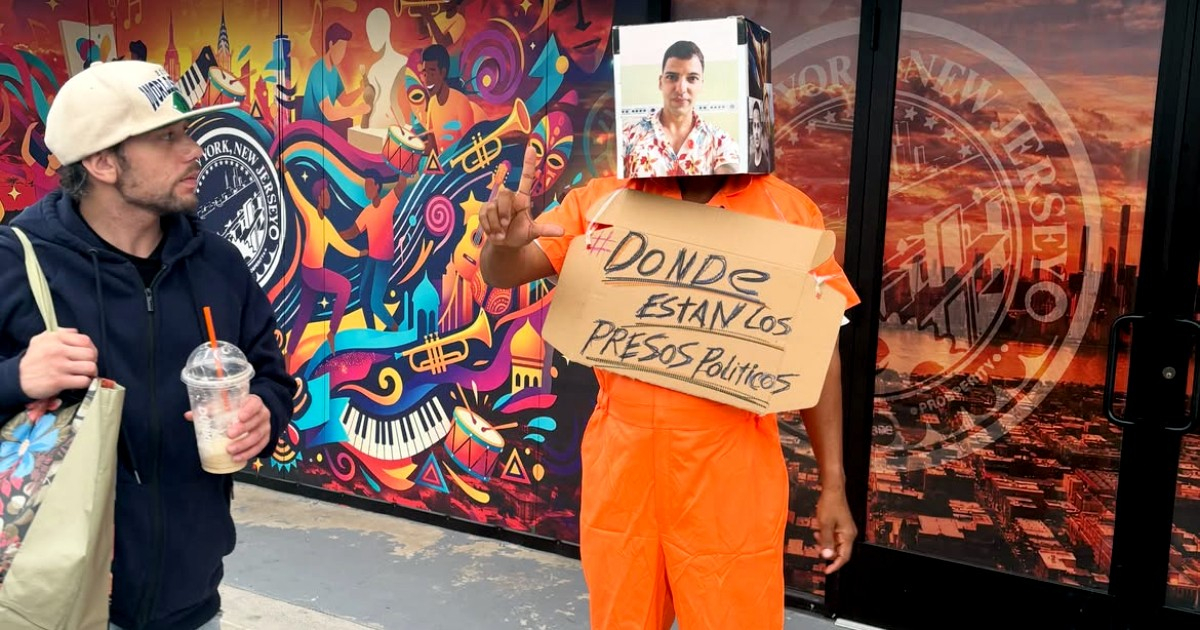
Clad in an orange jumpsuit—a stark representation of prison attire—and donning a cardboard box adorned with images of political detainees, Luis Manuel Otero Alcántara showcased his protest art at the West New York Cultural Center this past Sunday. His performance was a direct challenge to the Cuban regime regarding the hundreds who remain imprisoned following the July 11, 2021 protests.
The performance was part of the event "Libres x Derecho 2: Voices of 11J," organized by Juventud Cuba MDJC and CubaLex. The artist himself described it as "a platform to discuss memory, human rights, and those who are still politically incarcerated."
Otero Alcántara's presentation was a reimagining of his artwork "Where Is Mella?", originally created in 2017 in Havana. During that performance, he stood as a living statue inquiring about the vanished bust of student leader Julio Antonio Mella, a critique of the Cuban state's symbolic erasure of historical memory.
In its 2026 iteration, the question transformed entirely: "I presented a new version of my performance Where Is Mella? This time the question changed: Where are the political prisoners?" the artist stated.
The intended audience also shifted: "The question was no longer just for the public. I directed it at the dictatorship: How long must this suffering last? How long will the confinement continue? How long will so many families endure this pain?"
The sign he held during the performance encapsulated his demand in a single line: "#WhereAreThePoliticalPrisoners."
As a co-founder of the Movimiento San Isidro, Otero Alcántara arrived in Miami on July 18 of this year after being released by the regime under the condition of permanent exile. He had served a five-year sentence for "insulting national symbols," "disrespect," and "public disorder." He described his departure as an expulsion.
Since entering exile, the artist has not ceased his activism. He showcased works created during his incarceration in Miami and was featured in a book on political prisoners and dissidents, photographed by former President George W. Bush in September.
The Sunday performance in New York marks one of his first major artistic endeavors in the northeastern United States, just over two months after his arrival.
The concept of "artivism"—the fusion of art and activism—has deep roots in Cuban cultural resistance. In 2015, artist Tania Bruguera founded the Institute of Artivism Hannah Arendt (INSTAR) in Havana, which won the 2021 Arnold Bode Prize in Kassel and participated in documenta fifteen in 2022.
Otero Alcántara's urgent call for justice is underscored by hard numbers: as of April 2026, according to Justicia 11J, there were 775 political prisoners in Cuba, 338 directly linked to the 11J protests. Prisoners Defenders raised that count to 1,339 by the end of August.
The regime's announced releases have proven inadequate: in March, the release of 51 individuals was declared, but Justicia 11J verified only 20. The April pardon freed over 2,000 inmates but specifically excluded those convicted of "crimes against authority," the legal charge used against 11J protesters.
"Let the Cuban people be free. Release the political prisoners. No prison can forever contain the yearning for freedom," concluded Otero Alcántara in his statement.
Frequently Asked Questions About Political Prisoners in Cuba
Who is Luis Manuel Otero Alcántara?
Luis Manuel Otero Alcántara is a Cuban artist and activist known for his performances that challenge the Cuban government's policies and advocate for human rights and freedom.
What was the 11J protest in Cuba?
The 11J protest refers to the widespread demonstrations that occurred in Cuba on July 11, 2021, where thousands of Cubans took to the streets to protest against the government, demanding freedom and better living conditions.
What is artivism?
Artivism is a blend of art and activism, using artistic expression as a means to advocate for social or political change. It has been a significant tool in cultural resistance movements worldwide, including in Cuba.