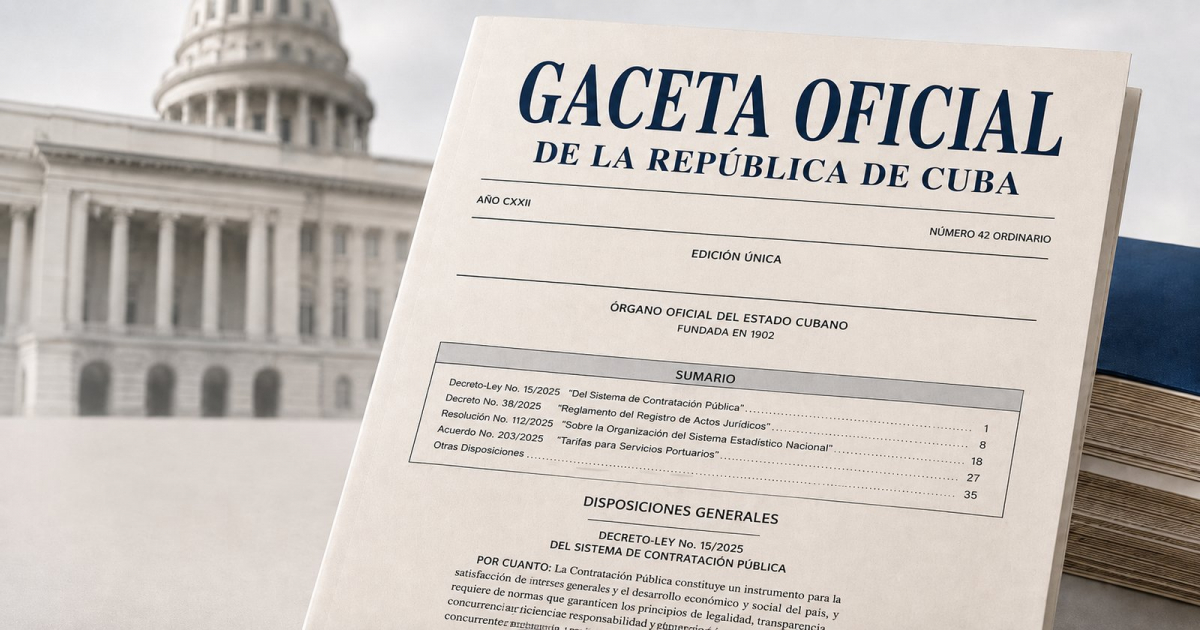
On Monday, the Cuban Council of Ministers released an updated version of Decree 76, a comprehensive regulation concerning the production, development, and application of biofertilizers, biostimulants, and biopesticides within the agricultural sector of Cuba.
This regulation, featured in Special Edition No. 19 of the Official Gazette dated September 28, 2026, spans pages two through nine. Its primary aim is to oversee various aspects, ranging from research and development to registration, production, marketing, comprehensive use of bioproducts, impact assessment, training, and enforcement of regulatory compliance.
The Ministry of Agriculture is designated as the leading authority overseeing the entire lifecycle of these products, from research and registration to production and commercial oversight.
Within the Ministry, the Soil and Fertilizers Directorate is responsible for registering biofertilizers and biostimulants, while the Plant Health Directorate manages the registration of biopesticides, requiring prior authorization from both their office and the Ministry of Public Health for usage approval.
Bioproduct production is organized at two levels: the national level, which includes industrial plants and Science and Technological Innovation entities, and the local or territorial level, comprising small plants, Entomophagous and Entomopathogenic Reproduction Centers, provincial laboratories, and universities.
The Institute for Plant Health Research is tasked with maintaining the mother strains and breeding stocks of beneficial arthropods, distributing them to provincial laboratories and the LABIOFAM Business Group based on agreed demand.
Research priorities for bioproducts are annually determined according to science and technological innovation programs set by the Ministry of Science, Technology, and Environment.
Additionally, individuals or entities wishing to introduce or market bioproducts in Cuba must provide the necessary documentation for registration.
Violations of Decree-Law 64 and its regulations can result in fines ranging from 2,000 to 10,000 pesos.
This special edition is part of a recent trend in revising the agricultural regulatory framework. Just four days earlier, the Council of Ministers had also issued an updated version of Decree 52 concerning soil conservation and sustainable management, published in Special Edition No. 18 of the 2026 Official Gazette.
The publication is in response to the mandate of the Second Final Provision of Decree 166, issued on August 19, 2026, and published in the Ordinary Gazette No. 75 on September 9, 2026, which called for updating, reviewing, and harmonizing the text of Decree 76 with amendments introduced by that decree.
Originally, Decree 76 was issued on December 5, 2022, as a regulation of Decree-Law 64, approved on September 19 of the same year, and was first published in Ordinary Gazette No. 53 on July 15, 2023.
Understanding Cuba's New Biofertilizer Regulations
What is the main purpose of Decree 76 in Cuba?
Decree 76 aims to regulate the production, development, and use of biofertilizers, biostimulants, and biopesticides in the agricultural sector of Cuba, covering aspects from research to marketing and usage.
Who oversees the registration and commercial oversight of biofertilizers in Cuba?
The Ministry of Agriculture is responsible for the registration and commercial oversight of biofertilizers and biostimulants in Cuba, specifically managed by the Soil and Fertilizers Directorate.
What are the potential penalties for violating Decree-Law 64 in Cuba?
Fines for violating Decree-Law 64 and its regulations can range from 2,000 to 10,000 pesos.