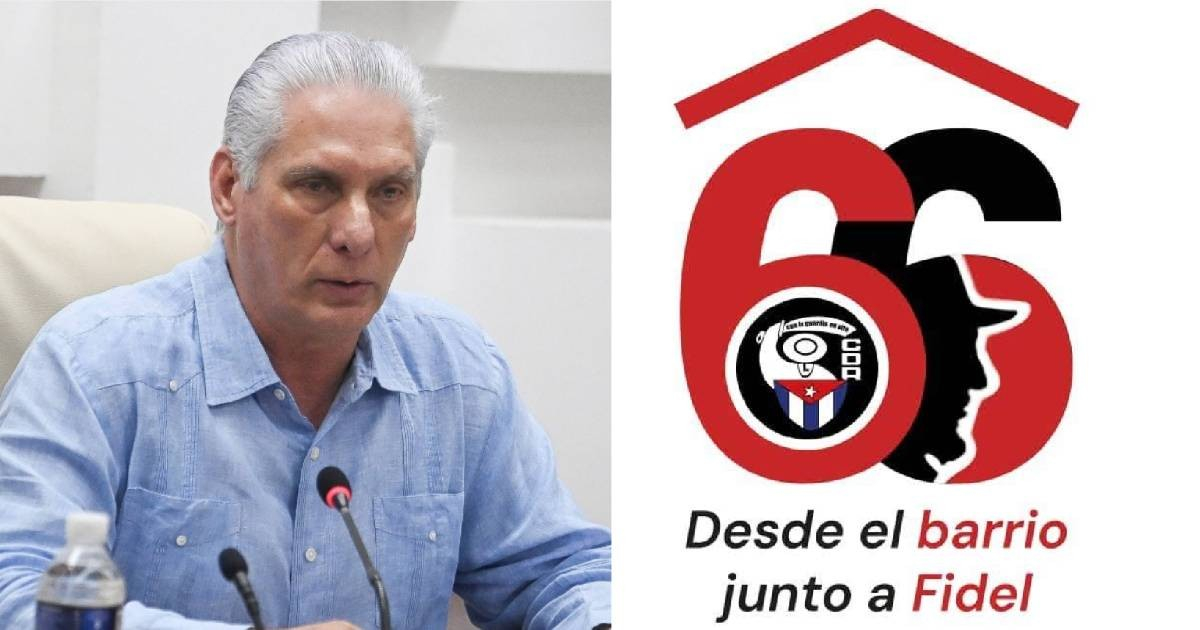
Marking the 66th anniversary of the Committees for the Defense of the Revolution (CDR), Miguel Díaz-Canel released a set of five posts on social media platform X this Monday. He urged the enhancement of the surveillance functions of the organization, originally established by Fidel Castro on September 28, 1960.
"Surveillance is not abandoned; it is expanded to save energy, protect the vulnerable, prevent crime, drugs, and corruption," wrote the Cuban leader, making a clear call to bolster the CDR's long-standing role in social control, which they've maintained since their inception over six decades ago.
Díaz-Canel characterized the CDR as "the link that connects national policy with everyday life" and dismissed the notion of creating new structures: "It's not about inventing structures but about articulating and leveraging what already exists."
Simultaneously, the leader acknowledged one of the organization's glaring issues: the aging of its members and the lack of new recruits. "Without the involvement of young people in its activities, the CDR becomes generationally empty," he warned, urging that the anniversary be celebrated "with concrete, measurable tasks and follow-up."
The Aging Structure and Its Challenges
The disconnect between official rhetoric and reality is stark. Just days before the anniversary, Díaz-Canel himself admitted to CDR members that "many people think this is already an outdated organization" that makes little sense in today's conditions and contributes nothing substantial.
Intellectual and activist Alina Bárbara López was more forthright, labeling the CDR as a "massive and ineffective bureaucratic structure with no social foundation." She highlighted that in Matanzas—the province designated as the National Vanguard of the organization for 2026 and the central site for the anniversary celebration—many citizens no longer pay monthly fees, attend meetings, or participate in CDR watches.
Historical Context and Current Initiatives
Founded during a massive rally in front of what was then Havana's Presidential Palace, the CDR began as a neighborhood watch and denunciation network aimed at identifying and reporting counter-revolutionary activities. Over time, they took on community tasks, but their role in social control has never disappeared.
To counteract the decline, the regime has launched the "My Neighborhood for the Homeland" program—aligned with the CDR through three pillars: Safe Neighborhood, Productive Neighborhood, and Participatory Neighborhood—and the Community Youth Network, led by the Union of Young Communists. Additionally, 134 CDR members were honored under Presidential Decree 1284.
This commemoration also coincides with the Centenary of Fidel Castro's birth, with the official anniversary logo bearing the phrase "From the neighborhood alongside Fidel," featuring the dictator's iconic silhouette with a military beret.
Public Response Amidst a National Crisis
All of this unfolds as Cuba endures power outages lasting between 18 and over 20 hours daily, an electricity generation deficit exceeding 2,000 MW, shortages of food and medicine, and a historic record of 1,339 political prisoners as of the end of August 2026, according to Prisoners Defenders.
The public reaction on social media to Díaz-Canel's call was marked by irony and outright rejection: "That's been dead for a long time, count me out," and "Only the fees work," were among the comments from Cuban netizens.
Understanding the CDR's Role and Impact in Cuba
What are the Committees for the Defense of the Revolution (CDR)?
The CDRs are neighborhood organizations in Cuba founded by Fidel Castro in 1960 to monitor and report on counter-revolutionary activities. Over time, they have also taken on various community tasks.
Why is Díaz-Canel calling for expanded surveillance by the CDR?
Díaz-Canel is advocating for enhanced surveillance to save energy, protect vulnerable populations, and prevent crime, drugs, and corruption, reinforcing the CDR's role in social control.
How has the public reacted to Díaz-Canel's message?
The public reaction on social media has been largely negative, with many expressing irony and rejection, citing the CDR as outdated and ineffective.