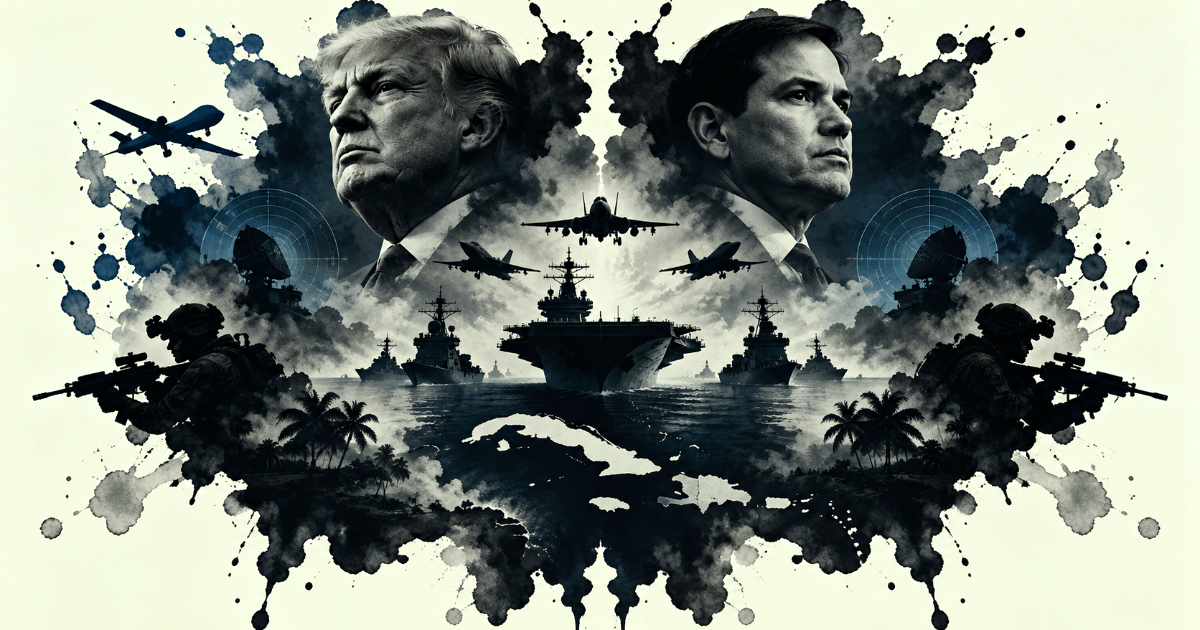
Spanish propagandist for the Cuban regime, Ana Hurtado, went beyond labeling the CBS News leak about U.S. military preparations related to Cuba as "psychological warfare." Her commentary was both more detailed and revealing.
"What the United States doesn’t want leaked, doesn’t get leaked," she posted on Facebook, adding, "There was no leak about the kidnapping of Maduro/Cilia and the assassination of the 32 Cuban heroes, nor the martyrdom of the Ayatollah and the massacres in Iran. They think we are naive with their damn psychological warfare."
Hurtado's thesis is straightforward: if a genuine operation doesn't leak, then what CBS published can only be an intimidation tactic. However, this theory overlooks the difference between operational secrecy and strategic signaling.
Strategic Moves: More Than Just Leaks
The final stages of military or intelligence actions are typically kept under wraps. This doesn't imply that there aren't prior warnings, sanctions, troop movements, calculated leaks, surveillance flights, and political messages intended to pressure the adversary.
Venezuela and Iran: Examples that Challenge the Argument
The very examples Hurtado uses point in the opposite direction of her conclusions. The capture of Nicolás Maduro didn’t arise out of nowhere. It was preceded by bounties, designations, naval deployments, attacks on ships, public warnings, and mounting pressure from Washington on the Chavista regime. The final operation might have been confidential, but the context leading up to it was visible for months.
Similarly, with Iran, Hurtado suggests that truly sensitive actions are never leaked. Yet, while a specific operation might remain classified, it is often preceded by a public escalation: threats, military movements, political messages, diplomatic preparation, and a framework for action.
What CBS Unveiled
CBS reported that the U.S. Army Reserve is assessing whether it can provide the Southern Command with military police forces, medical personnel, engineers, and other support units in a 90 to 120-day window.
The internal message reviewed by the network does not directly mention Cuba or constitute a deployment order, but several U.S. officials consulted by CBS linked these preparations to military planning concerning the island.
While no units have been ordered to deploy, CBS noted that capabilities being evaluated include logistical sustainment, transportation, maintenance, fuel, supplies, engineering, medical support, and military police. These forces are not necessarily the vanguard of a combat operation but rather rear capabilities, control, stabilization, and support. These are assets reviewed when the Pentagon considers scenarios more complex than a simple public statement.
A Hemispheric Shift in U.S. Strategy
The Trump administration has explicitly shifted its focus towards the Western Hemisphere. The 2025 National Security Strategy discusses applying a "Trump Corollary" to the Monroe Doctrine to prevent hostile incursions in the region, secure strategic locations, and maintain American primacy in its immediate environment.
The 2026 National Defense Strategy reinforces this stance from the Pentagon: after years of neglect, the Department of Defense will restore U.S. military dominance in the Western Hemisphere.
This framework helps explain why Cuba and Venezuela are no longer treated as frozen regional crises. In Washington's new reading, both are part of a national security agenda.
Cuba as a Formal Threat
On January 29, 2026, Trump signed Executive Order 14380, declaring that the policies and actions of the Cuban government constitute an "unusual and extraordinary threat" to U.S. national security and foreign policy.
This order activated a national emergency and paved the way for tariffs against countries selling or supplying oil to Cuba. This move placed the island within a legal framework of national threat and turned fuel into a direct lever of strategic pressure.
Since then, measures against Havana have been seen not only as economic punishment but as part of a broader architecture: isolating the regime, reducing its energy margins, limiting its external alliances, and increasing the cost of serving as a foothold for Washington's adversaries.
Energy Supply as a Pressure Point
One of the most significant components has been the pressure on energy supplies. The case of the Russian tanker Universal demonstrated how fuel supply became part of the strategic pulse between Washington and Havana.
The ship, loaded with diesel destined for Cuba, remained at sea for weeks without completing its arrival while being tracked by U.S. intelligence. Reports indicated that the Universal navigated without a confirmed destination and eventually moved away from the island amid OFAC restrictions on transactions with Russian oil bound for Cuba and pressure on maritime routes.
The precedent set by the Sea Horse, which redirected its Russian diesel cargo from Cuba to Trinidad and Tobago, showed how Washington's pressure could alter routes without direct intervention.
Rather than a formal naval blockade in the legal sense, what is observed is a de facto energy siege: sanctions, pressure on shipping companies, maritime surveillance, diplomatic warnings, and military presence in the Caribbean.
For a country plagued by chronic blackouts, deteriorating infrastructure, and a strong dependence on external fuel, this pressure has immediate political effects. Washington is targeting not only the regime's finances but also its ability to sustain basic services and maintain internal control.
Aerial Surveillance Around Cuba
Simultaneously, U.S. aerial surveillance around Cuba has become more visible. Since February, aircraft like the P-8A Poseidon, the RC-135V Rivet Joint, and the MQ-4C Triton drone have accumulated over 150 hours of intelligence flights around the island, according to reports.
Some missions came close to sensitive areas of the Cuban coast without entering national airspace. The military data is significant, but so is its visibility. When the United States wants to completely conceal an operation, it has the means to do so. The fact that some of these movements appear on public trackers suggests an intention to let Havana know it is being watched.
These are not routine flights without context. They are platforms for maritime surveillance, signals intelligence, reconnaissance, and operational space control.
Puerto Rico, Guantánamo, and the Geography of Pressure
Puerto Rico has once again become central to the U.S. military architecture in the Caribbean. The reactivation of Roosevelt Roads, maneuvers involving over 8,100 soldiers, and logistical agreements for the use of facilities like Ramey and Muñiz consolidate the island as a key enclave amid tensions with Cuba.
Guantánamo has also been part of the signaling. Pete Hegseth's visit to the naval base, his statements about being ready to act "offensively or defensively at any moment," and meetings between Southern Command and Cuban Revolutionary Armed Forces officials, place the base as a dual function: a channel for military communication and a constant warning.
Accumulation does not equate to an operation in progress, but it does indicate preparation, deterrence, and response capability in Cuba's immediate environment.
DASH, FLEX2026, and the Caribbean as a Technological Theater
The technological component completes the picture. The recent DASH experiment by the Department of the Air Force, ABMS, and the Space Force displayed Cuba on battle management screens with maps, symbols, traces, and delineated areas.
This doesn’t prove that Cuba was the operational target of a simulation, but it does reveal that the island is featured within scenarios of advanced command and control, involving artificial intelligence, data integration, and cross-domain coordination.
In April, U.S. military forces conducted the FLEX2026 exercise and experimented with autonomous systems, drones, unmanned maritime platforms, and detection and interdiction capabilities from Key West.
Both exercises point to a common trend: the Caribbean is being treated as an operational laboratory for surveillance, rapid decision-making, and maritime control.
Trump as the Principal Signal-Giver
The verbal dimension is another pressure element. Trump has repeatedly spoken of "taking Cuba," deploying an aircraft carrier, and suggesting an operation would be easier than in Venezuela.
In May, reports indicated that the U.S. president claimed that the United States would "take Cuba almost immediately," describing a scenario where the aircraft carrier USS Abraham Lincoln would approach Cuban shores to force the regime's surrender.
Trump may exaggerate, joke, or use threats as a negotiating tool. However, his statements don’t exist in a vacuum. When aligned with sanctions, intelligence flights, energy pressure, logistical planning, strategic documents, and military movements, they become part of the coercion mechanism.
It's not about interpreting every statement as an operational order. It's about understanding that presidential rhetoric creates a public framework of plausibility. What once seemed unthinkable begins to be discussed, repeated, and normalized.
Rubio, Hegseth, and the Message that Trump Means Business
Trump's entourage has reinforced this narrative. Marco Rubio has insisted that the Western Hemisphere will not be a platform for U.S. adversaries and has urged reading the National Security Strategy to understand that the administration is serious.
Hegseth, from Guantánamo and other regional scenarios, has reiterated that all options are on the table and has linked the stance towards Cuba with the defense of U.S. strategic interests.
Cuban-American congress members have also warned that Havana should not underestimate Trump nor assume that his threats are mere rhetoric. This chorus matters because it transforms presidential phrases into political lines.
America's Shield and Regional Support
The Shield of the Americas adds a diplomatic layer. The initiative, spearheaded by Trump, aims to build a regional security architecture against drug trafficking, organized crime, illegal migration, and the presence of extraregional actors.
In this context, Cuba appears not just as a bilateral issue but as part of a hemispheric threat axis alongside Venezuela and other allies of Washington's adversaries.
This regional support does not equate to authorization for a military operation, but it does create political cover, shared language, and a coordinated pressure block.
"Cuba: Capital of Communism" and Constructing the Case
The State Department document "Cuba: The Capital of 21st Century Communism" is not a military plan, but it is a political and ideological reinterpretation of Cuba as a structural threat: espionage, subversion, influence, links with Washington's adversaries, and network penetration within the United States.
This type of document is not published to passively describe reality. It is published to build a case, organize arguments, and justify a harsher policy before public opinion, Congress, regional allies, and adversaries.
In Washington's language, Cuba is no longer just a repressive and impoverished dictatorship. It is presented as an active node of a hostile network in the hemisphere.
Ana Hurtado and the Role of Mockery
Hurtado is not a neutral observer. Journalistic investigations identify her as the wife of Senén Casas Más, alleged to be an operator within the intimate circle of Alejandro Castro Espín.
Reports cited by CiberCuba state that Casas Más had access to diplomatic passports from the Ministry of the Interior and a history of dozens of secret missions abroad. The investigation places him within the circle of Raúl Castro's son, a figure associated with Cuba's security and intelligence apparatus.
This context does not mean every publication by Hurtado is an official regime message, but it does prevent reading her as a mere external commentator. Her reaction aligns with a known defensive narrative: mocking warnings, portraying the United States as manipulative, and convincing the officialist base that nothing serious is happening.
Propaganda needs to convey control. Strategic analysis requires looking at patterns, not slogans.
The Difference Between Hiding an Operation and Showing a Warning
Hurtado's statement — "what the United States doesn’t want to leak, doesn’t get leaked" — contains a partial truth and a misguided conclusion.
It's true that Washington rarely reveals the decisive details of a sensitive operation: timing, entry point, specific units, objectives, internal contacts, or operational intelligence. But this doesn’t mean prior signals can’t be shown to pressure the adversary.
Operations are hidden. Warnings, often, are shown.
CBS fits into this second category. It does not necessarily announce an intervention but shows that the military apparatus is evaluating useful capabilities should the White House order a major action. In coercion politics, revealing part of the board can also serve as a warning.
Havana's Miscalculation
The question isn’t whether every leak will turn into an operation. The question is why the Cuban regime insists on mocking signals that Washington has been making increasingly visible for months.
In international politics, warnings are not always fulfilled. But when a government accumulates doctrine, capabilities, sanctions, intelligence, and rhetoric in the same direction, dismissing them as mere "psychological warfare" may be more than naiveté.
It might be a miscalculation.
Key Questions About U.S. Military Preparations and Cuba
What does the CBS leak reveal about U.S. military intentions towards Cuba?
The CBS leak indicates that the U.S. Army Reserve is assessing its ability to provide support to the Southern Command with military police, medical personnel, engineers, and other units. While it doesn't constitute a direct deployment order, it signals military planning towards Cuba.
How does the Trump administration's strategy affect Cuba?
The Trump administration's strategy positions Cuba as part of a national security agenda, viewing it as a potential platform for U.S. adversaries. This strategy involves sanctions, military preparedness, and diplomatic efforts to isolate and pressure the Cuban regime.
What impact does the U.S. energy pressure have on Cuba?
The U.S. energy pressure, including sanctions and maritime surveillance, affects Cuba's ability to secure fuel supplies. This pressure impacts the regime's finances and its capability to maintain essential services, leading to immediate political ramifications.