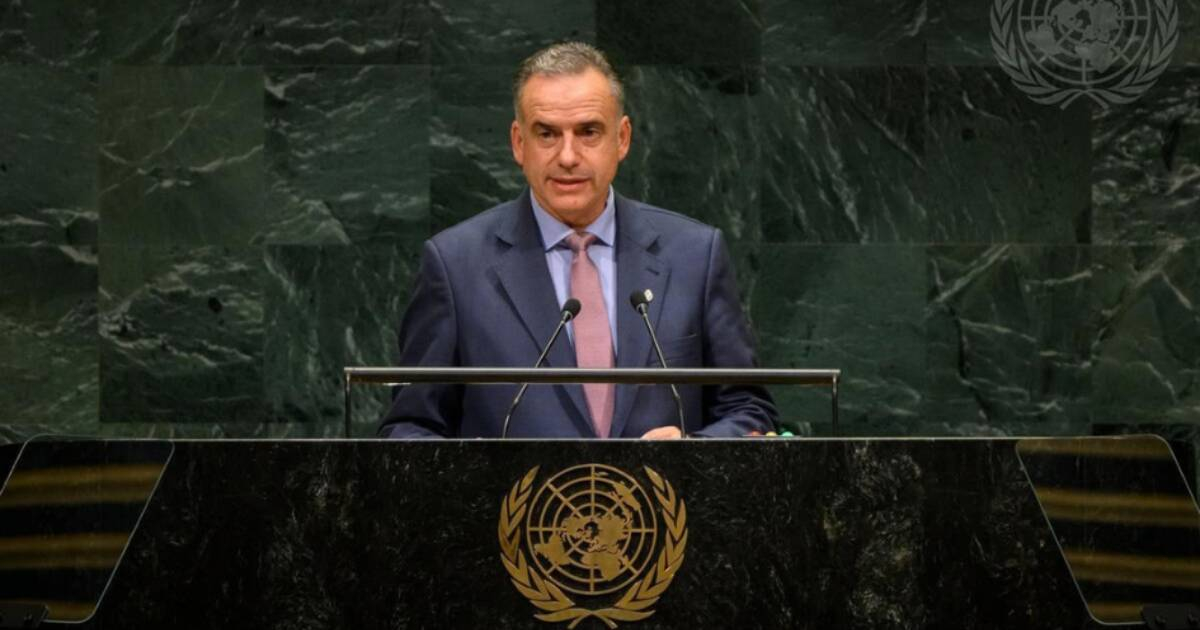
Uruguayan President Yamandú Orsi has addressed the backlash he received after highlighting the "rigid economic blockade" against Cuba at the United Nations without explicitly condemning the Havana regime. He argues that his general mention of "tyrannies" was a clear indication of his stance.
“I didn’t really talk much about Cuba. I didn’t talk about Cuba,” Orsi stated on Saturday following his return from New York, where he attended the 81st session of the UN General Assembly, as reported by Teledoce.
The president clarified that while he used Cuba as an example when discussing economic blockades, he refrained from directly assessing the island’s political system.
“I referred to not-so-good signals, such as terrorism, wars, extreme inequality, and strict economic blockades like the example of Cuba, but I did not discuss the Cuban regime,” he explained.
Orsi's Subtle Criticism of Tyrannies
Orsi also reminded that during his address, he mentioned the “pain caused by tyrannies,” believing that his statement was sufficiently explicit.
“Sometimes there's no need to be so explicit and say: I like this government, I don’t like that one,” he remarked before concluding, “A word to the wise is sufficient.”
The controversy arose following Orsi’s Thursday speech at the UN, where he included Cuba in a list of international situations that, in his opinion, cause suffering.
“We cannot be indifferent to the pain of an endless state of war; the fear and pain generated by organized crime; the constant threat of terrorism; the repression arising from tyranny or the suffering caused by the strict economic blockade like the one endured by the Cuban people,” he expressed.
Internal Political Tensions in Uruguay
Despite the consecutive mention of "tyranny" and Cuba, Orsi did not explicitly label the Cuban regime as a tyranny during his address.
His remarks drew criticism from Álvaro Delgado, president of the National Party board, who recalled that Orsi had previously consulted Uruguayan parties about his UN address content.
According to Delgado, the opposition had emphasized the need to “speak clearly about democracy and free elections in Cuba, Nicaragua, and Venezuela.”
“Yesterday, Nicaragua and Venezuela were not mentioned, and regarding Cuba, he chose to discuss the blockade,” criticized the opposition leader, accusing Orsi of delivering “many internal messages and very little state policy.”
This discussion highlights the differing views within Uruguay regarding policy toward Havana and contrasts with the stance of former President Luis Lacalle Pou (2020-2025).
Before leaving office in 2025, Lacalle Pou blocked invitations to the governments of Cuba, Venezuela, and Nicaragua for Orsi’s inauguration, despite the incoming government’s intention to invite all countries with which Uruguay had diplomatic relations.
Lacalle Pou openly labeled Cuba as a “dictatorship” and, in 2021, engaged in a memorable confrontation with Miguel Díaz-Canel during a CELAC summit, citing lines from “Patria y Vida” and referencing Cubans who felt oppressed by their government.
Uruguay's Political Dynamics on Cuba
Since Orsi took office, the Frente Amplio has maintained a different position. In May, the ruling coalition issued a statement defending Cuban sovereignty against statements from U.S. President Donald Trump. Months earlier, its 17 senators supported a motion against U.S. restrictions on fuel supply to Cuba.
This stance has also drawn criticism from members of the Cuban community in Uruguay. Doctor and activist Daycee Zamora publicly questioned the Frente Amplio in May for avoiding labeling the Cuban regime as a dictatorship, while Leydis Aguilera, the first Cuban-born deputy in the Uruguayan Parliament and a National Party member, has urged the government to take a firmer stance on human rights in the island.
Orsi, however, reiterated on Saturday that his policy does not involve publicly endorsing or rejecting governments.
“I don't usually get involved in describing or analyzing how one government functions compared to another,” he stated, emphasizing that the defense of freedom was repeatedly present in his UN address.
Understanding Uruguay's Position on Cuba
Why did Orsi's remarks at the UN spark controversy?
Orsi's comments sparked controversy because he mentioned the economic blockade against Cuba without explicitly condemning the Cuban regime, which some believed was a necessary statement regarding tyranny and human rights.
What has been the Frente Amplio's stance on Cuba?
The Frente Amplio has taken a stance that defends Cuban sovereignty against external criticism, including statements from U.S. officials, and has opposed U.S. restrictions on Cuba.