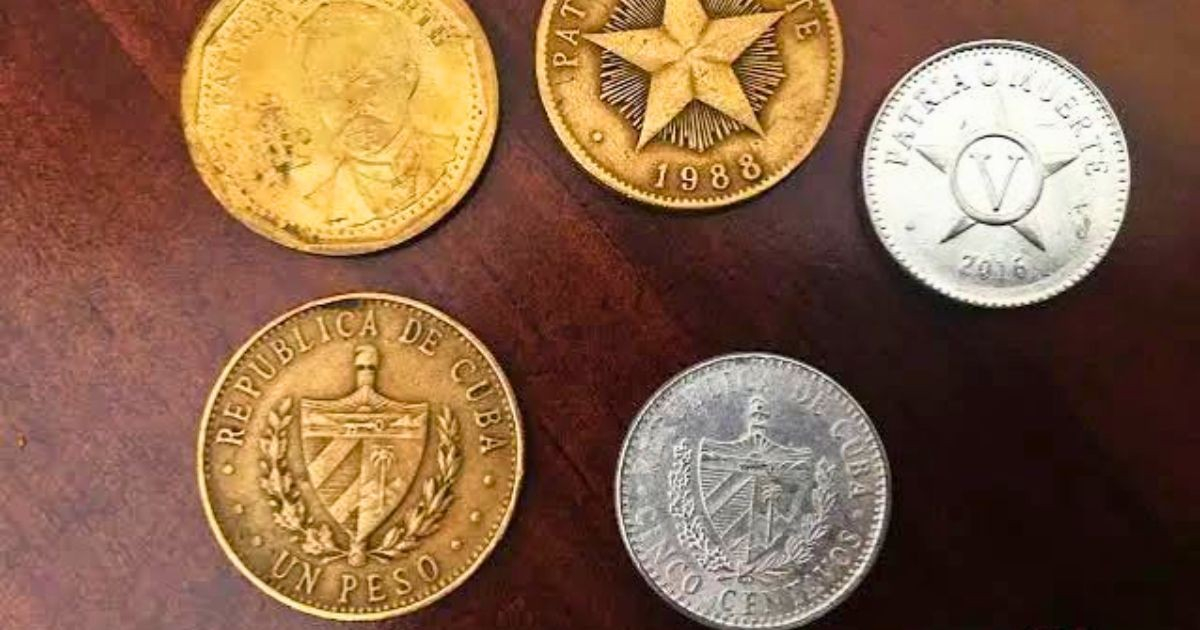
A compelling list of nine words, shared on Facebook this Sunday by Camagüey-born writer and journalist María Antonia Borroto Trujillo, captures, with linguistic precision and a touch of humor, the collapse of the purchasing power of the Cuban peso. The list reads: “Change (as a noun), Small Coins, Peseta, Half (as a noun), Peso Macho, Coin, Kilo, Dark Kilo… Cheap.”
Accompanied by a photograph of Cuban coins, the post quickly resonated with Cubans, who saw in these words a stark depiction of an economy where such terms have lost all real-world relevance.
The Historical Context of Monetary Terms
Each of these words is deeply rooted in the island's monetary and linguistic history. The "peseta" referred to the traditional 20-cent denomination, a term inherited from old Spanish monetary language that once thrived in Cuba. The "half," meaning five cents, retained the memory of the half-real from the former monetary system. "Small coins," a term with a long-standing Spanish tradition, now almost archaic in Cuba, was a generic term for minor or low-value coins.
In Cuban vernacular, the "kilo" or "quilo" became synonymous with a cent, while the "dark kilo" originally referred to the U.S. copper cent that circulated on the island, colloquially linked to an insignificant sum of money. Lastly, the "peso macho" was a popular name for the Cuban one-peso coins minted in the early years of the republican monetary system.
Inflation's Erosive Impact
As inflation eroded the value of peso fractions, these terms fell out of common use, a process accelerated dramatically by the "Tarea Ordenamiento," a currency reform that began on January 1, 2021. This reform eliminated the CUC, leaving the CUP as the only legal tender, sparking an inflationary spiral that by 2026 reached historic levels.
The University of Havana’s Center for the Study of the Cuban Economy (CEEC) reported that annual inflation in Cuba hit 25.19% in August 2026, with food and non-alcoholic beverages prices soaring by 36.01% in the same period. Independent economists estimate that the real inflation rate, including the informal market, is substantially higher.
Current Economic Challenges
On September 16, the Central Bank of Cuba introduced 10,000 and 20,000 peso bills, the highest denominations in the country's history, while the informal market saw the dollar exceed 700 pesos. Economist Pedro Monreal cautioned that this currency issuance signifies "chronic inflation, monetary duality, or a dollarized circuit, not a payment system anchored in labor."
The everyday reality of this economic deterioration is evident in prices: one pound of chicken sells for 800 pesos in Havana’s MiPYMES, a bag of milk costs up to 6,500 pesos in Matanzas, and a bottle of oil ranges from 3,800 to 4,000 pesos, with peaks reaching 7,000.
Meanwhile, the minimum wage remains at 3,210 pesos per month, and the cost of living for a small family in Havana, according to a local's calculations, exceeds 205,000 pesos monthly. In this context, speaking of "pesetas," "halves," or "small coins" is to refer to values so negligible that they have vanished from everyday conversation.
Social Commentary Through Literature
Borroto Trujillo, a Doctor in Communication Sciences and member of the Union of Writers and Artists of Cuba (UNEAC), has become a recurrent voice on Cuban social media throughout 2026. On July 31, she published an ironic "basic manual" on how to call the Electric Company without suffering a heart attack, and in August, she recounted the effects of seven days without electricity with the same mix of literary irony and direct criticism that characterizes her writing.
The concluding word in her list—“cheap”—perhaps delivers the sharpest blow: it isn't just a monetary term that’s fallen out of use, but a summary of a reality that Cubans no longer recognize.
Understanding Cuba's Economic Crisis
What is the "Tarea Ordenamiento" in Cuba?
The "Tarea Ordenamiento" is a currency reform initiated on January 1, 2021, which eliminated the CUC and left the CUP as the only legal currency, leading to a significant inflationary spiral.
How has inflation affected the value of the Cuban peso?
Inflation has severely eroded the purchasing power of the Cuban peso, rendering many traditional monetary terms obsolete as the value of smaller denominations has become negligible.
What are the implications of the new high-denomination bills in Cuba?
The introduction of 10,000 and 20,000 peso bills reflects chronic inflation and suggests a dual or dollarized monetary circuit rather than a stable payment system.