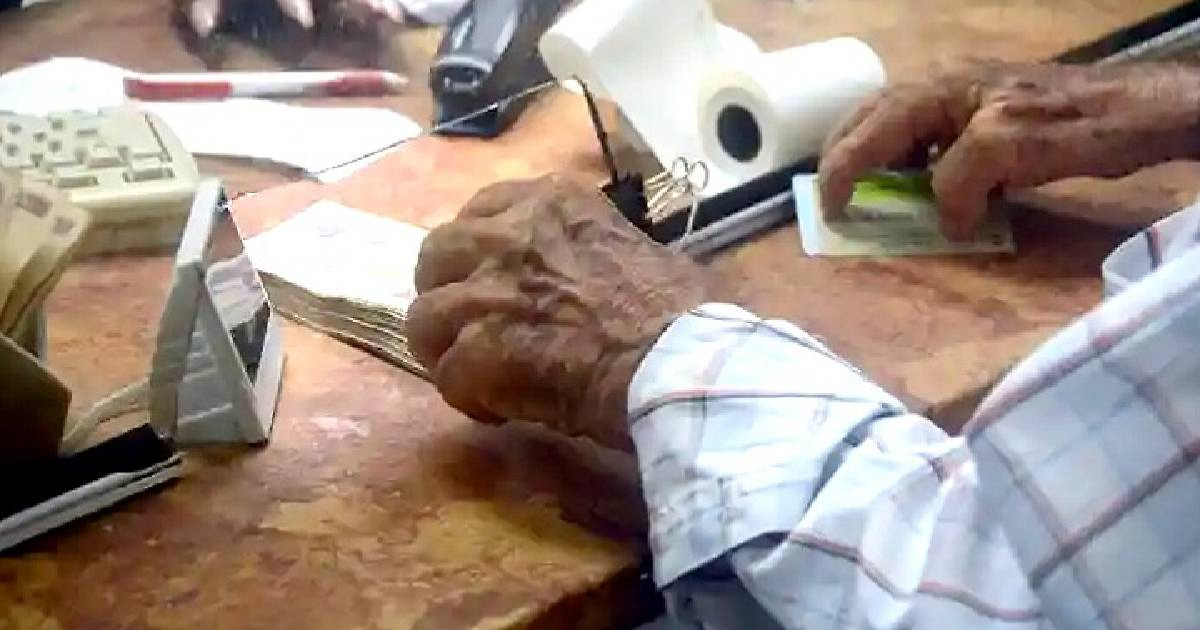
The administration in Guantanamo has executed 1,056 agreements with economic entities to disburse pensions in cash to 18,344 retirees, accounting for 37% of the province's pensioners, as confirmed by the official newspaper Venceremos on Sunday.
This arrangement is part of the eighth pillar of the 176 economic and social reforms sanctioned nationwide and was formalized through the Central Bank of Cuba's Resolution 74/2026. Rather than visiting a bank branch, retirees now collect their payments from the designated economic actor.
The framework extends to self-employed workers, micro, small, and medium enterprises (MSMEs), cooperatives, and state entities. These entities receive a payroll listing the beneficiaries and their respective amounts, execute the payments, and have 72 hours to submit the paperwork to the bank for reimbursement, the source elaborated.
On average, each retiree in Guantanamo receives 3,256 pesos monthly. This amount falls short of the national minimum of 4,000 pesos and, according to various economists, is inadequate against the basic basket cost, which is estimated at over 50,000 pesos.
Oscar Mendoza Pérez, head of Guantanamo’s Work and Social Security Directorate, portrayed the shift of this responsibility as advantageous for pensioners, relieving them from enduring long lines at banks.
Mendoza acknowledged that pensioners will no longer need "to wait for hours in lines, under the sun, sometimes from the night before, as has happened for years," to collect their pensions.
The MSMEs with the highest earnings have mainly undertaken the payments, especially in the Guantanamo municipality, where this initiative has been in place for two months following the Central Bank's directive.
Significant progress is noted in Imías, Niceto Pérez, Caimanera, and El Salvador, while other municipalities show coverage levels between 11% and 36%, the media detailed.
This payment transition coincides with liquidity challenges faced by the Banco de Crédito y Comercio (Bandec) in Guantanamo. The institution requires daily receipts of nearly 15 million pesos but manages to collect just over 34% of this target, a situation that, as Venceremos acknowledged in July, has evolved from a mere banking issue to a broader social concern.
Nevertheless, three years into the bancarization process, over 31,000 retirees in Guantanamo, representing 63% of the nearly 50,000 total, still rely on bank counters for their payments, while more than 18,000 use postal agencies, a method that continues even through postal agents in remote areas.
Cuban economist Elías Amor cautioned about the pitfalls of this model and described it as "madness," arguing that pension payments "are a state responsibility that cannot be transferred to the private sector," highlighting risks of liquidity issues, delays in reimbursement, and bureaucratic burdens on participating businesses.
Understanding the Pension Payment Shift in Guantanamo
Why did Guantanamo shift pension payments to economic actors?
The shift is part of national economic and social reforms aimed at relieving bank congestion and providing a more efficient payment process for retirees.
What are the potential risks of this new pension payment model?
The model poses liquidity risks, possible delays in reimbursement, and additional bureaucratic demands on the private entities involved in the process.
How has the pension payment change affected retirees in Guantanamo?
Retirees are now spared from long waits at banks, as their pensions are distributed by designated economic actors, though the payments remain below the national minimum.