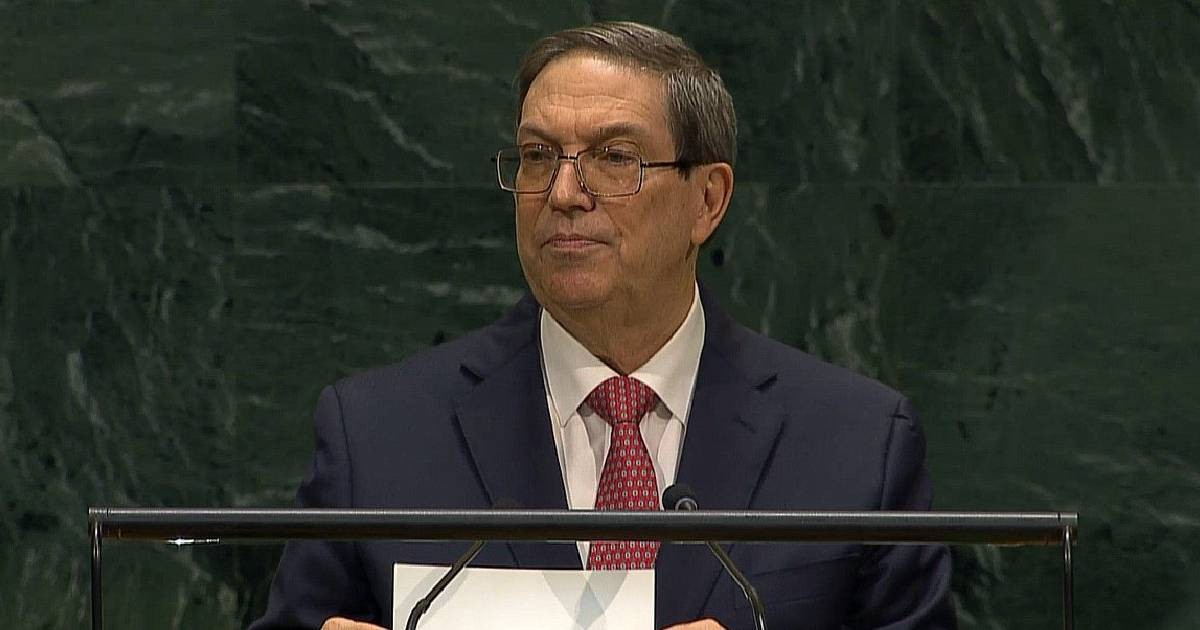
In a recent address to the United Nations General Assembly in New York, Cuban Foreign Minister Bruno Rodríguez Parrilla announced that Cuba is prepared to engage in trade and business relations with American companies. At the same time, he criticized Washington's stringent policies towards the island nation.
Rodríguez's remarks were part of the general debate at the 81st session, happening just days after former President Donald Trump labeled Cuba as a "completely failed state" from the same platform, predicting a future of freedom for the island—a statement that prompted the Cuban delegation to leave the assembly room.
Addressing these comments, Rodríguez posed a rhetorical question: "The President of the United States recently declared here that Cuba is a failed state. If that were true, why then impose a fuel blockade, implement secondary sanctions, or resort to threats, persecution, and pressure on every state globally?"
The Cuban diplomat denounced Washington's actions as "collective punishment" and a "crime" under International Humanitarian Law. He likened the energy restrictions imposed since January 2026 to a "naval blockade," an act defined in international law as an act of war.
Rodríguez claimed that over 7,000 containers with food, medicine, and medical devices have been halted in various countries' ports due to U.S. pressures, affecting shipments contracted by Cuban private enterprises.
He also accused the U.S. State Department of convening a meeting last Thursday with nations receiving Cuban medical services, aiming to dissuade them from continuing such cooperation while the General Assembly was in session.
In his address, Rodríguez referenced Secretary of State Marco Rubio to illustrate the extent of Washington's strategy: "As explained by the Secretary of State, the official U.S. policy is to close off every valve, exit, or survival strategy for Cuba."
He also recalled a prior statement by President Trump suggesting that "all that's left is to go in and destroy the place," warning that any military action against Cuba would be a "serious crime."
Contrasting Positions on Economic Relations
The Cuban regime's open call for commercial engagement sharply contrasts with Rubio's stance, who at the UN argued against investing in Cuba under the current regime. He emphasized that the embargo is not the primary cause of the island's energy crisis.
This crisis has worsened throughout 2026, with the regime blaming U.S. sanctions for reducing fuel imports by 80% to 90%, leading to electricity generation deficits exceeding 2,000 MW and frequent total disconnections of the national grid.
Rodríguez's speech coincides with mixed signals from Washington. On the same Saturday, Trump told reporters that "Cuba and the U.S. will make a deal," dismissing the need for military intervention, according to reports from Al Jazeera.
Since March 2026, the Cuban government has been trying to attract investment from American companies in sectors like tourism, mining, energy, and oil exploration, as European hotel chains begin to withdraw from the island due to sanction pressures.
This public gesture at the UN is the most overt expression of that strategy, although any actual trade agreements would still require the U.S. to negotiate "on equal sovereign terms and without preconditions," according to Rodríguez.
Key Questions about Cuba's Trade Relations
What is Cuba's stance on trade with the United States?
Cuba has expressed openness to establishing trade and business relationships with American companies, provided the negotiations occur on equal terms without preconditions.
How has the U.S. responded to Cuba's offer for trade?
The U.S. response has been mixed, with some officials remaining critical of investment under the current Cuban regime, while others, like Donald Trump, have hinted at potential deals without military intervention.
What impact have U.S. sanctions had on Cuba?
According to Cuban officials, U.S. sanctions have significantly reduced fuel imports, exacerbating the island's energy crisis and causing substantial electricity shortages.