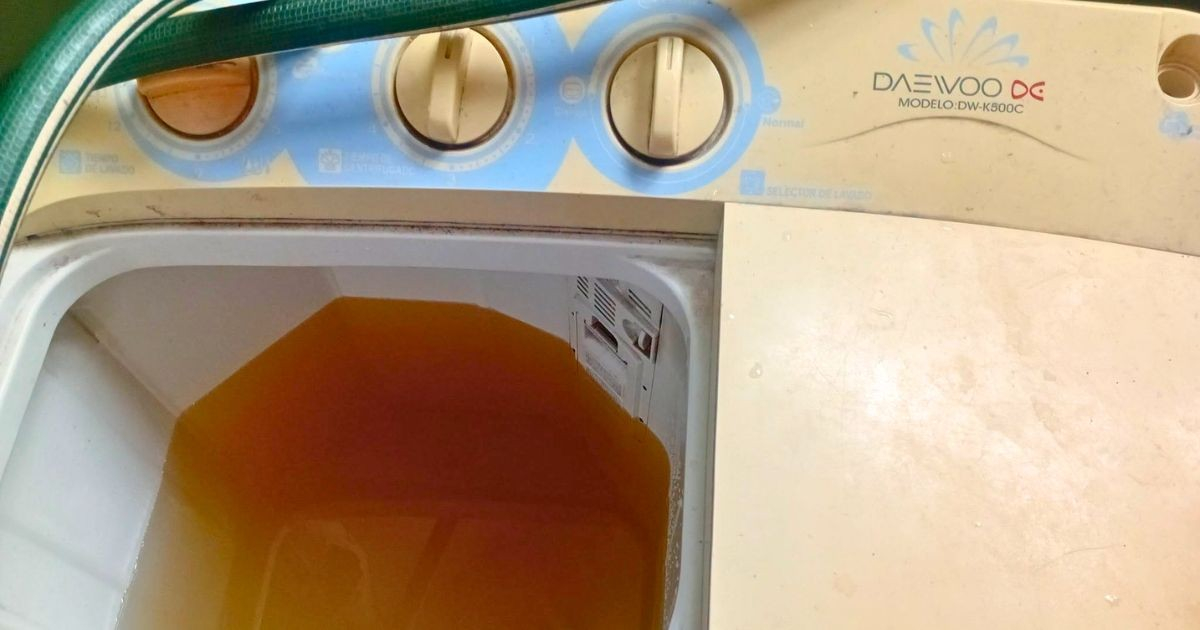
A Cuban woman named Verónica C. Barrios shared a poignant reflection on Facebook this past Friday that quickly resonated with her fellow Cubans. She drew a powerful analogy between the state of her aged Daewoo washing machine and the condition of Cuba, accompanied by a photo showing the appliance's tub filled with murky brown water, representative of what flowed from the tap before she even began the wash cycle.
Barrios paints a vivid picture of her washing machine, using imagery that every Cuban might find familiar in their own lives: "My washing machine is old, tired, and battered. Years of use, the knocks it's taken, and the countless times I've dragged it around the house to reposition it have taken a toll on its structure. It barely washes anymore. To get it to agitate the clothes, I have to stick my arm in and spin and spin until my shoulder aches."
The transition from domestic woes to political commentary is seamless: "My country is like my washing machine and me—exhausted from spinning in circles, battered, pushed around, worn out, on the brink of collapse, and most of all, utterly fed up with dirty water," she writes, clarifying in parentheses that she's speaking metaphorically about the water.
However, the accompanying photo ensures her complaint is both literal and symbolic. "The photo shows the water that came out of the tap when I started to fill the washing machine to wash, and I hadn't washed anything yet," Barrios clarifies, emphasizing that the brown liquid is not a result of the washing process but the actual water supply.
She preempts any calls for resignation with a firm rejection: "And to the complainers who say I should be grateful to have even that much water, spare me the whining. I'm not in the mood for such nonsense." Her post concludes with hashtags like #SOSCuba, #Cubaagoniza, #cubaduele, #Basta, #Váyanse, and #libertad.
Barrios' account is far from unique. The water crisis in Cuba has reached alarming levels, partially acknowledged even by the authorities. According to official data released in May, about 2.7 million people lacked regular access to safe drinking water, while millions more received sporadic service. In Havana, by July, over half a million residents faced disruptions in water supply.
The connection between power outages and water shortages is deeply entrenched: Cuban officials have admitted that over 80% of the pumping system relies on the electrical grid, meaning every blackout—of which there were at least eight total blackouts in 2026—also halts the water supply.
The water quality that sporadically reaches homes is yet another facet of the crisis. In Camagüey, images from April depicted brown, muddy water flowing directly from aqueduct taps. In Cienfuegos, residents reported water contaminated with larvae, red worms, and abundant dirt in August. In Boyeros, over 40,000 people have been severely affected since January.
The frustration articulated by Barrios is backed by stark statistics. Extreme poverty now impacts 94% of Cubans, with eight out of ten individuals having to skip meals due to lack of money or food, according to the IX Report on the State of Social Rights in Cuba, developed by the Observatorio Cubano de Derechos Humanos (OCDH) and the Observatorio de Derechos Sociales Cuba.
The metaphor of the old washing machine, pushed to its limits and weary of dirty water, brutally encapsulates the daily reality for millions of Cubans living under a dictatorship that has persisted for nearly seven decades.
Understanding Cuba's Current Crisis
What is the current state of the water crisis in Cuba?
As of 2026, Cuba is experiencing severe water shortages, with 2.7 million people lacking regular access to potable water and millions more receiving intermittent service. The crisis is exacerbated by frequent power outages that halt water pumping operations.
How do power outages affect water supply in Cuba?
Over 80% of Cuba's water pumping systems depend on the electrical grid. Thus, power outages, of which there were at least eight total blackouts in 2026, directly interrupt the water supply, leaving many without access.
What are the implications of the water quality issues in Cuba?
Water quality issues in Cuba contribute to the broader crisis, with reports of brown, muddy water and contamination with larvae and worms. These conditions pose significant health risks and exacerbate the daily struggles of affected communities.