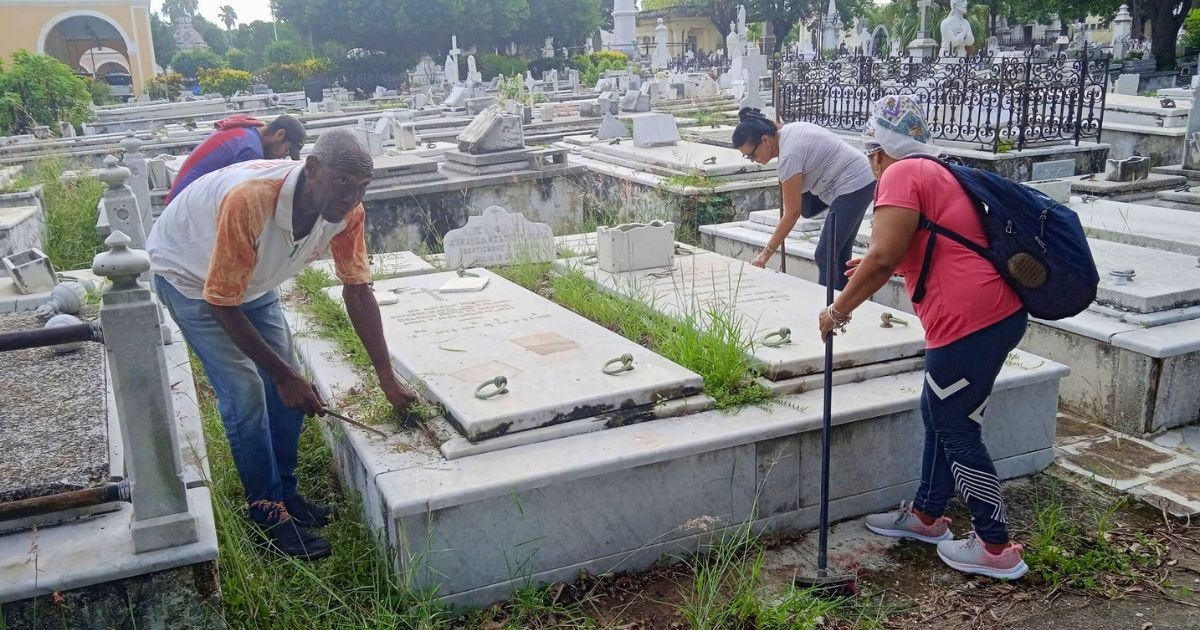
This past Friday, representatives from the Cuban Book Institute (ICL) arrived at Havana's Colón Cemetery to commence a cleanup initiative aimed at the gravesites of Cuban writers. This effort, involving clearing overgrown areas, will occur every Friday throughout September and October.
The Cristóbal Colón Necropolis confirmed that the event was spearheaded by Niurka Eligio de la Fuente, the ICL's deputy director. The list of gravesites to be maintained includes 49 distinguished Cuban "writers of all genres, and poets," curiously distinguishing poetry from other writing forms.
During the inaugural session, the graves of Laura Muestre Hevia, José Lezama Lima, Julián del Casal, Dulce María Loynaz, Renée Méndez Capote, and Onelio Jorge Cardoso were tended to, with museum curator Ricardo Rafael Díaz Murgas guiding the process.
The Cuban state apparatus, historically known for neglecting, poorly treating, censoring, or outright persecuting its artists and writers, appeared with machetes and gloves for this posthumous gesture of goodwill. A reconciliation of sorts, though the deceased cannot express their opinions on the matter.
Lezama Lima's situation is particularly telling of the regime's belated magnanimity. His novel Paradiso, published in 1966, was swiftly removed from Cuban bookstores after being labeled "pornographic" by cultural authorities. From 1971, during the oppressive "Grey Period," he lived in official isolation until his passing in August 1976.
Commemorating his legacy, Miami recently hosted a packed screening of Ernesto Fundora's documentary "Lezama Lima: Let the Tongue Loose" at the Coral Gables Museum, marking the 50th anniversary of his death and 60 years since Paradiso's release. Meanwhile, Havana opted for weed removal.
Dulce María Loynaz's experience is equally telling. Despite being ostracized for decades, her Cervantes Prize in 1992—making her the first Latin American woman to receive it—was proposed by Mexico, not Cuba, as Cuban-Mexican scholar Alejandro González Acosta noted. Cuba's official candidate was Eliseo Diego.
González Acosta also recalled that during the 1980 Mariel boatlift, Loynaz's home was attacked by CDR-affiliated neighbors, who threw stones and eggs. Now, the government sends its staff to trim the grass around her grave.
The cemetery's neglect is no secret. In November 2024, journalist Carlos Herrera Rodríguez exposed the state of disrepair, and a month later, journalist Yasel Porto discovered vandalized tombs and exposed bones while visiting his grandmother's grave.
By April 2026, the cemetery reflected years of neglect, with human remains mixed with debris, as reported by journalist Camila Acosta. However, just months earlier, in November 2025, the regime had once again staged a well-publicized cleanup as part of an institutional image campaign, yielding equally fleeting results.
The ICL's initiative is part of a well-established tradition of sporadic cleanups touted as grand gestures, without providing ongoing care for a site designated a national monument. These efforts will continue every Friday until the end of October, ample time for the resilient weeds to make their return.
Understanding the Colón Cemetery Cleanup Efforts
Why is the Cuban Book Institute involved in cleaning Colón Cemetery?
The Cuban Book Institute has initiated a cleanup at Colón Cemetery as part of a campaign to maintain the gravesites of notable Cuban writers and poets. This action is intended to honor their legacies, despite the historical neglect these figures faced during their lifetimes.
How often will the cleanup efforts at Colón Cemetery take place?
The cleanup efforts by the Cuban Book Institute are scheduled to occur every Friday throughout the months of September and October.
What is the significance of José Lezama Lima’s novel Paradiso in Cuban history?
Paradiso, published in 1966, is a significant work by José Lezama Lima that was banned shortly after its release by Cuban authorities, who deemed it "pornographic." This reflects the cultural repression during the "Grey Period" in Cuba.