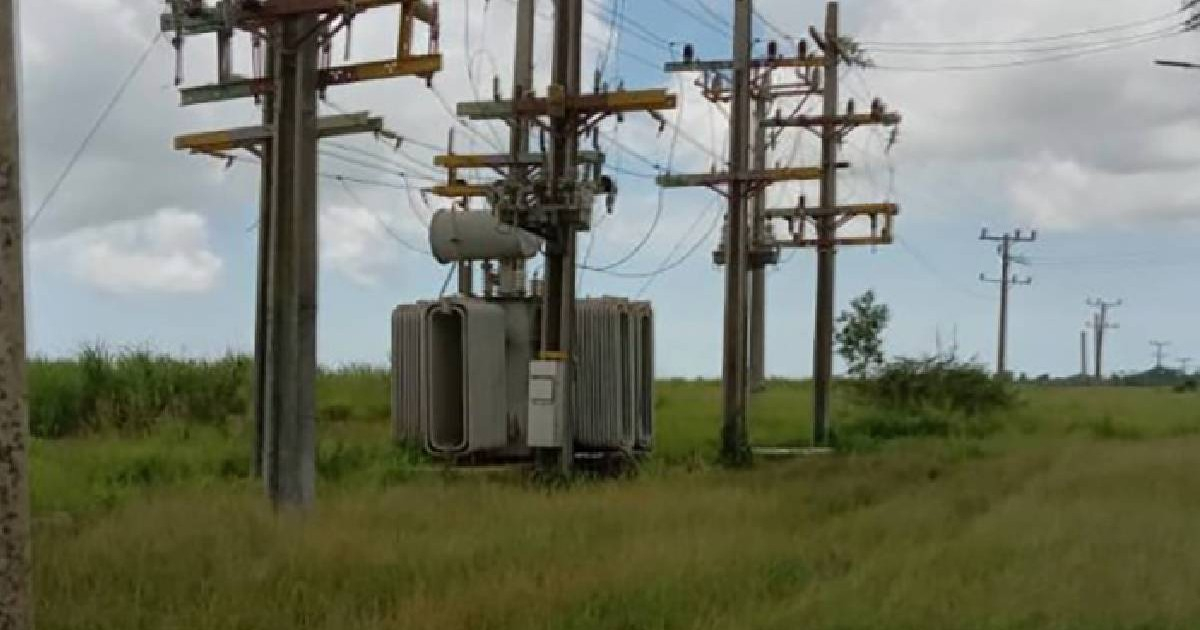
The Provincial Prosecutor's Office in Artemisa has initiated a preliminary investigation into suspected sabotage involving two individuals accused of stealing dielectric oil from an electrical transformer in the municipality of Bauta. This act left local residents and state entities without power.
The case, reported this Thursday by the weekly El Artemiseño and the Cuban News Agency, is currently being handled by the Artemisa Unit for Crimes Against State Security. Both suspects have been placed in provisional detention as a precautionary measure.
One of the accused is reportedly an employee of the Havana electricity sector who allegedly used a work-assigned vehicle to carry out the theft. This not only exacerbates the crime but also involves a breach of trust and misuse of privileged access to infrastructure.
Impact on Community and State Operations
The compromised transformer supplied electricity to both residential homes and state entities involved in milk collection. After power was restored, the equipment remained out of service because the dielectric oil levels were insufficient to ensure the required cooling and insulation for proper operation, according to the Prosecutor's Office.
As a result, community residents and various economic entities experienced temporary power outages.
Prosecution's Stance on Severe Punishments
Representing the Cuban state, the Prosecutor's Office has announced intentions to seek "severe criminal penalties, corresponding with the harmfulness of the investigated actions and the damage caused to the National Electric System."
Under the current Penal Code, sabotage charges carry sentences ranging from seven to 15 years of imprisonment. In aggravated cases—where significant economic harm, severe injuries, or fatalities occur—penalties can range from 10 to 30 years, life imprisonment, or even the death penalty, in accordance with articles 125 and 126 of the law.
Widespread Issue of Oil Theft in Cuba
This incident is part of a broader national trend of dielectric oil theft from transformers, which authorities are addressing with increasing severity.
As of August 2026, the Ministry of Energy and Mines reported 479 such cases across the country, with over 460 criminal investigations launched between 2025 and the first half of this year. Matanzas leads the list of affected provinces with 175 thefts resulting in the loss of more than 55,950 liters of oil. In one instance, a town in this province was left without electricity for 26 days after a theft.
The stolen oil is resold on the black market to be mixed with diesel and used as fuel in tractors, trucks, and agricultural machinery amid the island's severe fuel shortages.
Frequently Asked Questions About Oil Theft in Cuba
What penalties do those accused of sabotage in Cuba face?
Individuals charged with sabotage in Cuba can face prison sentences ranging from seven to 15 years. In severe cases, penalties may extend to 30 years, life imprisonment, or even the death penalty.
How are stolen dielectric oils used?
Stolen dielectric oils are often sold on the black market, mixed with diesel, and used as fuel for tractors, trucks, and agricultural machinery, especially during fuel shortages.
Why is Matanzas significant in the context of oil thefts?
Matanzas is notable due to having the highest number of oil theft incidents, with 175 cases reported, leading to significant power outages and economic impact.