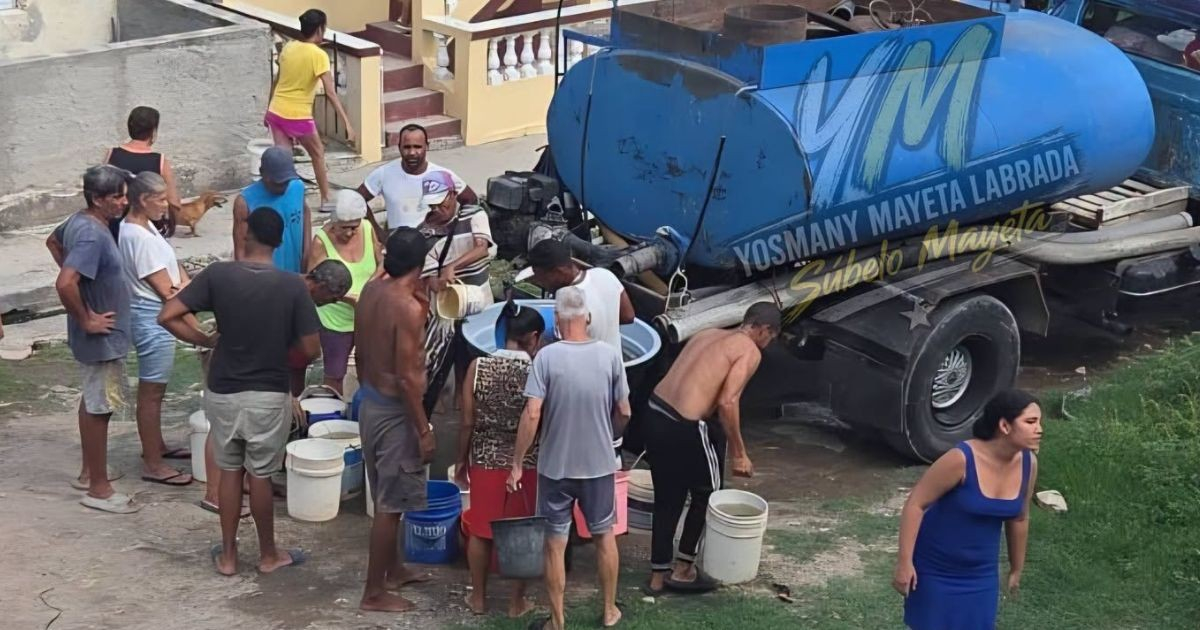
Inhabitants of Los Cocos Street in Palma Soriano, Santiago de Cuba, have reported enduring over half a year without a consistent water supply through the local networks. This dire situation has forced them to rely on water trucks and other means to secure water for their homes.
On Thursday, social communicator Yosmany Mayeta Labrada shared this plight, posting images of residents, including seniors and children, gathered around a water truck as they filled buckets and other containers.
According to Mayeta, the water truck arrived only after complaints were made by the residents to the local government, and so far, it has been the sole one sent to the area.
"After more than six months, the arrival of a single water truck cannot be considered a definitive solution," Mayeta remarked, demanding explanations for this prolonged issue and clarity on when regular service might be restored.
A local resident commented on the post, stating that local officials and representatives from the water utility were already aware of the issue and had visited the area following repeated complaints.
They were informed that the problem stemmed from a disconnection on the street and that plans were in place to open up the area with an excavator to perform necessary repairs. However, this intervention had yet to occur.
"They're still not here; we're still waiting," the resident wrote.
Other users took the opportunity to highlight similar hardships in various communities. One individual mentioned that areas like Mutilao and the buildings of La Cuba have been "months and months without a drop of water," while another noted that some regions in San Luis have been facing severe service irregularities for nearly a year.
From El Salao, known formally as the Centro Urbano Abel Santamaría in Santiago de Cuba, another comment detailed around four months of difficulties, describing disputes among neighbors over small amounts of water from a broken pipe.
Long-standing Water Supply Issues in Palma Soriano
These hardships in Los Cocos are occurring in a municipality long plagued by serious supply problems. In May 2025, the Aguas Turquino Water and Sewer Company acknowledged severe issues in Palma Soriano: the municipality was supposed to receive about 300 liters per second, but only received 150, with some areas experiencing distribution cycles exceeding 30 days.
At the time, Maricela Fernández Hernández, the entity's then-general director, attributed part of the challenges to recurring breakdowns in pump equipment and issues at sources like La Teresita and the Hatillo reservoir.
In other Santiago municipalities, such as San Luis and Songo-La Maya, cycles extended to between 70 and over 80 days.
Compounding Factors: Electrical Outages and Infrastructure Failures
The problems have persisted into 2026. In July, a failure in the main pipeline of the Northwest system drastically reduced water supply in Santiago de Cuba, affecting the flow to the Quintero I and II water treatment plants.
Electrical outages have further worsened access to water. In early September, residents of the 18-story buildings on Garzón, Santiago de Cuba, reported having to carry water from the street to upper floors because power cuts prevented the use of pumping turbines.
This situation is part of a broader water supply crisis on the island.
By the end of May, data from the National Institute of Hydraulic Resources indicated that around 2.7 million Cubans lacked daily access to regular potable water, while nearly 10 million experienced some form of intermittent supply.
At that time, the hydraulic system operated with approximately 37% of the fuel needed to keep pumping stations functional.
Understanding the Water Crisis in Santiago de Cuba
What is causing the prolonged water shortage in Palma Soriano?
The water shortage in Palma Soriano is attributed to a disconnection on the street, ongoing pump equipment failures, and insufficient water supply from key sources like La Teresita and the Hatillo reservoir.
How are residents coping with the lack of water?
Residents have been relying on water trucks, which are infrequent, and have to fill containers from these trucks to supply their homes. Some also engage in disputes over small amounts of water from broken pipes.
What broader issues contribute to Cuba's water crisis?
Cuba's water crisis is exacerbated by electrical outages, which hinder the operation of pumping systems, and by a lack of fuel needed to maintain these systems. This has resulted in millions of Cubans experiencing irregular water supply.