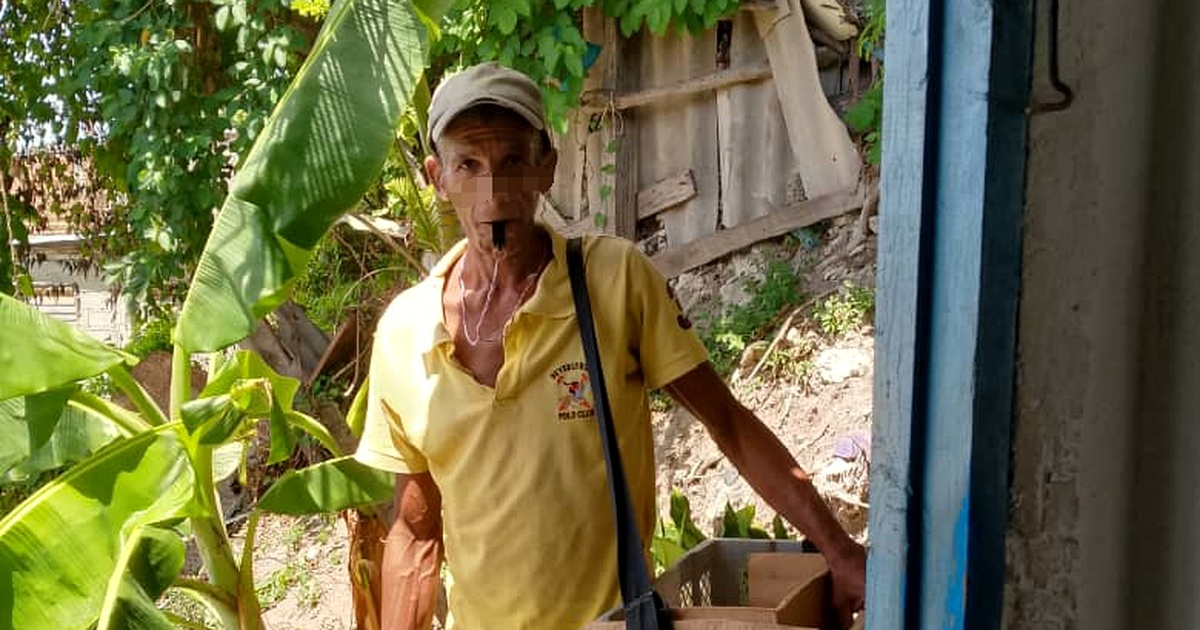
The sound doesn't originate from a weary throat but from a plastic whistle clutched between the lips. In the hills of Santiago de Cuba, the traditional street cries have been replaced by a sharp auditory signal: a whistle announcing to the neighbors that bread has arrived at their doorstep. Across his chest, Felo, a man around 55 years old, noticeably thin with a face weathered beyond his years by the relentless eastern sun and decades of survival, carries a plastic mesh cage in his left hand as he walks through the city, step by step.
This man is neither a state employee nor the owner of the flour. He is the last link in the informal distribution chain: the roaming reseller.
From Monday to Friday, he shoulders up to 180 "balls" of bread, those small round wheat flour buns that the state bakery no longer guarantees regularly. On weekends, the quota drops to 150. His entire day, from dawn until the last piece disappears from his plastic crate, is spent on foot.
The arithmetic of his livelihood is precise yet unforgiving. The supplying bakery provides each round piece for 26 to 27 Cuban pesos (CUP). On the streets, where scarcity drives prices, bread is sold individually for 35 to 40 CUP. He makes a profit of 8 to 9 pesos per piece. On a good day with 180 breads sold, his gross income hovers around 1,400 CUP.
In Cuba, where state salaries are low, earning over a thousand pesos daily might seem substantial. However, in an economy under constant devaluation, those 1,400 CUP equate to barely two dollars in the informal market. The amount is not enough to buy a bottle of oil, which costs between 3,500 and 4,500 CUP, nor a carton of eggs, which easily surpasses 2,000 pesos. With the daily profit from 180 breads, Felo can barely afford a single pound of pork to put something on the table.
To earn this subsistence wage, his legs must cover 10 to 15 kilometers daily. In Santiago de Cuba's landscape, this distance isn't measured in flat meters but in the angle of steep hills, broken sidewalks, and worn-out steps, under temperatures that reach 35 degrees in the shade.
The physical toll on his body after more than five decades is cumulative. Therefore, his immediate aspiration isn't to change professions but to save 3,000 pesos, equivalent to two full days of work, to buy a second-hand baby stroller. "Sales are poor," he admits with the resignation of someone watching both his customers' pockets and his own shrink. Adapting stroller wheels to his plastic box isn't a commercial whim; it's a biomechanical necessity to save his knees and spine. "I need to sell more to keep going," says the vendor.
His story reveals the harsh reality of Cuba's economic crisis, forced to open up to the private sector. It has returned processed flour to the streets, but the distribution logistics rest not on trucks, but on the anatomy of the most vulnerable. The bakery provides the raw materials and the oven; the informal worker provides the sweat, the shoe soles, and the joints.
Behind him, amid the banana vegetation and unpainted facades of the neighborhood, the whistle's sound echoes once more. Felo resumes his uphill climb. While the official economy grapples with figures and speeches, many Santiago families' tables still have only a piece of bread, dependent on the breath of a man walking through the crisis, uphill.
Understanding the Bread Distribution Challenges in Cuba
Why does Felo use a whistle in Santiago de Cuba?
Felo uses a whistle to signal to the neighbors that bread has arrived, replacing the traditional street cries in the hills of Santiago de Cuba.
How much profit does Felo make per bread sold?
Felo earns a profit of about 8 to 9 Cuban pesos per bread sold, depending on the street price, which ranges from 35 to 40 CUP.
What are the daily challenges faced by bread vendors like Felo?
Bread vendors like Felo face challenges such as walking long distances daily over steep and broken terrain, dealing with extreme heat, and earning wages that are insufficient for basic necessities.