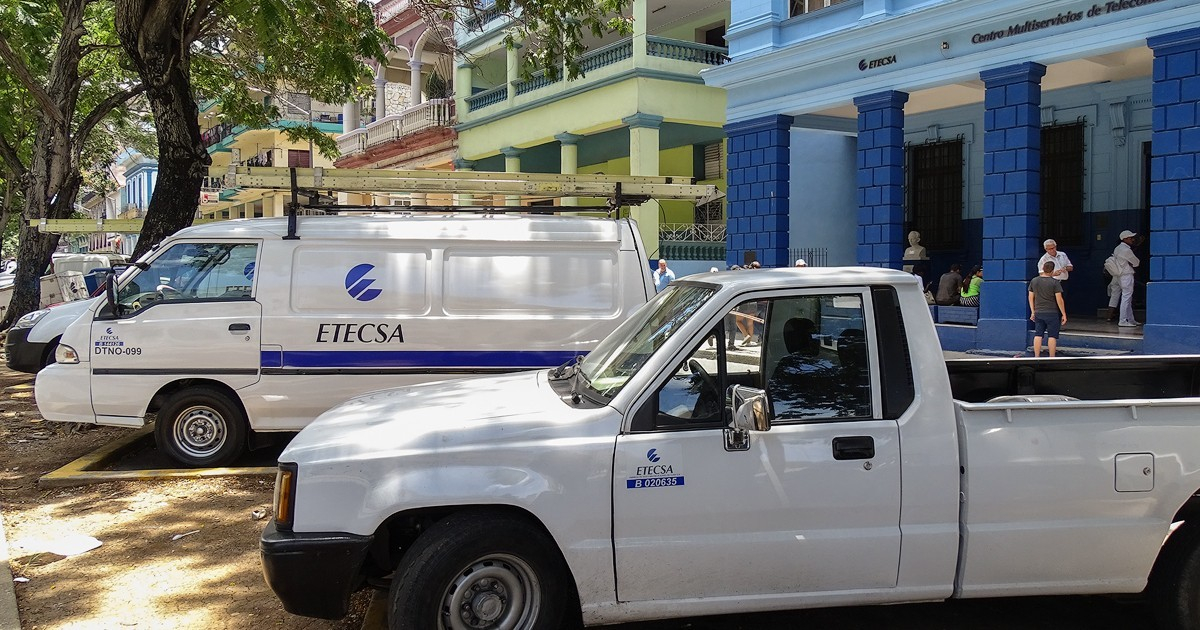
The state-run telecommunications monopoly, ETECSA, has openly acknowledged that Cuba's ongoing energy crisis is hampering its ability to expand communication infrastructure. This admission was made in an official statement on their website titled "Telecommunications in the Current Context."
ETECSA admits that power shortages are shutting down numerous technological sites, leaving entire communities without landline phones, mobile coverage, or internet access. "In recent months, the availability of mobile and fixed services has decreased, causing growing dissatisfaction among the public. This is largely due to many technological sites shutting down in the absence of electricity," the statement explains.
The most severe incident detailed in the statement was the collapse of the National Electric System (SEN), which disrupted over 80% of cell towers and nearly 70% of telecommunications cabinets, resulting in internet traffic losses of up to 58% compared to similar periods.
This total blackout, the eighth of its kind in Cuba so far in 2026, occurred on September 18 and took approximately 32 hours to restore, as reported by the Electrical Union. At that time, the available power generation was a mere 1,000 MW compared to a demand of 3,200 MW.
Challenges in Expanding Communication Networks
In light of this scenario, ETECSA was unequivocal: "It is not feasible to continue investing in expanding the access network (cell towers, cabinets, WiFi sites, etc.) if we cannot provide energy support for the telecommunications infrastructure."
The statement also highlights the company's economic woes. Landline services are unable to cover their operational costs and must be subsidized through mobile phone revenue, a situation that is no longer sustainable under current conditions. As a result, around 77,000 reports of interrupted fixed services have been blamed on resource shortages and outdated, costly technology.
Adding to these challenges are thefts and vandalism targeting infrastructure. In Santiago de Cuba, two solar panels were stolen from a telephone cabinet in the Santa Bárbara district, leaving nearly 900 users without energy backup. In the same province, between 140 and 150 ETECSA sites are out of service each day due to a lack of electricity or fuel for generators, according to Ricardo Serrano Díaz, the company's regional director, as reported by the state-run newspaper Granma.
Transition to Renewable Energy
As a structural response, ETECSA has announced a phased transition program towards photovoltaic energy. By the end of the statement, the main centers in 64 municipal capitals already had solar coverage, with more significant progress in Pinar del Río, Villa Clara, Matanzas, and Granma. However, the company concedes that the installed capacity does not always cover 24-hour needs.
The public reaction on social media was one of skepticism and frustration, partly because the announcement comes more than a year after the controversial "rate hike" in May 2025, when ETECSA limited Cuban peso recharges to 360 monthly and raised data package prices. "Is this why they raised prices last year?" questioned a Facebook user. Another was more blunt: "So, no connection because the power situation isn't improving."
Of the approximately 2,520 cell towers across the country, only half have some form of energy backup, and around 450 face mechanical failures or fuel shortages for their generators. This figure underscores the magnitude of the problem that ETECSA acknowledges but cannot resolve as long as the electrical crisis remains unsolved.
Understanding ETECSA's Challenges and Solutions
What is causing ETECSA's network expansion difficulties?
ETECSA's network expansion is hindered primarily due to the ongoing energy crisis in Cuba, which leads to frequent power outages affecting technological sites necessary for communication services.
How has the power crisis impacted telecommunications in Cuba?
The power crisis has resulted in the shutdown of numerous cell towers and telecommunications cabinets, causing significant disruptions in mobile and internet services across the country.
What steps is ETECSA taking to address its energy challenges?
ETECSA has initiated a phased transition to photovoltaic energy to provide more reliable energy support, focusing on solar coverage for key municipal centers.