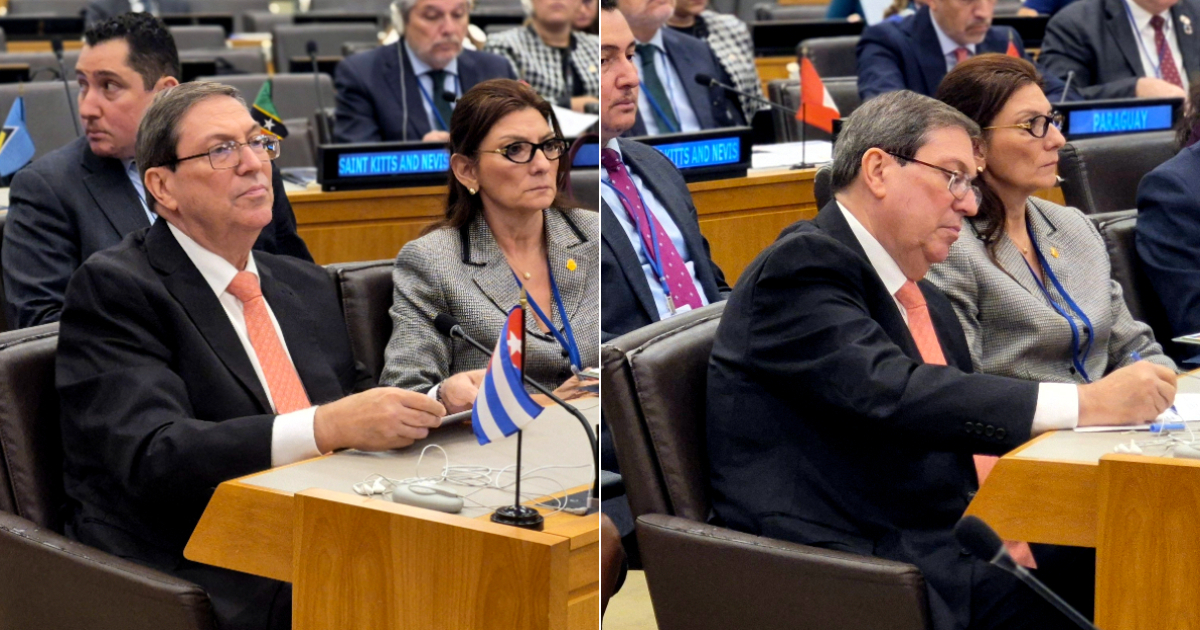
On Monday, Cuban Foreign Minister Bruno Rodríguez Parrilla addressed the United Nations, invoking the 1986 Declaration on the Right to Development. His aim was to reiterate the well-worn argument that Cuba's development is hampered by U.S. policies. However, the declaration also implicates the Cuban state itself.
During his speech at the high-level meeting convened by the General Assembly to mark the 40th anniversary of the declaration, Rodríguez criticized what he described as an "unjust by design" international economic order. He spoke of "dependency," "exploitation," sanctions, and the U.S. embargo.
The Cuban foreign minister essentially blamed external forces for the nation's hardships, asserting Cuba's right to self-determination. Yet, a closer look at the document he referenced reveals a broader accountability, one that also points to the Cuban government.
The Declaration's Broader Implications
The Declaration's principles don't solely target Washington or the global economic order; they also underscore obligations within each nation. These principles place individuals at the heart of development and explicitly link it to human rights, presenting a challenging contradiction for the Cuban regime.
Article 6 of the Declaration emphasizes that "all human rights and fundamental freedoms are indivisible and interdependent," calling for equal attention to civil, political, economic, social, and cultural rights. This is particularly significant for Cuba, where the government has long showcased its questionable achievements in education and healthcare as political legitimacy, while dismissing pluralism, freedom of expression, and dissent.
Rodríguez's citation of the Declaration inadvertently highlights these contradictions. Literacy cannot replace freedom of speech. Medical access does not substitute for the right to association. Education access does not make up for political competition. The Declaration insists that social rights do not override civil and political rights.
International Responsibilities vs. Domestic Obligations
Rodríguez focused on international responsibilities, which do exist and cannot be ignored. The Declaration calls for state cooperation and the removal of international development barriers, aligning with discussions on the economic impact of U.S. sanctions on Cuba.
However, the Declaration also mandates that states take "national measures" to ensure development rights, demanding equal resource access, fair income distribution, appropriate economic and social reforms, and public participation across all spheres. This aspect challenges the Cuban government to address its own political and economic conditions.
Economic Challenges Beyond External Factors
Cuba's economic woes, exacerbated by internal policies, were absent from Rodríguez's remarks. The Economic Commission for Latin America and the Caribbean (ECLAC) predicts another contraction for Cuba in 2026, identifying it as a drag on Central America's growth.
The country's energy crisis is severe, and its tourism sector, a major investment focus, is collapsing. By the end of 2025, hotel occupancy was at a mere 18.9%, and international visitors numbered only 1.81 million. In early 2026, occupancy fell further, leading to significant job losses.
These outcomes raise questions about Cuba's production model, state planning, investment policies, and resource allocation. Recognizing U.S. sanctions' impact doesn't absolve domestic responsibilities.
Human Rights Concerns in Medical Missions
Cuba's medical service exports, often highlighted as a social achievement, face scrutiny when viewed through the lens of individual rights. In April, the Inter-American Commission on Human Rights reported severe restrictions on overseas medical workers, including document and salary retention, coercion, and forced labor conditions.
The Cuban government dismisses these claims, framing the missions as international solidarity. Yet, the issue relates directly to the Declaration: if individuals are central to development, their rights cannot be secondary to state interests.
A Declaration from a Bygone Era
The 1986 Declaration, backed by 146 votes, with the U.S. opposing and eight abstentions, is not a binding treaty but a programmatic document that has significantly influenced development concepts. Its international context was vastly different, with the Soviet Union, the Berlin Wall, and Cold War dynamics shaping global relations.
Today, with the Soviet Union dissolved and the socialist bloc gone, Russia and China operate differently from their centrally planned economies of the past. The world has changed drastically since 1986, a fact acknowledged during the Declaration's anniversary commemoration.
Rodríguez's reliance on a document from this era to explain Cuba's challenges primarily through external factors underscores a reluctance to address internal economic decisions and global transformations.
Looking Inward: A Call for Accountability
Bruno Rodríguez utilized the Right to Development to criticize U.S. actions. While the 1986 Declaration supports arguments against sanctions and economic inequalities, it also emphasizes internal state responsibilities, indivisible rights, participation, and equitable opportunity distribution.
This is where the Declaration becomes uncomfortable for Havana. If Cuba invokes this right to explain its crisis, the document demands a broader examination: not just of U.S. policies, but of Cuba's economic decisions, investment priorities, resource distribution, and political exclusion.
Forty years after 1986, this may be the Declaration's most challenging aspect for the Cuban government: it doesn't allow for demanding global accountability without also scrutinizing domestic actions.
Understanding the 1986 Declaration's Relevance to Cuba
What does the 1986 Declaration on the Right to Development entail?
The 1986 Declaration emphasizes that development is a comprehensive process involving full respect for human rights and fundamental freedoms. It highlights the indivisibility and interdependence of all human rights, requiring states to remove obstacles to development at both national and international levels.
How does the Declaration challenge the Cuban government's stance?
While the Declaration supports arguments against international sanctions, it also mandates that states ensure development rights within their borders, emphasizing individual participation and equitable opportunity. This challenges Cuba's focus solely on external factors without addressing internal political and economic issues.
Why is the Declaration considered outdated by some?
Adopted during a different geopolitical era, the Declaration reflects a world that included the Soviet Union and Cold War dynamics. Its principles remain relevant, but the historical context has shifted significantly, challenging the Cuban government's reliance on it for current issues.
What internal issues does Cuba face that the Declaration highlights?
Cuba's economic challenges, such as energy shortages and declining tourism, along with political repression and restricted freedoms, are internal issues highlighted by the Declaration's focus on comprehensive human rights and development obligations.