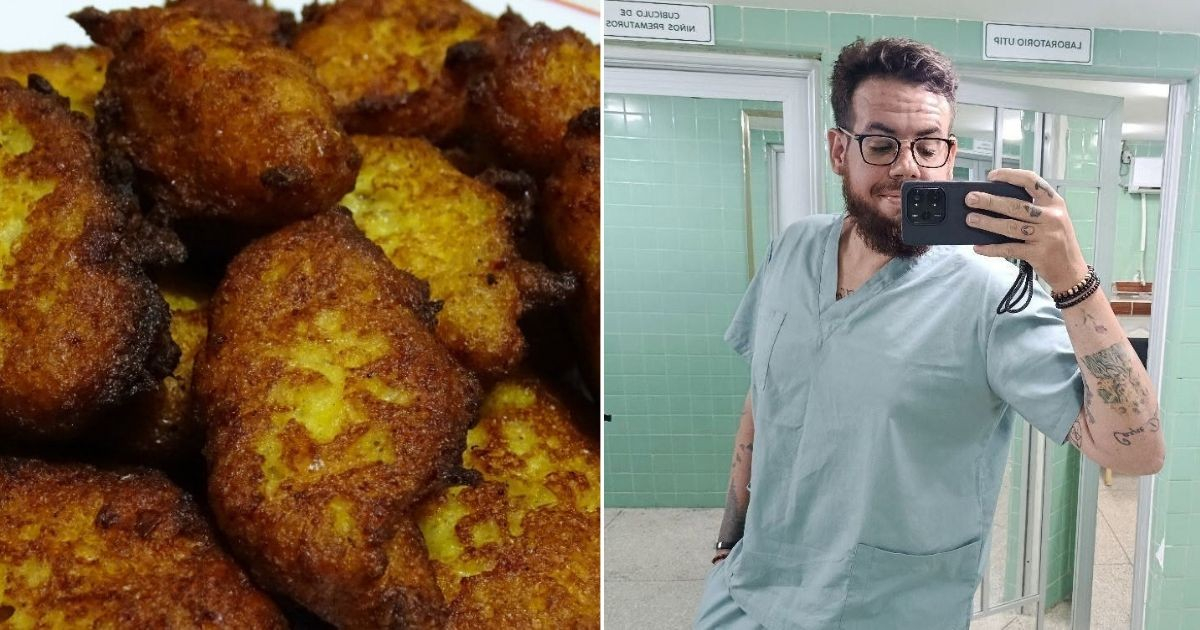
Dr. Daniel Del Toro González, a Cuban physician, turned to something as ordinary as a corn fritter to vividly illustrate the significant gap that, according to him, has developed between prices and wages in Cuba.
On Wednesday, Del Toro took to Facebook to offer what he described as a straightforward explanation of inflation "for primary school and preschool levels" by comparing the price of corn fritters before the monetary restructuring and their current cost.
"Prior to the restructuring-restructuring-restructuring again, corn fritters were priced at 1 peso... 2 at most," wrote the doctor from Las Tunas Pediatric Hospital.
He pointed out that back then, his basic salary was around 1,400 CUP. Now, he states that he earns 8,400 CUP.
In stark contrast, he noted that fritters which once cost one peso now sell for 30 CUP.
"The price of fritters multiplied by 30... and my salary by 6, roughly," he summarized.
Del Toro concluded his comparison with a pointed remark: "Do you see the difference, dear swamp catfish?" referring to the derogatory term "cyberclarias" often used for government supporters.
He further explained his choice of fritters for this comparison: "I chose to talk about fritters to avoid discussing rice, meat, or oil, which would give me a headache."
The post sparked numerous reactions from Cubans who shared their own stories about price increases.
"Well, you explained it nicely... if no one can afford a fritter, imagine a pound of meat," commented one user.
From Camagüey, another person mentioned that prices are even higher: "Doctor, here in Camagüey they cost 50, so you lowballed it... what about everything else, haha."
Another comment directly addressed healthcare workers' income: "I loved it, couldn't have said it better; we study, specialize, and still aren't paid enough."
A user added another difference from past years: "You forgot to mention that now fritters cost 30 pesos and are smaller than when they were one peso."
There were also sarcastic responses. "There might be inflation, dear doctor, but the president has a radio program and all, so Cuba is moving forward," wrote another person online.
Del Toro's comparison comes shortly after a new salary scale for Cuban doctors was implemented.
Since July, a newly graduated doctor earns a base salary of 7,045 CUP, while a first-degree specialist officially receives 8,500 CUP, and a second-degree specialist, 8,880 CUP.
Del Toro has previously turned to household calculations to highlight the erosion of healthcare professionals' purchasing power.
In August, he compared his salary as a specialist to the cost of a pack of chicken, a liter of oil, and a carton of eggs.
In that post, he concluded: "The utopia was always thinking we could live off our salary."
The doctor from Las Tunas Pediatric Hospital has also used social media to discuss the challenges faced by Cuban healthcare workers and the lack of resources available in the system.
In July, he reported that a man showed up at his home with the intent to assault him, days after he treated the man's son during a medical consultation.
Understanding Inflation and Salary Disparities in Cuba
What did Dr. Del Toro use to illustrate inflation in Cuba?
Dr. Del Toro used the price increase of corn fritters to highlight inflation, showing how fritters' prices have multiplied by 30 while salaries have only increased sixfold.
How have salaries for Cuban doctors changed recently?
As of July, a newly graduated doctor's basic salary is 7,045 CUP, while a first-degree specialist earns 8,500 CUP, and a second-degree specialist receives 8,880 CUP.
What challenges do Cuban healthcare professionals face?
Cuban healthcare professionals face challenges such as low salaries, inflation eroding purchasing power, and inadequate resources in the healthcare system.