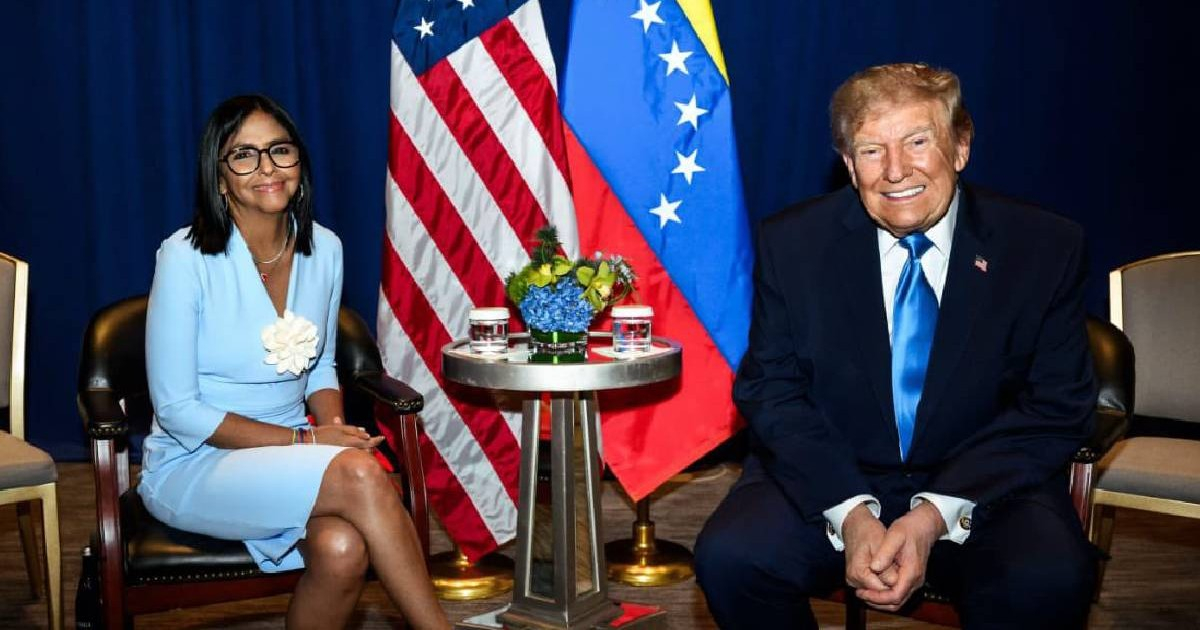
Venezuelan Foreign Minister Félix Plasencia González expressed his approval on Wednesday regarding the meeting between Venezuela's interim leader, Delcy Rodríguez, and U.S. President Donald Trump. He described the event as a turning point, potentially marking a new era in the diplomatic relations between the two nations.
Plasencia, a key member of the Venezuelan delegation, shared his thoughts on social media just hours after the leaders convened in New York, coinciding with the United Nations General Assembly.
"It was truly an honor to accompany our President at this significant meeting with President Donald Trump, which marks the beginning of a new phase in relations between Venezuela and the United States," Plasencia stated.
The gathering took place at the Lotte New York Palace Hotel in Manhattan, marking the first in-person interaction between a U.S. president and a Venezuelan leader in over a decade.
The meeting was conducted in an informal and brief manner, with no formal delegations seated or a joint press appearance.
On the American side, participants included Secretary of State Marco Rubio, Treasury Secretary Scott Bessent, Chief of Staff Susie Wiles, and Advisor Stephen Miller.
Rodríguez hailed the meeting as "historic," highlighting discussions on energy, mining, security, and bilateral cooperation.
Rubio described the encounter as "short but significant," revealing that the primary topics were Venezuela's sovereign debt restructuring, economic stabilization, and a political transition towards free and fair elections.
Plasencia emphasized that "both presidents have reaffirmed the spirit of friendship, cooperation, and respect between our countries, setting a path towards building a strong and mutually beneficial relationship for both peoples."
The foreign minister also declared that "Venezuela is solidifying its role as a fundamental pillar for the development and stability of the Americas," a statement that contrasts with Washington's conditions for full normalization, including the holding of free elections.
The rapprochement between Caracas and Washington gained momentum following the capture of Nicolás Maduro by U.S. forces on January 3, 2026, when Rodríguez assumed the interim presidency of the country.
Since then, the normalization process has progressed rapidly: Venezuela has re-established its diplomatic missions in the U.S., Washington has appointed a representative in Caracas, and in late August, a historic oil agreement was announced. This deal granted North American Blue Energy Partners rights to 17 Venezuelan oil fields with roughly 65 billion barrels of proven reserves.
Plasencia was appointed as foreign minister on July 13, 2026, by Rodríguez, following the merger of the Ministries of Foreign Affairs and Foreign Trade. Prior to this role, he served as Venezuela's diplomatic representative to the U.S., making him a pivotal figure in the thawing of bilateral relations.
The meeting did not escape criticism: Congresswoman María Elvira Salazar questioned Rodríguez's visit to the U.S. and cast doubt on her legitimacy as a representative.
However, Rubio framed the meeting as an initial step in a longer process that involves specific political conditions, including the participation of the 2015 National Assembly leaders in discussions to rebuild Venezuela's institutions before calling for elections.
Key Questions on Venezuela-U.S. Relations
What was the significance of the meeting between Trump and Delcy Rodríguez?
The meeting marked a potential new era in relations between Venezuela and the United States, as it was the first direct contact between leaders of both nations in over 11 years.
What topics were discussed during the meeting?
The discussions included energy, mining, security, and bilateral cooperation, along with Venezuela's sovereign debt restructuring, economic stabilization, and political transition towards free elections.
How has the relationship between the U.S. and Venezuela progressed since the meeting?
The relationship has seen rapid progress, including the re-establishment of diplomatic missions, the appointment of a U.S. representative in Caracas, and a significant oil agreement granting North American Blue Energy Partners rights to Venezuelan oil fields.