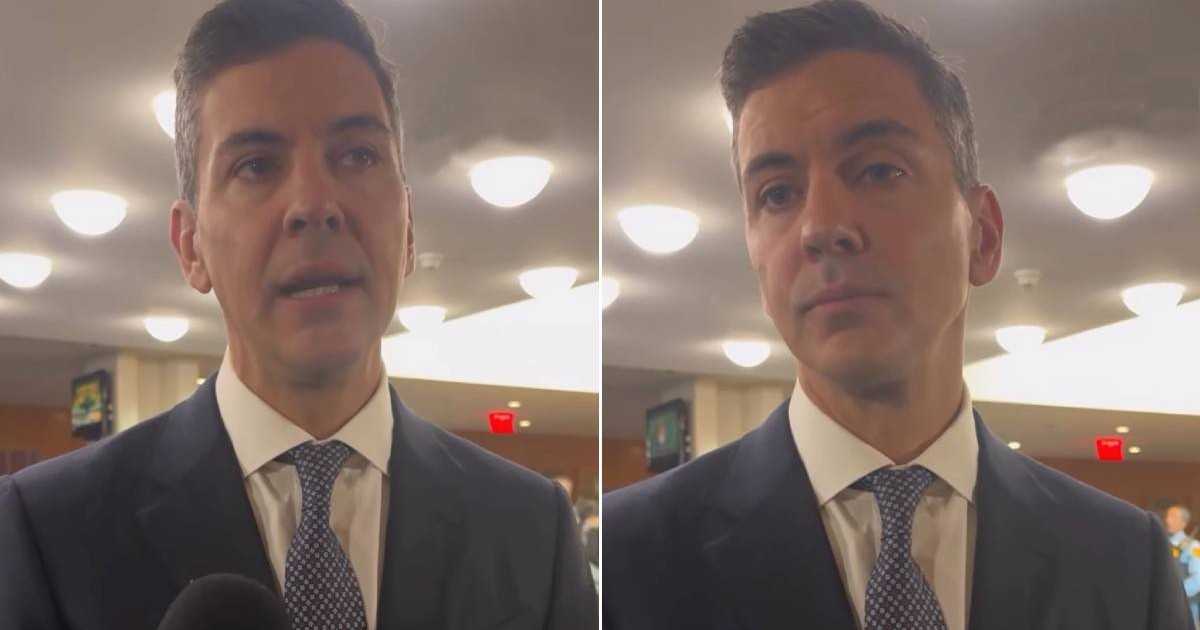
During a side event at the United Nations General Assembly in New York, Paraguay's President, Santiago Peña, called for a "democratic transition" in Cuba, Venezuela, Nicaragua, and Haiti. In an interview with Martí Noticias, he also discussed his recent visit to Caracas.
"What we desire for Venezuela—a democratic transition—is exactly what we want for Nicaragua, for Cuba, and for Haiti, as they have been suffering for too long," Peña stated.
Paraguay's Active Role in Regional Crises
Peña emphasized that Paraguay refuses to remain a passive observer in these crises. "Paraguay wants to take an active role, not just be a bystander," he declared.
The president linked his mediation offer to Paraguay's own history, having endured the dictatorship of Alfredo Stroessner for 35 years until 1989. "We believe there is now an opportunity for a transition. Paraguay experienced it 35 years ago, after a 35-year dictatorship, and we are committed, equipped, knowledgeable, and willing to assist the Venezuelan people," he added.
Diplomatic Engagement with Venezuela
Peña's comments came shortly after his trip to Caracas on September 19, where he met with Venezuela's interim president, Delcy Rodríguez, at the Miraflores Palace. This was the first high-level meeting between the two nations after nearly 20 months of diplomatic estrangement.
Speaking at the UN, Peña clarified that his visit was not to "endorse a regime," but to take a "second step" towards a political solution that would reintegrate Venezuela into the international community and MERCOSUR. Both governments agreed to enhance bilateral ties through a joint communiqué.
Venezuelan Opposition and Political Prisoners
The president also addressed the case of María Corina Machado, a Venezuelan opposition leader who has been unable to return to her country for months. On Tuesday, she attempted to re-enter from Panama on three occasions within 24 hours—once by sea and twice by air—but was unsuccessful. Her team reported at least seven failed attempts since June 2026.
"Key elements are crucial, such as the release of all political prisoners and the reopening of borders to allow returns, including María Corina's case," Peña demanded.
Call for Elections and International Stance
Regarding elections in Venezuela, the Paraguayan leader was firm: "Calling for elections is a very, very important step." He noted that setting a specific date relies on internal dialogue between the Venezuelan government and opposition parties within the National Assembly.
Paraguay has consistently criticized the regimes in Cuba, Venezuela, and Nicaragua in international forums. It voted against the annual resolution on the U.S. embargo on Cuba in October 2025 and repeated this stance at the special UN session in July 2026, alongside the United States, Argentina, and Israel, among others.
"This is going to be a complex process, with open wounds still present, and I firmly believe there is a path forward and we must move along it," concluded Peña. He also called for the next UN Secretary-General to come from Latin America and the Caribbean in his speech to the General Assembly.
Frequently Asked Questions about Paraguay's Stance on Democratic Transitions
Why does Paraguay advocate for a democratic transition in other countries?
Paraguay seeks to promote democratic transitions in countries like Cuba, Venezuela, Nicaragua, and Haiti to end prolonged suffering and establish more stable and representative governments.
What role does Paraguay intend to play in these transitions?
Paraguay aims to take an active role in mediating and supporting these countries, drawing on its own experience of transitioning from a dictatorship to a democracy.
How has Paraguay engaged with Venezuela recently?
Paraguay's President Santiago Peña recently visited Caracas to meet with the interim president of Venezuela. This marked a significant step towards renewing diplomatic relations and seeking political solutions.