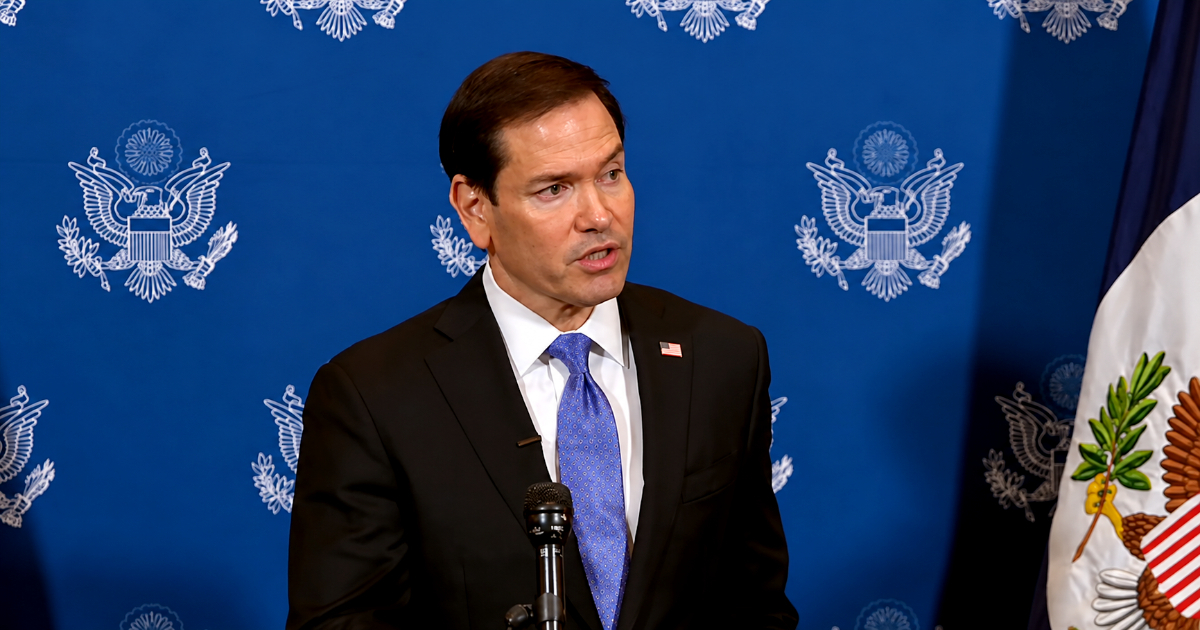
U.S. Secretary of State Marco Rubio provided insights on Wednesday into the meeting held the previous day between President Donald Trump and Venezuela's interim president, Delcy Rodríguez, characterizing it as "brief yet significant."
During a press conference, Rubio outlined the primary topics discussed: restructuring Venezuela's massive sovereign debt, achieving economic stabilization, and navigating a political transition towards free and fair elections.
This significant meeting, which took place on Tuesday at the Lotte New York Palace Hotel amidst a reception for international leaders during the UN General Assembly's High-Level Week, marked the first interaction between a U.S. president and a Venezuelan leader in over a decade, according to reports from EFE.
The White House described the encounter as informal, while Rodríguez took to social media to label it as "historic."
Rubio highlighted the dire situation in Venezuela, noting nearly two decades of economic and institutional collapse, exacerbated by a recent earthquake. He emphasized the critical need to restructure what he referred to as "probably the largest sovereign debt in the world" before any electoral process can commence.
Progressing Towards Political Change
Regarding the political transition, Rubio assured that progress is underway, with 2015 National Assembly leaders engaging in regular dialogues with interim authorities to rebuild essential institutions.
He underscored necessary preconditions such as media freedom, party reconstruction, and an electoral system with credible authorities.
Media and Political Challenges
Rubio brought attention to a significant development that has received little coverage: several independent Venezuelan media outlets, silenced for nearly seven years, have resumed broadcasting in recent weeks.
He also addressed the situation of many opposition leaders who remain abroad, stressing the need for them to reform as political movements rather than just protest groups. "It's not just about Maria Corina, who is a very courageous woman; others are also outside the country," he pointed out.
Rubio articulated the ultimate goal: "We seek not only free and fair elections but also a sustainable republic. The real threat to a lasting republic in Venezuela would be electing someone who inherits an absolute economic and social disaster."
Three-Phase Plan and Controversies
These remarks are part of Rubio's three-phase plan for Venezuela—stabilization, recovery, and transition—introduced in January 2026 after Nicolás Maduro's capture.
Nevertheless, the process is mired in controversy. In late August, Trump announced a landmark oil deal with Venezuela, granting Washington a 35% stake in 17 oil fields with estimated reserves of 65 billion barrels, facilitated through the private firm North American Blue Energy Partners.
The agreement has sparked opposition from various factions and Republican congress members who question whether Washington prioritizes oil over democratization. Maria Corina Machado expressed "sadness and anger," arguing that a regime lacking democratic legitimacy cannot commit the country's oil assets.
Rubio also reminded that there are 8 million Venezuelans living abroad who wish to return but need "confidence" that they can live, invest, and thrive in their homeland.
Understanding the Venezuelan Political Transition
What were the main topics discussed in the meeting between Trump and Rodríguez?
The meeting focused on restructuring Venezuela's sovereign debt, economic stabilization, and the political transition towards free and fair elections.
Why is restructuring Venezuela's debt considered critical?
Restructuring the debt is deemed essential to stabilize the economy and create conditions for any electoral process to begin.
What is the significance of the recent oil deal between the U.S. and Venezuela?
The oil deal, granting the U.S. a 35% stake in Venezuelan oil fields, has sparked debate over whether economic interests are being prioritized over the democratization of Venezuela.