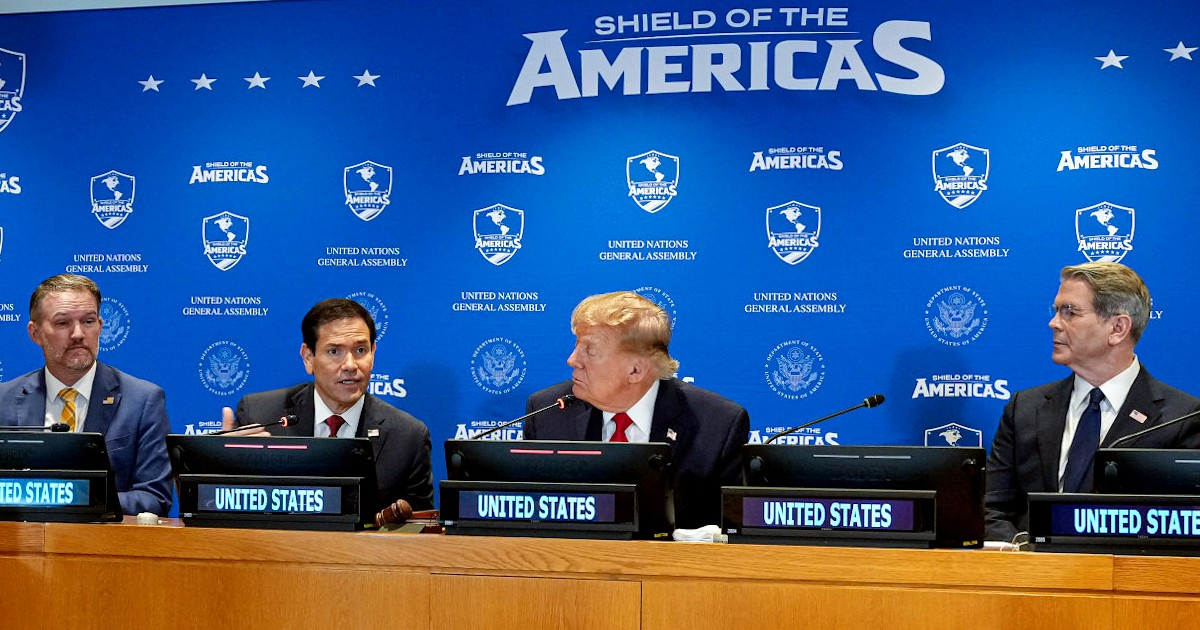
The Trump administration is actively working to create a collective justification for ramping up military actions against drug trafficking operations in Latin America and the Caribbean.
According to a report by The New York Times, officials from the State Department revealed during the United Nations General Assembly that 14 countries in the region will collectively designate 25 criminal organizations as terrorist entities.
These countries, all part of the Alliance of the Americas—a coalition of conservative governments initiated by Donald Trump—include Argentina, Bolivia, Colombia, Chile, Costa Rica, the Dominican Republic, Ecuador, El Salvador, Guyana, Honduras, Panama, Paraguay, Peru, and Trinidad and Tobago.
Peru and Paraguay have openly supported the announcement, while other governments and the State Department have yet to comment on the matter.
The Controversial Use of the Rio Treaty
The Rio Treaty of 1947, a collective defense agreement among American states, is the formal mechanism being invoked. This treaty asserts that an attack on one member is an attack on all. Applying it to non-state criminal groups, however, is legally contentious since it was originally meant for state-to-state conflicts.
In his address to the General Assembly, Trump emphasized the strategy: "Upon taking office, I designated drug cartels as foreign terrorist organizations and unleashed the United States Armed Forces to dismantle them. The cartels are the ISIS of the Western Hemisphere."
Criticism and Potential Consequences
Experts warn that this initiative may be an attempt to frame what critics perceive as Washington’s unilateral agenda as a shared regional priority, while laying the political and legal groundwork for possible military interventions.
Gimena Sánchez, director for the Andes at the Washington Office on Latin America, cautioned that these designations "could undermine national sovereignty and each country’s laws on the use of force," potentially leading to bombings that endanger civilians or expanding governments' power to target political opponents under the guise of counterterrorism.
Escalation and Military Actions
Since Trump resumed office, the State Department has added approximately 20 Latin American groups to the list of foreign terrorist organizations, including the Sinaloa Cartel, Tren de Aragua, and various Ecuadorian gangs.
Meanwhile, the U.S. has carried out at least 69 attacks against suspected drug trafficking vessels in the Caribbean and Eastern Pacific, resulting in over 231 fatalities. A UN special rapporteur recently questioned whether these operations could constitute crimes against humanity.
Historical Context and Future Implications
A significant event in this policy was the capture of Nicolás Maduro on January 3, 2026, during "Operation Absolute Resolution," executed by Delta Force on charges of narcoterrorism. Trump hailed the operation as a landmark in the fight against transnational organized crime, setting the tone for Washington's ongoing military pressure in the region.
The joint statement was coordinated by Juan Pablo Segura, Deputy Secretary of State for Western Hemisphere Affairs, and Kristi Noem, former Secretary of Homeland Security and current special envoy to the Alliance of the Americas, who met last week in Washington with diplomats from the 14 countries.
Following Secretary of State Marco Rubio's tour of Colombia, Ecuador, and Peru, the U.S. announced the reallocation of $52 million in military aid—sourced from Middle Eastern and European funds—toward these three countries plus Panama to combat "narcoterrorism" and safeguard the Panama Canal.
Todd Robinson, former Under Secretary of State for Narcotics under the Biden administration, criticized the strategy: "They're doing it at the General Assembly to try to lend it legitimacy. But I think the strategy is fundamentally flawed. Criminal organizations are not terrorist organizations."
Robinson also pointed out that the militarized approach has already led to extrajudicial killings, citing deadly attacks on vessels as evidence.
Understanding Trump's Anti-Drug Strategy
What is the Alliance of the Americas?
The Alliance of the Americas is a coalition of conservative governments in Latin America and the Caribbean, established by Donald Trump to combat drug trafficking and related criminal activities in the region.
Why is the Rio Treaty controversial in this context?
The Rio Treaty is controversial because it was originally designed for state-to-state conflicts, not for addressing non-state criminal groups. Applying it to drug cartels raises legal and political questions about its appropriateness.
What are the potential risks of militarizing the fight against drug cartels?
Militarizing the fight against drug cartels could lead to the violation of national sovereignty, endanger civilians, and allow governments to misuse power against political opponents under the pretense of counterterrorism.