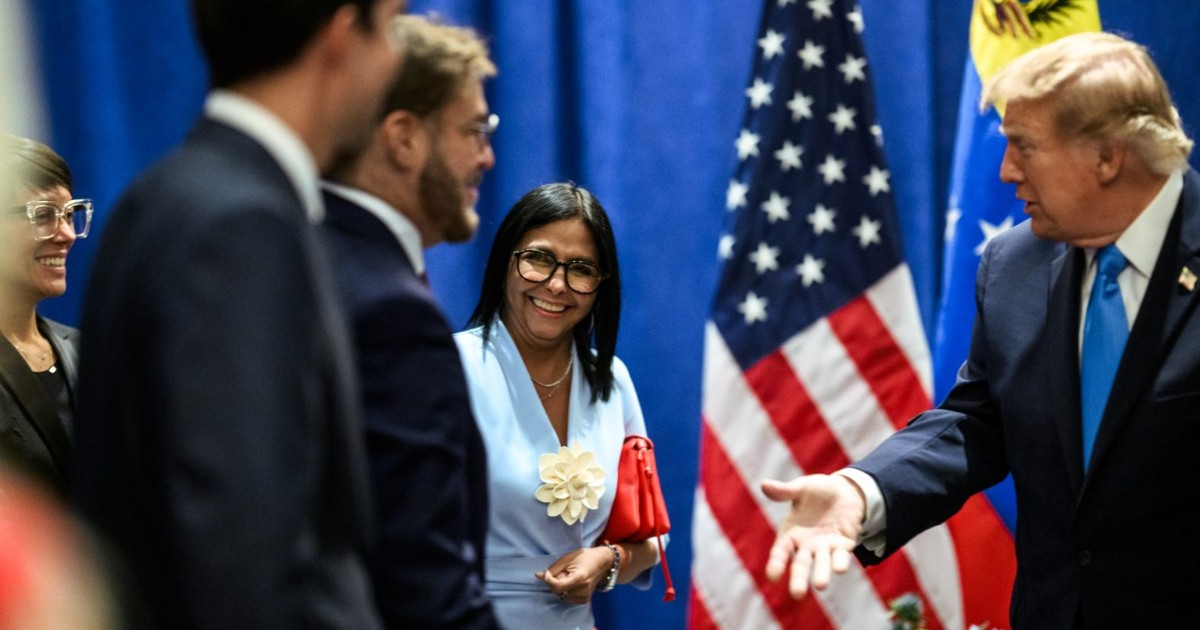
Delcy Rodríguez, the interim president of Venezuela, characterized her meeting with Donald Trump on Tuesday in New York as "historic." The meeting occurred alongside the United Nations General Assembly's High-Level Week. Rodríguez publicly thanked the U.S. president for backing Venezuela's reintegration into international forums.
The meeting, reported by EFE, took place at the Lotte New York Palace hotel behind closed doors, excluding press access. This contrasts with other meetings Trump held in New York that week, such as his session with Ukrainian President Volodymyr Zelensky.
"We held a historic meeting with U.S. President Donald Trump, discussing the strengthening of bilateral relations," Rodríguez posted on her official X account.
The interim president expressed gratitude to Trump for his "support in the reintegration process" of Venezuela into "multilateral spaces," highlighting that energy, mining, and security cooperation were the main topics of discussion. She also thanked the White House for their assistance during the emergency following the earthquakes on June 24.
In addition to the two leaders, the meeting included Secretary of State Marco Rubio, Treasury Secretary Scott Bessent, White House Chief of Staff Susie Wiles, and Deputy Chief of Staff Stephen Miller.
This meeting marks the first between a U.S. president and a Venezuelan leader in over eleven years, since a brief encounter between Barack Obama and Nicolás Maduro at the 2015 Summit of the Americas in Panama. Venezuela had also been absent from the General Assembly with a president since 2018.
The backdrop of the meeting is fraught with unresolved tensions. It took place just miles from the Brooklyn prison where Maduro is held on drug trafficking charges, awaiting trial in June 2027.
When Bloomberg News journalist Eric Martin inquired if Rodríguez would visit Maduro in prison, she did not respond and proceeded to her security vehicle. She also avoided questions regarding Venezuela's electoral timeline.
In his address to the General Assembly, Trump applauded Maduro's capture—occurring on January 3, 2026—and described the recent oil agreement with Venezuela as "the largest oil deal in history."
The agreement, announced on August 28, granted U.S. company NABEP access to 17 Venezuelan oil fields with proven reserves of 65 billion barrels, about 21% of the country's total reserves.
The deal has sparked bipartisan criticism in the U.S. Congress. Republican Congresswoman María Elvira Salazar warned against negotiating with someone "not elected by Venezuelans," while Democratic lawmakers like James McGovern questioned the administration's economic dealings with a regime previously deemed illegitimate.
The Trump administration has insisted on a three-phase plan for Venezuela, yet critics argue that economic agreements progress without verifiable democratic guarantees, fueling the perception that Washington prioritizes oil over genuine political transition in the country.
Key Insights on the Trump-Rodríguez Meeting
What made the meeting between Delcy Rodríguez and Donald Trump historic?
The meeting was considered historic as it marked the first interaction between a U.S. president and a Venezuelan leader in over a decade, against a backdrop of long-standing tensions between the two nations.
What were the main topics discussed during the meeting?
The primary focus of the discussion was on strengthening cooperation in energy, mining, and security sectors, as well as the reintegration of Venezuela into international spaces.
What has been the reaction in the U.S. Congress to the oil agreement with Venezuela?
The oil agreement has drawn criticism from both Republican and Democratic members of Congress, with concerns about negotiating with an unelected leader and engaging economically with a regime previously labeled illegitimate.