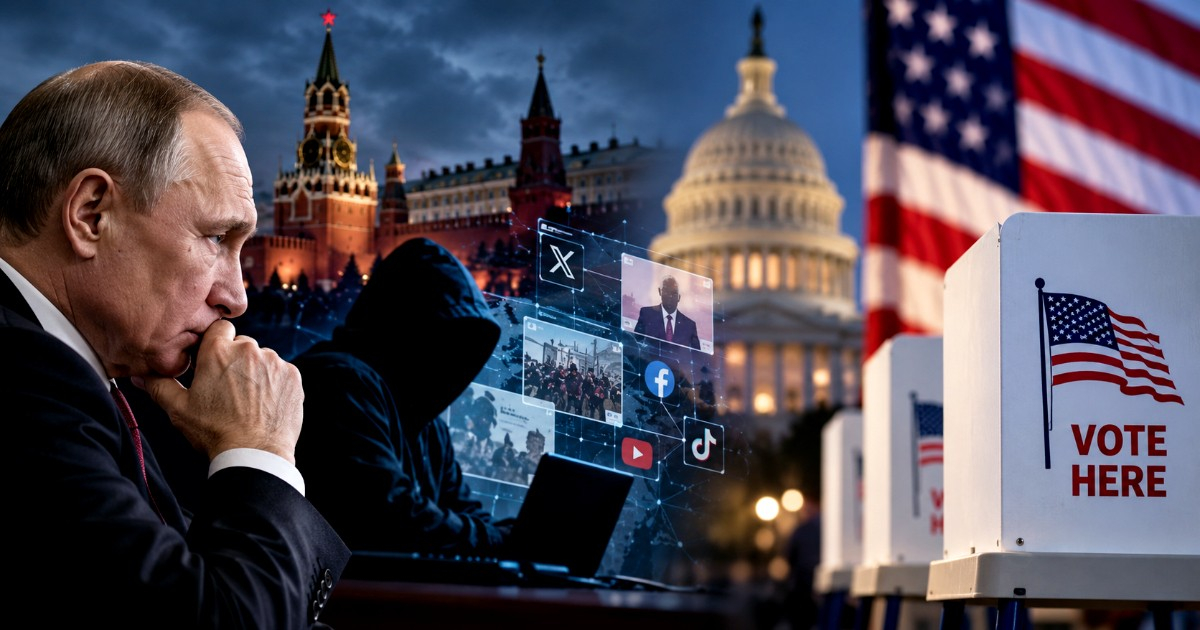
Classified assessments from U.S. intelligence have revealed that the Kremlin has greenlit a covert digital influence operation designed to undermine public confidence in the upcoming midterm elections in November 2026. These revelations, reported by the New York Times, include statements from officials who spoke on the condition of anonymity.
The campaign utilizes AI-generated videos impersonating Hollywood celebrities and masquerading as content from major outlets such as CNN, the BBC, and the New York Times itself. The aim is to target Democratic candidates in pivotal states where Senate seats are being contested.
Russian Influence Operations Intensify
Graphika, a company specializing in digital threat analysis, has attributed this operation to a Kremlin-linked network known as Operation Overload or Matryoshka, which frequently impersonates legitimate media to disseminate fabricated content.
In two separate waves during the week of September 14, this network published videos on platforms like X and BlueSky targeting Democratic candidates in tightly contested races, including Jon Ossoff (Georgia), Sherrod Brown (Ohio), Roy Cooper (North Carolina), Troy Jackson (Maine), Chris Pappas (New Hampshire), Mary Peltola (Alaska), Abdul El-Sayed (Michigan), James Talarico (Texas), and Joshua Turek (Iowa).
AI-Generated Content and Its Impact
One video falsely attributed to the New York Times featured actress Jamie Lee Curtis, with subtitles presenting her as criticizing Democratic policies on transgender rights. Her publicist, Heidi Schaeffer, firmly denied the video’s authenticity, stating, "There is not a shred of truth in that." The video garnered nearly 200,000 views on X in a single day.
Intelligence officials have pointed out that Russia's primary goal is to create chaos rather than favor a specific party, although all documented examples so far solely attack Democratic candidates in contested states.
Geopolitical Context and Future Implications
The current campaign is reportedly less extensive than some of the Kremlin's previous efforts, partly because Moscow is preoccupied with the war in Ukraine and views the midterms as less critical than presidential elections.
Nonetheless, since 2016, Russia has consistently executed influence operations in every U.S. federal election cycle, according to previous declassified assessments.
Jean Le Roux, a senior researcher at Graphika, highlighted that U.S.-targeted content emerged just after elections concluded in Germany and Sweden, suggesting a geographical shift in focus. "We definitely expect it to intensify," he noted. "I don't think they're going to stop. We're witnessing the initial stages of a campaign focused on U.S. elections."
This scenario is particularly revealing: as Russia deploys its disinformation machinery against American democracy, Vladimir Putin's party, United Russia, has just claimed victory in its own legislative elections from September 18-21, securing 57.8% of the vote and 355 out of 450 State Duma seats, according to Russia's Central Election Commission.
These elections were widely condemned as fraudulent, according to an investigation by The Kyiv Independent. The OSCE was not invited to observe, the only registered anti-war party, Yabloko, was excluded, and there were reports of ballot stuffing, document falsification, and opaque electronic voting. The European Union labeled the process a "farce."
Potential Global Influence in U.S. Midterms
Russia is not the only adversary eyeing the U.S. midterms. U.S. intelligence also identifies Iran, which has been in conflict with the U.S. since February 2026, as a potential player in influence operations, though with less documented activity.
In August, Meta discovered a small network of Iranian-origin accounts on Facebook and Instagram featuring AI-generated content with "anti-Republican" messaging. Meanwhile, China might target congress members considered adversaries, although analysts believe Beijing might refrain from acting due to fear of reprisals.
The connection between Russia and Cuba in this disinformation ecosystem is not new: Russia has trained over 1,000 Latin American influencers, including Cubans, through the RT CompaRTe program, and RT has been broadcast on Cuban state television since 2020.
The midterm elections are set for November 3, 2026, with 35 Senate seats and the entire House of Representatives up for grabs. Le Roux left no doubt about what to expect: "I don't think they're going to stop."
Understanding Russian Disinformation in U.S. Elections
What is the goal of Russia's disinformation campaign?
The primary objective is to create chaos and undermine public confidence in the electoral process, rather than favoring a specific political party.
How does Russia execute these disinformation strategies?
Russia employs AI-generated videos that impersonate celebrities and mimic reputable media outlets to spread false information and influence public opinion.
Are there other countries involved in influencing U.S. elections?
Yes, U.S. intelligence identifies other countries like Iran and potentially China as actors in influence operations, though their activities appear less documented.