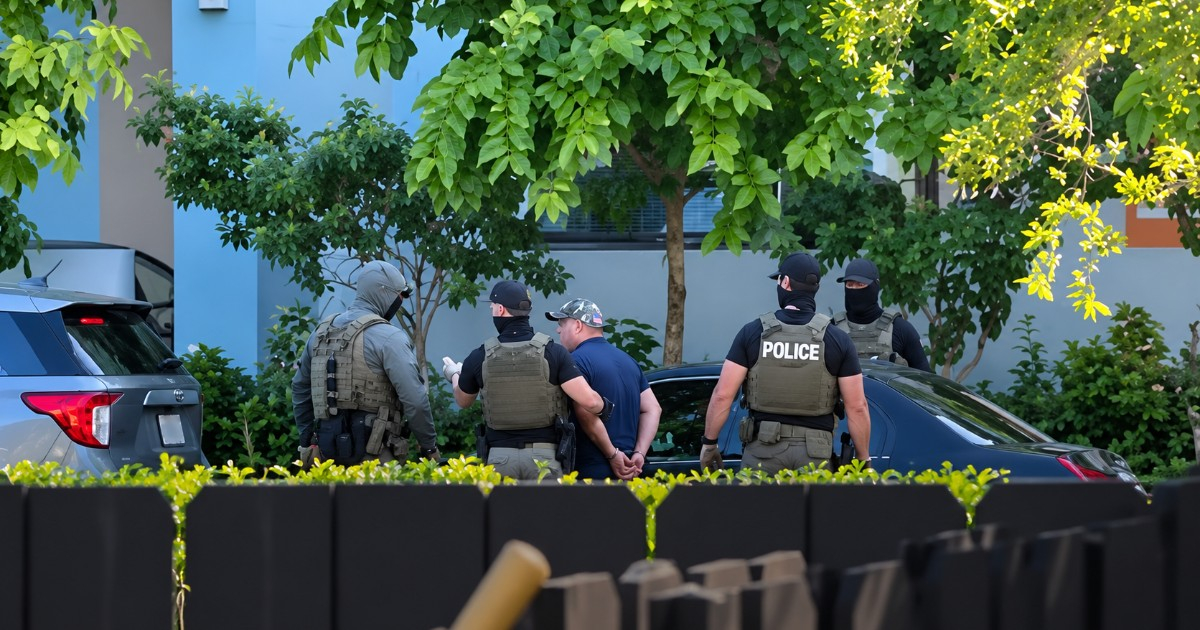
On Tuesday, the call for Doral's government to end its collaboration with Immigration and Customs Enforcement (ICE) gained momentum. Former legislators, community leaders, and the mayor of South Miami gathered to demand that the city withdraw from the federal 287(g) program.
CBS News Miami reported the gathering, where participants dismissed Doral authorities' claim that the city had no choice but to sign the agreement, which grants local police departments certain roles in enforcing federal immigration laws.
The focus of the protest is the 287(g) agreement between the Doral Police and ICE. While breaking this agreement would not prevent federal agents from conducting their own immigration operations in the area, it would halt local participation under this arrangement.
South Miami's experience was highlighted as an example during the meeting. According to South Miami Mayor Javier Fernández, his city did not sign a 287(g) agreement and has not faced any repercussions.
Among the attendees was former federal representative Joe García, who sharply criticized Doral's decision, stating, "They could have chosen compassion, but they chose cruelty."
The ex-congressman also criticized local leaders attempting to distance themselves from the outcomes of the immigration policy implemented in the city.
Community and Economic Concerns
The controversy arises as residents continue to report ICE agents' presence and activities across Doral, a city where approximately 70% of the population was born outside the United States.
Doral Mayor Christi Fraga has maintained that the municipal government lacks the authority to prevent ICE from enforcing federal law within the city.
Nevertheless, the debate unfolds amid growing economic and social impacts attributed to fear from these operations. Businesses in Doral have reported significant declines in sales as employees and residents avoid leaving their homes due to fear of encountering immigration agents.
A local restaurant reported a 70% drop in sales, while other businesses have faced worker losses, including employees with work permits and pending immigration processes.
Support Initiatives Emerge
Fraga has publicly acknowledged the "great deal of fear" within the community, emphasizing that the Doral Police do not lead federal raids and are not notified in advance of ICE operations.
Concerns over the impact of detentions have also spurred private assistance initiatives. This week, activist Carlos Eduardo Espina contributed $50,000 to establish an emergency fund for Doral families who have lost their main breadwinner due to ICE detention or deportation.
Administered by LULAC, the fund provides up to $1,000 per household to cover basic necessities such as rent, food, utilities, and childcare.
The 287(g) agreement in Doral is just one aspect of the broader immigration debate in the United States. Stay informed on policies, deportations, and rights in our U.S. Immigration section.
Understanding Doral's Immigration Debate
What is the 287(g) program?
The 287(g) program allows local law enforcement to collaborate with ICE by performing certain immigration enforcement functions under federal supervision.
Why is Doral's agreement with ICE controversial?
The agreement is controversial because it involves local police in federal immigration enforcement, which some argue creates fear and disrupts community trust without necessarily improving safety.
How has the agreement affected Doral businesses?
Businesses in Doral have reported a significant decrease in sales and loss of workers due to the fear and uncertainty surrounding ICE operations.