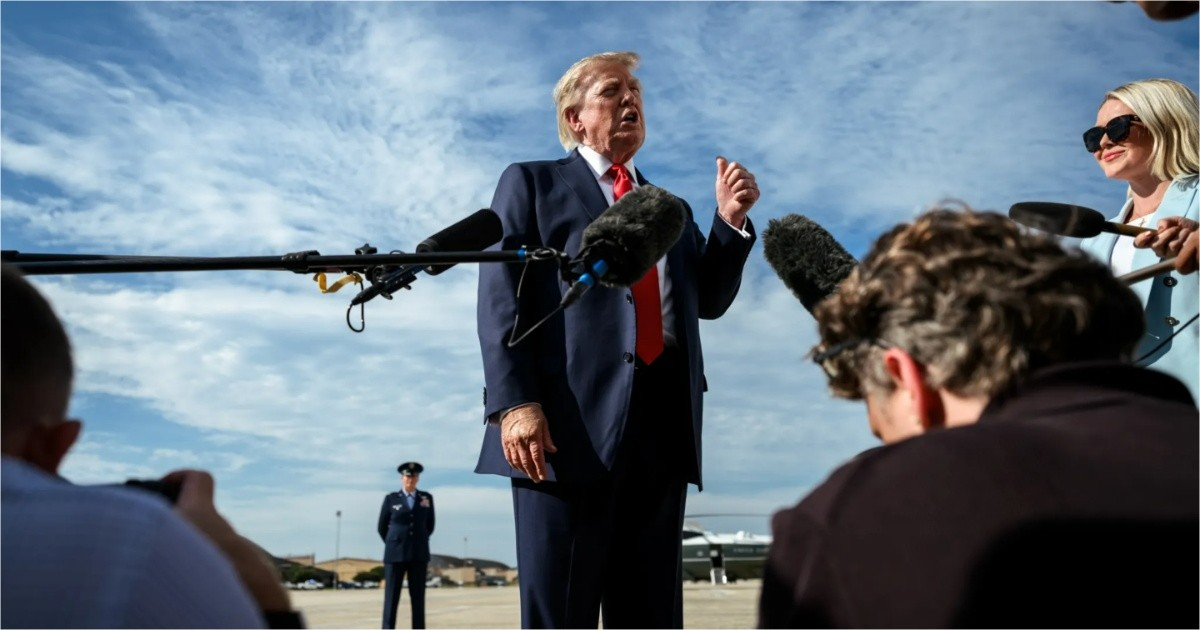
Key American television networks, including ABC, CBS, NBC, and Fox News, revealed on Monday that they would pause their collective coverage of President Donald Trump's activities. This decision aligns with their support for CNN, which, along with MS NOW and Politico, has been barred from the White House.
The controversy began on Friday, September 18, when Trump declared on his social platform, Truth Social, that these three media outlets would be denied access "effective immediately." He accused them of spreading false information. The ban was enforced the next day, as CNN, MS NOW, and Politico reporters were physically blocked from entering the presidential grounds, and a Politico journalist's press pass was confiscated.
Escalating the situation further, the White House on Monday removed CNN from its scheduled slot in the rotating coverage system for Trump's trip to New York, where he is attending the United Nations General Assembly.
Television Pool Coverage Disrupted
The joint coverage system, or pool, operates on a rotation among five networks: ABC, CBS, CNN, NBC, and Fox News. The designated outlet records presidential events and shares the footage with other accredited media. In response to CNN's exclusion, the four remaining networks declined to provide a substitute, leaving the day's presidential events without shared television coverage.
Fox News' Washington bureau chief and acting head of the television pool, Bryan Boughton, issued a statement formalizing this decision: "Starting today, the television pool will not cover events designated as pool coverage for the President. There will be no replacement pool."
Legal Actions and Media Solidarity
Coinciding with these events, CNN, MS NOW, and Politico filed a joint lawsuit against the Trump administration, alleging a First Amendment violation. In a shared statement, the media outlets emphasized: "We have informed the Government this morning that we are filing a lawsuit today to protect our First Amendment rights and uphold the principle that the Government does not dictate what the press reports or publishes."
The Associated Press confirmed the lawsuit, which argues that revoking credentials "without notice or due process" is a "blatant violation" of constitutional rights and a form of content-based discrimination in journalistic coverage.
Reactions from the White House Press Community
The White House Correspondents' Association (WHCA), led by Jacqui Heinrich, demanded the immediate restoration of access and warned that the criteria used to exclude one outlet might be applied to others in the future.
Bruce D. Brown, constitutional expert and president of the Reporters Committee for Freedom of the Press, criticized the ban as "flagrantly unconstitutional," stressing that legal precedent is clear: "Once the White House invites some journalists, it cannot exclude others based on their coverage, which is viewpoint discrimination."
Responding on Monday via Truth Social, Trump made a statement that his critics found contradictory: "The White House is not attacking the free press, something I value," he asserted, maintaining that his actions target "fake news," not press freedom at large.
Throughout his first term, Trump attempted to limit media access to the White House, including CNN, though these efforts were unsuccessful in court. The coordinated suspension of the television pool by the remaining networks, however, marks a recent unprecedented move in the history of presidential media coverage in the United States.
FAQs on the Media Ban and Legal Actions
Why did the major U.S. networks halt joint coverage of Trump?
The networks paused their joint coverage to show solidarity with CNN after it was banned from the White House, alongside MS NOW and Politico, due to accusations of spreading false news.
What legal action did CNN, MS NOW, and Politico take?
The three media outlets filed a lawsuit against the Trump administration for violating their First Amendment rights, arguing that the revocation of their credentials was unconstitutional and discriminatory.
How did the White House Correspondents' Association respond?
The WHCA demanded the immediate restoration of access for the banned outlets and warned against the potential future application of such exclusionary criteria to other media entities.