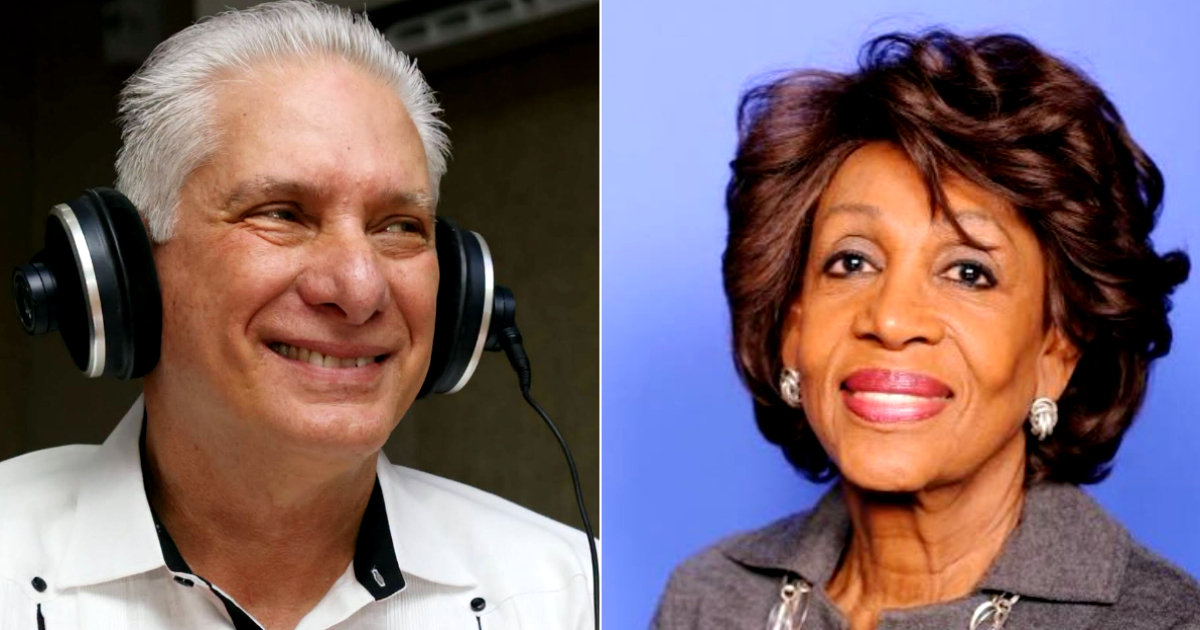
Miguel Díaz-Canel recently found himself in a politically contradictory situation that is hard to overlook.
The same Cuban leader who has consistently downplayed the importance of a multi-party system and defended the idea of a single-party state, recently expressed great approval for an event that could only occur within a vibrant democracy.
The key figure in this scenario was Democratic Congresswoman Maxine Waters, a long-standing critic of the U.S. sanctions policy against Cuba. During a hearing of the House Financial Services Committee, she fiercely criticized the Trump administration's approach to the island.
Waters held this policy responsible for worsening the hardships faced by the Cuban people. She questioned Treasury Secretary Scott Bessent on why he was acting so "cruelly", even labeling Trump as "cruel" and asked if Bessent was acting as a "puppet" of the president. Furthermore, she warned that history would not look kindly on the administration's actions towards Cuba.
Díaz-Canel was thoroughly impressed.
"With her distinguished dignity, Democratic Representative Maxine Waters has challenged the Treasury Secretary over the criminal policy of #Blockade," he shared on social media.
He further stated, "Thank you, Maxine, as you rightly point out, history will not forgive them. And it will recognize the dignified Americans who denounce the crime."
Examining the Political Context
Beyond Waters' stance on sanctions, this incident highlights a question that Díaz-Canel's message skirts: the political conditions that facilitated such an intervention.
Maxine Waters is a member of the Democratic Party, whereas Trump belongs to the Republican Party. She is part of the opposition and utilizes her institutional position to scrutinize the Executive.
Despite being the Treasury Secretary under Trump, Bessent must appear before a Congress where opposing voices can vehemently criticize the administration's policies.
Thus, Waters is able to accuse the government of cruelty, directly challenge the president, and still serve as a congresswoman. Her dissent does not undermine her legitimacy as a representative or brand her as an enemy of the United States.
Contrasting Cuban Political Structures
Where is the Cuban equivalent of Maxine Waters? Díaz-Canel has persistently argued that multi-party systems are not a measure of democracy. He has also championed the "unity of powers" and presented the usual unanimity in the National Assembly as indicative of Cuba's political consensus.
His praise for Waters allows us to shift the discussion from theory to a tangible example: where is her institutional counterpart in Cuba?
The comparison isn't about finding someone who shares her views. It necessitates a legislator from an opposition party who can publicly question a minister, hold the government accountable for crises, criticize Díaz-Canel's policies, and advocate for an alternative to the ruling party.
Such a figure does not exist in Cuba's political framework.
The Cuban Constitution states that the Communist Party is the sole "superior leading political force in society and the state." While individuals may disagree, there is no room for organized party competition for governmental control.
This is a fundamental difference. Waters can oppose Trump without opposing the United States, and her party can openly strive to defeat the president's party.
In Cuba, there is no equivalent mechanism wherein a party opposition could attempt to replace the Communist Party of Cuba (PCC).
The Broader Implications
Whether Waters is right, wrong, or partially correct regarding sanctions is a separate matter from what Díaz-Canel's appreciation reveals.
What stands out is the position from which she could make such statements.
Díaz-Canel did not merely applaud an American citizen sympathetic to Havana. He praised an opponent acting within a state institution, using her parliamentary authority to challenge the Executive.
This episode is awkward for Cuba's official rhetoric. While the Havana government often dismisses party pluralism as unnecessary for measuring democracy, here one of its international critics is being challenged precisely through such pluralism.
This comparison doesn't require idealizing the American system. Its flaws, inequalities, and political conflicts can be critiqued separately. The key point is simple: Waters has an institutional space to confront the government because organized political disagreement is part of the system.
The Unanswered Question
Díaz-Canel's message of gratitude aimed to strengthen his denunciation of Washington's policy but inadvertently highlighted the value of institutions his political discourse often diminishes.
He can use Waters' words against Trump, but it's harder to explain why Cubans lack a parliamentary opposition capable of performing a similar role against their government.
This is the unresolved issue his gratitude opens up: If political pluralism and organized opposition are dispensable for democracy, why are they so valuable when they produce favorable criticism of Havana from Washington?
Insights on Cuban Political Dynamics
What political contradiction did Díaz-Canel exhibit?
Díaz-Canel celebrated a democratic action in the U.S. that he typically criticizes in Cuba, highlighting the contradiction in his stance on pluralism and opposition.
Why is Maxine Waters' role significant in this context?
Maxine Waters, as an opposition figure, used her position to challenge the U.S. administration, illustrating the democratic mechanisms absent in Cuba.
How does Cuba's political structure differ from the U.S.?
Cuba's political system is dominated by a single party, the Communist Party, with no space for organized party opposition, unlike the U.S. multi-party system.