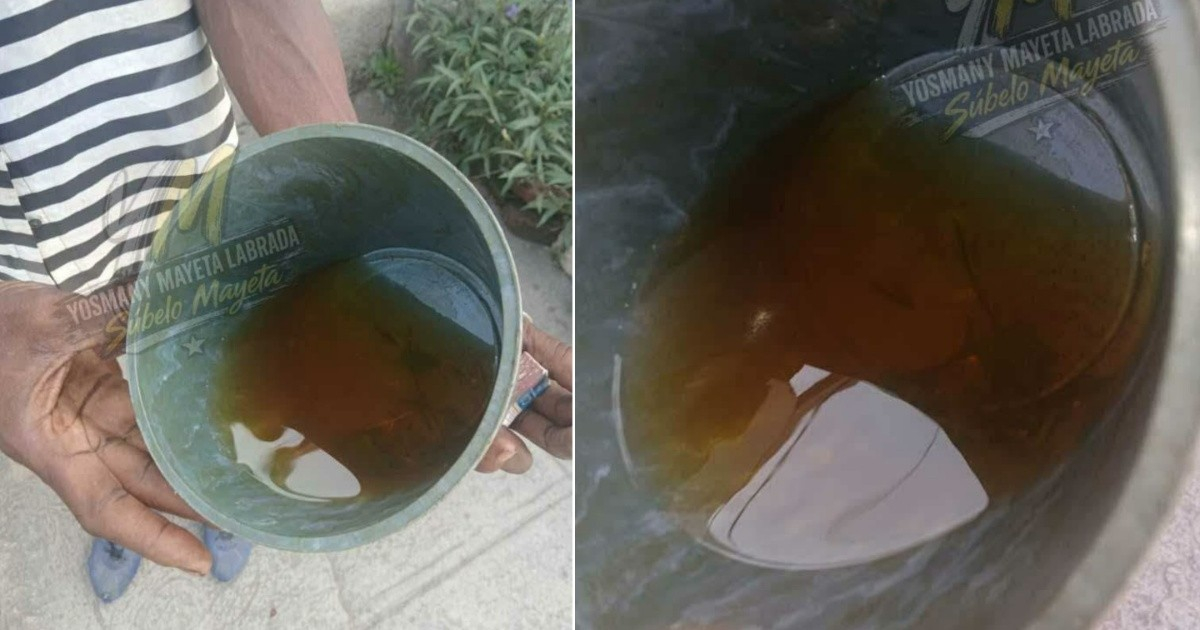
Images released on Facebook this Sunday reveal a distressing scene at a social dining facility in Santiago de Cuba, where an anonymous source described the so-called "soup" offered to the elderly and vulnerable as nothing more than a dark, murky liquid in a green bucket, devoid of any visible substance. This facility is part of the Family Attention System (SAF) located in what was once the Cremería on Paseo de Martí.
Citizen journalist Yosmany Mayeta Labrada shared the complaint along with photos, citing the person's description who provided the images: "It's an infusion of chopped cilantro and garlic; they claim it's soup."
In Cuban cooking, garlic and cilantro are typically used to flavor broths. Their mention in this complaint highlights that the liquid served was essentially fragrant water, lacking any real nutritional value.
Nutritional Deficiencies and Widespread Issues
This is not an isolated incident. Back in May, a pro-government report on SAF included a testimony from a recipient at another dining hall on Avenida Martí, also in Santiago, who criticized the poor quality of the meals and noted that some elderly individuals ended up seeking food at churches or from humanitarian individuals.
By June, another report acknowledged insufficient rations and supply issues at facilities where the provided meal might be the only daily nourishment for many seniors.
Challenges Beyond Santiago
This troubling pattern extends to other provinces. In Holguín, by August 2025, only four out of the 9.2 tons of peas allocated to SAF were delivered, leading to situations where only plain rice was served. In Havana, a dining facility supporting 84 seniors relied on donations from the World Food Program and a private company to keep operating.
The Economic Hardship Faced by Cuban Seniors
The vulnerability of elderly Cubans exacerbates the issue. Since September of the previous year, the minimum pension has remained at 4,000 Cuban pesos per month, less than 10 dollars on the informal market, compared to a basic basket estimated to cost between 12,000 and 30,000 pesos.
Due to the state's inability to maintain the system, the regime opened the management of SAF dining facilities to non-state actors through public bidding in August, underpinned by Agreement 10418 of the Council of Ministers and Resolution 14/2026 from the Ministry of Domestic Trade. The regulation mandates two daily meals, safety, and home delivery for those unable to travel, but the gap between policy and reality is stark.
Community Efforts and Government Response
In Santiago de Cuba, this gap was temporarily bridged by the opposition group UNPACU, led by José Daniel Ferrer. Their Altamira headquarters was distributing up to 330 meals daily to vulnerable individuals in 2025 until authorities began harassing those who came for assistance.
Mayeta Labrada has called for a public response from the responsible institutions: "The Ministry of Commerce, Labor and Social Security, and the authorities of Santiago de Cuba must answer."
His conclusion underscores the human aspect of this complaint: "The issue is how far the inadequacy of a system that claims to protect its elderly has gone, leaving some to stare into an empty pot searching for food that is barely there."
Addressing the Crisis in Cuban Social Dining Facilities
What is being served at Santiago de Cuba's social dining facilities?
The facilities are reportedly serving a liquid described as water with cilantro and garlic, lacking substantial nutritional content.
How are Cuban seniors coping with food shortages?
Some seniors are turning to churches or humanitarian individuals for food due to the inadequate supply and quality at state-run facilities.
What steps have been taken to address the issues in SAF dining facilities?
The Cuban government has opened the management of these facilities to non-state actors through public bidding, seeking to improve conditions.