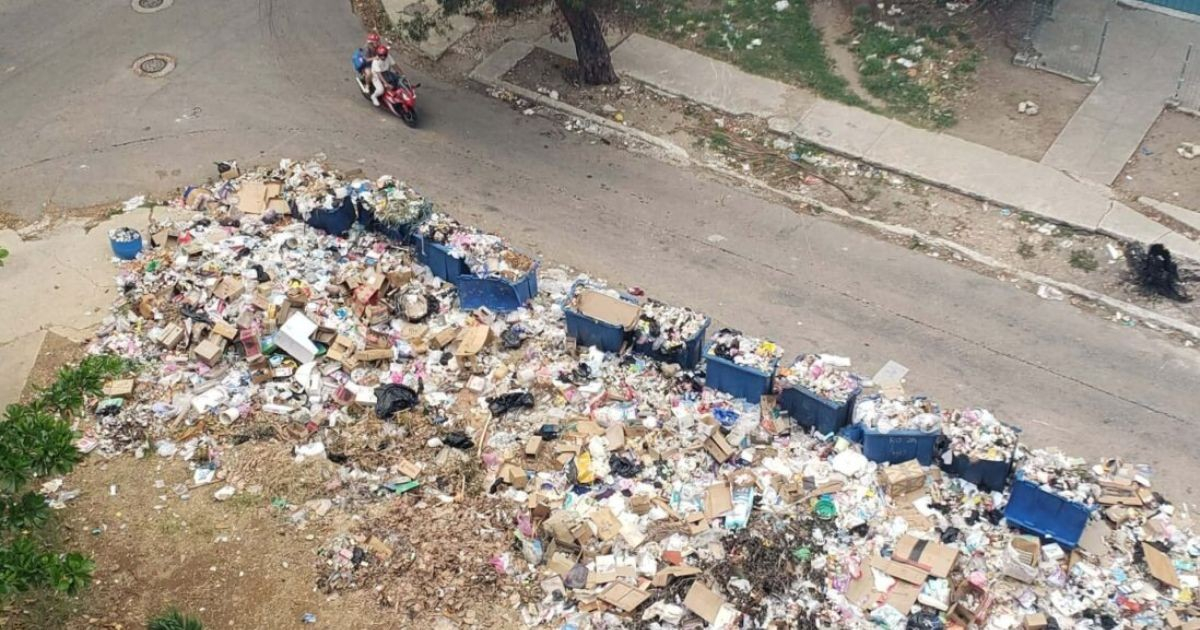
Residents living in the Minfar 3 apartment complex, a building with 144 units located near Havana's Plaza de la Revolución, have voiced complaints about a severe garbage buildup that has persisted for over a month. This situation has rendered San Pedro Street nearly impassable, as reported by the state-run Tribuna de La Habana on Sunday.
The garbage issue is not confined to Minfar 3 alone. Waste from nearby buildings such as Granma, Communications, Minfar 1, and Minfar 2 also contributes to the overflow in this area. Plastic bins placed in the vicinity are overwhelmed, causing trash to spill onto Panorama Street and reaching Colón Avenue. The resulting stench and swarms of flies have made it impossible to open windows, even on the upper floors, as detailed by the source.
Two months ago, a large metal container known as an ampirol was installed, transported by specialized trucks. While it somewhat mitigated the overflow, it failed to address the root of the issue. Wind and rain continue to scatter debris, clogging drains and exacerbating the problem, according to messages sent by residents to the press outlet.
Adding to the garbage crisis is a longstanding sanitary infrastructure issue that has persisted for over a year. A sewage pit on Hidalgo Street, located between San Pedro and Lombillo, spills waste without any official intervention. To alert drivers and pedestrians, residents have placed a tree branch to mark the open pit.
Each morning, people known locally as “buzos” can be seen rummaging through the garbage. According to current health regulations, these individuals are considered “disease carriers,” warns the Tribuna report. The accumulation of trash in densely populated urban areas also fosters the spread of diseases like dengue fever, leptospirosis, hepatitis A, and chikungunya.
In a temporary measure, heavy machinery arrived early Sunday to clear the piled-up trash, the media noted. However, the report acknowledges this as an "extraordinary expense of resources we scarcely have," cautioning that without structural solutions, the area will soon return to a state of neglect and potential hazard.
The situation at Minfar 3 is not an isolated incident but rather a localized expression of a garbage crisis that has plagued Havana for years, worsening in 2025 and 2026. At the start of this year, only 44 of the capital's 106 trash collection trucks were operational, hindered by a diesel shortage and mechanical failures, while the city produces about 30,000 cubic meters of solid waste per day, far surpassing collection capabilities.
The Plaza de la Revolución municipality, where the building is situated, has been a frequent center of such complaints. Last July, the Council of Popular Rampa initiated the “El Rampeño” project, deploying 30 electric tricycles for door-to-door collection at a cost of 100 pesos per household per month. However, this attempt at an alternative solution ultimately failed. Just days ago, a mountain of trash blocked a passenger train's path in Cuba, forcing travelers to clear the tracks themselves.
Tribuna’s article ends with a stark warning that encapsulates residents' despair: without the installation of a new ampirol and the repair of the Hidalgo Street pit, the problem "will once again present an image of neglect and potential danger due to the presence of disease-carrying agents."
Frequently Asked Questions about Havana's Garbage Crisis
What is causing the garbage overflow near Plaza de la Revolución?
The overflow is caused by garbage from multiple buildings, including Minfar 3, Granma, Communications, Minfar 1, and Minfar 2. The waste exceeds the capacity of plastic bins, leading to trash spilling into nearby streets.
How are local authorities addressing the garbage issue?
Authorities have used heavy machinery to temporarily remove the trash. However, without long-term solutions like new containers or infrastructure repairs, the problem is expected to reoccur.
What health risks are associated with the garbage crisis?
The accumulation of waste fosters the spread of diseases such as dengue fever, leptospirosis, hepatitis A, and chikungunya, posing serious health risks to residents.