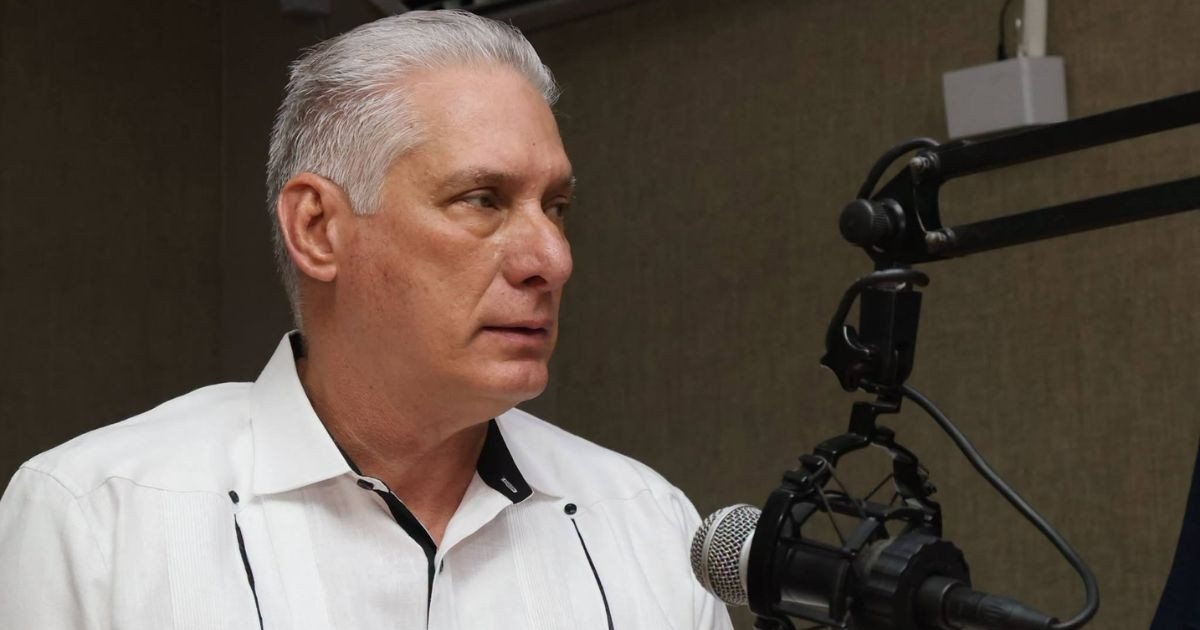
Miguel Díaz-Canel's announcement that he will host a new radio program on Radio Rebelde quickly became fodder for the ever-creative Cuban humor, which rarely lets such opportunities slip by.
On Wednesday, September 16, the Cuban leader appeared at the station's studios around 7:00 a.m. to reveal the upcoming launch of “Shared Opinions,” a bi-weekly segment he will co-host with government-aligned journalist Bárbara Betancourt as part of the “Making Radio” program.
Díaz-Canel enthusiastically described the show as a platform for “citizen participation, transparency, and consensus building.” He promised to “engage deeply with our audience about Cuba’s realities, concerns, and aspirations.” The program was set to debut “next Wednesday,” September 23.
The choice of Radio Rebelde—established clandestinely by Che Guevara on February 24, 1958, in the Sierra Maestra and hailed by the state as “the first and foremost news station of Cuban Radio”—seems deliberate. It serves as a symbolic platform within the regime's media apparatus to lend weight to the initiative.
Humor as a Mirror
However, Díaz-Canel seemingly underestimated the Cuban people's sharpened wit, honed through years of blackouts, queues, and empty rhetoric. Comedian Alian Aramis captured this in a Facebook post listing 14 satirical alternative titles for the show, such as “Progress Denied,” “Breadless Opinions,” “No Room,” “From 5 to 7 Lies,” “Table Talk Allergies,” “A Sunday with Lemon,” “The Joy Horde,” “Total Dementia,” “The Exile Show,” “Talking Crap,” “Made-Up Radio,” “Canel Channel 4,” “Tabletop Utopias,” and “Hello Smelly.”
Each title is a snapshot of Cuba in 2026: the power outages disrupting schedules (“No Room”), the scarcity leaving tables bare (“Breadless Opinions”), the official rhetoric promising endless horizons (“Tabletop Utopias”), the relentless exodus (“The Exile Show”), and the leader himself as a symbol of the crisis (“Canel Channel 4”). This list serves as a popular diagnosis more insightful than any economic analysis.
A Legacy of Skepticism
Skepticism is not new. In February 2026, when a special appearance by Díaz-Canel was announced, Cubans quipped, “Those with electricity will see it.” Such humor, or “Cuban teasing,” has often followed his public appearances.
The new program also carries the baggage of a previous endeavor: the podcast “From the Presidency,” launched in March 2024. It reached 32 episodes before ceasing without formal cancellation after the June 2025 episode on ETECSA's rate hikes. In that episode, Díaz-Canel acknowledged communication failures but defended the measures, while ETECSA president Tania Velázquez apologized for their flawed implementation without reversing the tariffs.
In July 2026, Díaz-Canel, with his “poetic communication,” quoted Eduardo Galeano—“Utopia is on the horizon… What is utopia for? It helps us to walk”—as an answer to whether Cuba could overcome its crisis, sparking ridicule. Comedian La Crema mocked the “philosophical lecture” in a 43-second video, and Ulises Toirac wrote a satirical piece on the aimless journey metaphor.
With such a track record, “Shared Opinions” faces a credibility deficit before airing its first minute. Yet, the humorists might have already found the most fitting title: “Tabletop Utopias.”
Questions About Díaz-Canel's Radio Program
What is the concept of Díaz-Canel's new radio show?
The show is intended to be a platform for citizen participation, transparency, and consensus building, discussing Cuba's realities and public concerns.
Why was Radio Rebelde chosen for the show?
Radio Rebelde is a historically significant station within Cuba's state media, providing symbolic weight to the initiative.
How has Cuban humor responded to the announcement?
Cuban humorists have created satirical alternative titles for the show, reflecting skepticism and critique of the government's promises.