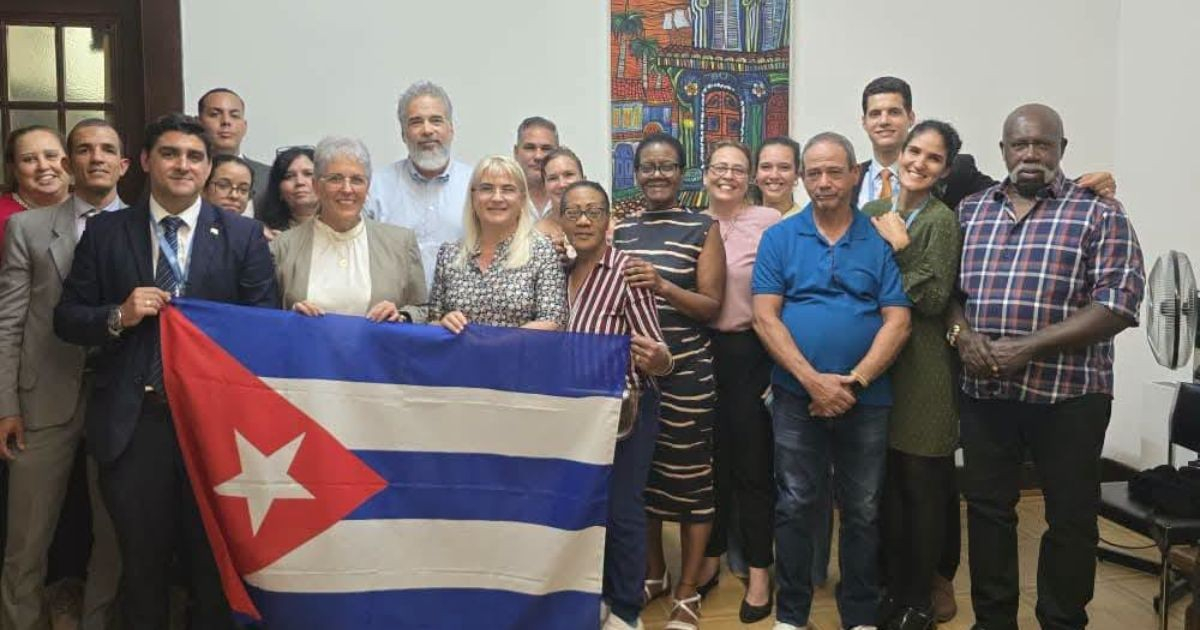
As Cuba reaches an unprecedented tally of 1,339 political prisoners and State Security continues to detain activists in the streets, the top leadership of the Union of Writers and Artists of Cuba (UNEAC) traveled to Geneva to present a narrative of Cuba's "commitment to human rights."
Marta Bonet de la Cruz, the president of UNEAC, and the first vice president, Magda Resik Aguirre, embarked on a mission to Switzerland during the 63rd session of the UN Human Rights Council, which takes place in Geneva from September 7 to October 7, 2026.
On September 18, Bonet addressed the Council, advocating for "the universal and free nature of education and access to culture in Cuba" while blaming the U.S. embargo as the primary impediment to the island's artistic development.
UNEAC, which has held consultative status with the United Nations Economic and Social Council (Ecosoc) since 1998, utilized this platform to assert, according to their own statement, "the comprehensive perspective of Cuba's commitment to human rights and the hindrance posed by the U.S. to their full enjoyment." This statement, delivered from Geneva, appears almost "poetic" considering the simultaneous events in Cuba.
On the same September 18, as Bonet argued that "Cuban art, literature, heritage, and artists... have the right to both creative freedom and life," State Security agents detained intellectual and historian Alina Bárbara López Hernández in Matanzas during her monthly civic protest. She was held for nearly five hours, marking at least her sixth detention that year.
UNEAC had previously expelled Hernández from its ranks in September 2024 for "activities against the revolution," prompting the public resignation of writer Jorge Fernández Era.
The backdrop of this tour becomes even more striking when examining the statistics. According to Prisoners Defenders, Cuba ended August 2026 with a record 1,339 political prisoners, the highest since the July 11, 2021 protests. Cubalex documented 1,894 human rights violations from January to June 2026, affecting 919 victims. This is the "comprehensive perspective" that UNEAC chose not to highlight in Geneva.
The organization also failed to remind diplomats that in August 2025, writer Laideliz Herrera Laza publicly resigned from UNEAC, accusing it of remaining silent in the face of intellectual repression and acting as a front for repressive policies. Nor did it mention its own endorsement of the crackdown following the July 11, 2021 protests and its statement against the musicians of "Patria y Vida."
The Swiss itinerary also included a more celebratory segment: in Bern, UNEAC presented the Josefina Méndez International Prize to Russian dancer, choreographer, and teacher Azari Plisetski, recognizing his contribution to Cuban ballet development. Plisetski spent a decade affiliated with the Cuban National Ballet, serving as Alicia Alonso's principal partner for over eight years. His creation, Canto Vital, premiered in 1973 and remains in the company's repertoire.
The ceremony, hosted at the Cuban Embassy and attended by Ambassador Laura Pujol, also brought together representatives from Cuba and Russia—two countries with a very "particular" relationship with human rights—alongside Cuban artists residing in Europe.
Accompanying UNEAC at the Council were leaders from the Cuban Union of Jurists and the Cuban Association of Animal Production, all under the umbrella of the Cuban Association of the United Nations (ACNU). This well-coordinated delegation delivered a unified message: Cuba's problem is the embargo.
The tour coincides with the 65th anniversary of UNEAC, celebrated on the island with an intense propaganda campaign centered on Fidel Castro.
Cuba's Human Rights Situation and International Perception
What was the main purpose of UNEAC's visit to Geneva?
UNEAC visited Geneva to promote Cuba's image of commitment to human rights and to argue against the U.S. embargo as a barrier to the island's cultural development.
How many political prisoners were reported in Cuba as of August 2026?
As of August 2026, Cuba had a record of 1,339 political prisoners.
What notable event occurred simultaneously with UNEAC's Geneva agenda?
While UNEAC was advocating in Geneva, State Security detained Alina Bárbara López Hernández in Matanzas during her civic protest.